
BUILT IN THE USA. READY FOR YOUR PROJECT.
Switchgear Manufacturing
New switchgear manufacturing turns an electrical design into a documented power-distribution assembly, not simply a collection of devices in an enclosure.
DIRECT FROM THE MANUFACTURER / NEW EQUIPMENT
THE MANUFACTURER’S PERSPECTIVE — 02
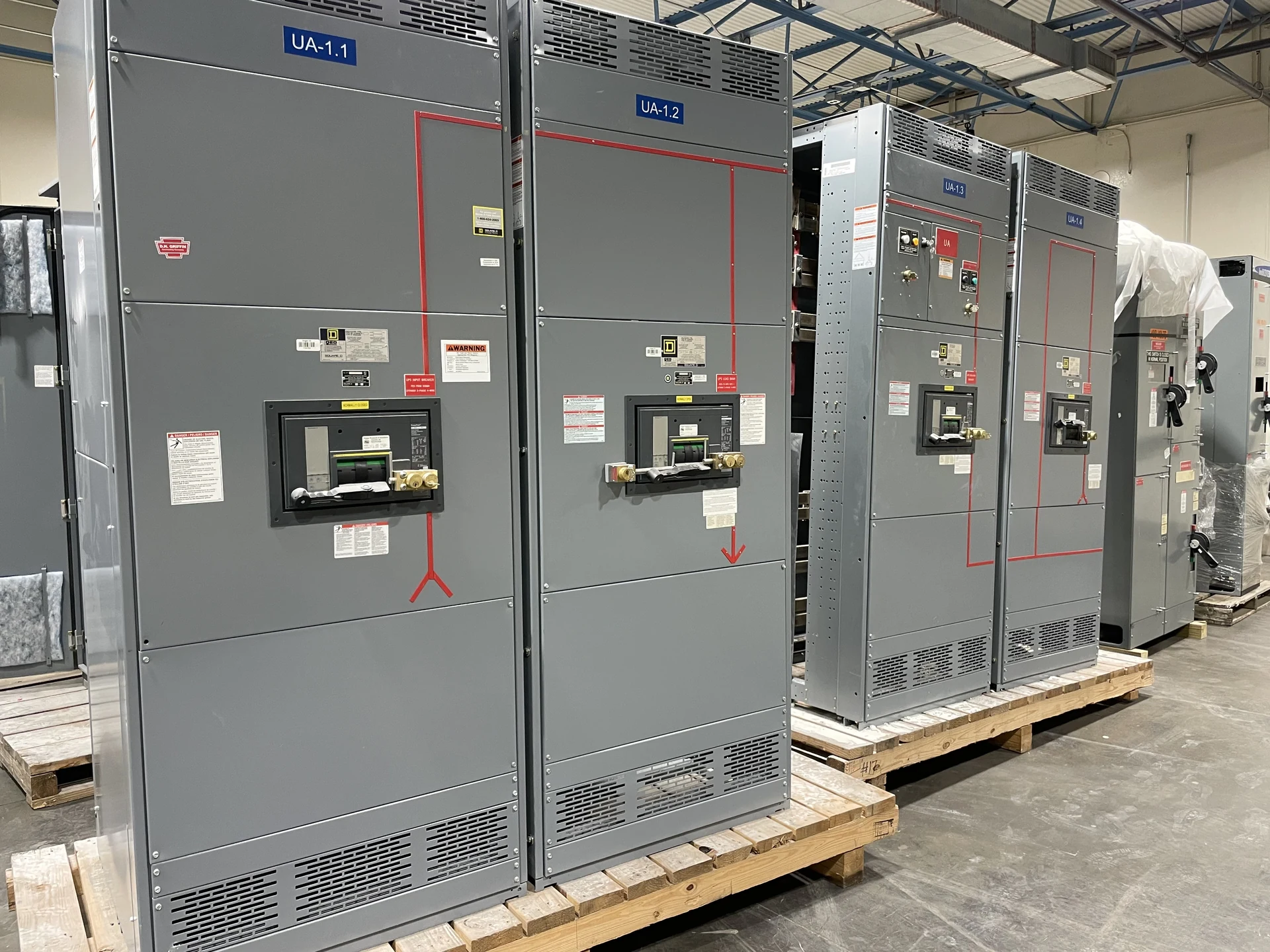
New switchgear manufacturing turns an electrical design into a documented power-distribution assembly, not simply a collection of devices in an enclosure. For procurement teams working in San Antonio, South Texas, and nationwide, buying directly from an American manufacturer makes it important to agree on engineering inputs, interfaces, inspection requirements, and commercial scope before fabrication begins.
Start with a usable design basis
The quotation package should include a current one-line diagram, load and feeder schedules, source details, and the required system configuration. Identify normal and alternate sources, metering, protective functions, and any expected expansion. A diagram that leaves a future feeder undefined may be sufficient for a budget discussion, but not for a final equipment commitment.
Supply the equipment location, environmental conditions, room or pad dimensions, cable entry preferences, and delivery constraints. These details affect more than appearance: top versus bottom entry can change termination space and the arrangement of sections. Mark uncertain information as an assumption, assign an owner to resolve it, and update the quote when the design changes.
Translate requirements into an engineered assembly
Engineering review establishes the voltage class, continuous-current requirements, available fault current, protective-device duties, and assembly short-circuit requirements for the proposed configuration. Device interrupting capability and the assembly’s withstand or short-circuit rating are related but distinct checks. The project engineer should provide the system study information needed to evaluate protection and coordination.
Submittals may include an equipment one-line, elevations, device schedules, dimensions, and a list of exceptions. Procurement should compare each document with the specification instead of approving a catalog description alone. If US-made components are required, identify which parts and documentation the requirement covers; sourcing and availability need confirmation rather than assumption.
Plan the enclosure and power path
Fabrication translates the approved layout into an enclosure with mounting provisions, access, barriers, and cable space appropriate to the design. Indoor or outdoor exposure, corrosion risk, ambient conditions, ventilation, and maintenance access influence construction. A smaller footprint can be attractive, but only if terminations, working clearances, and service access remain acceptable to the project team.
Bus material, conductor arrangement, insulation, supports, and connections must be evaluated as an assembly, including mechanical stresses during a fault and heat under the intended loading. A material preference should not override compatibility with the selected design and its verified ratings. Drawings should identify the points where field conductors or adjacent equipment connect.
Coordinate components and control interfaces
During assembly, protective devices, metering, bus, and control wiring must fit the reviewed design. A component substitution can alter dimensions, protection characteristics, or the assembly’s applicable listing, so establish who can propose and approve alternatives. Keep a revision-controlled component schedule and record any accepted changes before they affect purchasing or production.
Define boundaries between the lineup and the utility, transformer, generator, transfer equipment, or building controls as applicable. Terminal designations, control power sources, communications protocols, and signal ownership should be documented on interface drawings. For example, a remote status indication needs an agreed signal and destination, not merely a note requesting connectivity.
Agree on inspection and acceptance
Specify factory inspection and testing in the purchase scope: the checks to be performed, acceptance criteria, records to be delivered, and whether the customer will witness any tests. Depending on the design, the plan may cover visual and mechanical inspection, wiring verification, and functional checks of controls. Resolve failed checks and document corrective actions before release.
Confirm the applicable equipment standards and required listing for the particular assembly. UL 891 can be relevant to an appropriate low-voltage switchboard; it is not a universal switchgear designation. Ask for evidence that the proposed configuration and any substitutions fall within the required listing scope, and coordinate acceptance with the project’s authority having jurisdiction.
Manage release, delivery, and handoff
Build the schedule around design review, approved submittals, component procurement, fabrication, inspection, and shipment. A late change to feeder quantities or control logic can affect several stages, so track drawing revisions and approval dates alongside dependencies. Request a current project-specific schedule and identify when customer decisions are needed; do not treat an estimate as a delivery guarantee.
Clarify who handles freight, unloading, rigging, foundations, field connections, protection settings, and commissioning. Shipping splits may ease transport but introduce field alignment and connection responsibilities. Turnover should identify the agreed final drawings, test records, manuals, and equipment labels. Qualified electrical personnel must plan and perform installation, testing, and energization under applicable site procedures and manufacturer instructions.
LET'S BUILD SOMETHING RELIABLE — 03
Ready to talk
switchgear?
Tell us about the new equipment your project needs. Include as much or as little detail as you have today.
(951) 403-5738CALL TO DISCUSS YOUR PROJECT