
BUILT IN THE USA. READY FOR YOUR PROJECT.
Motor Control Centers: New Equipment Replacement Planning
Replacing a motor control center (MCC) is more than matching the width of a lineup.
DIRECT FROM THE MANUFACTURER / NEW EQUIPMENT
THE MANUFACTURER’S PERSPECTIVE — 02
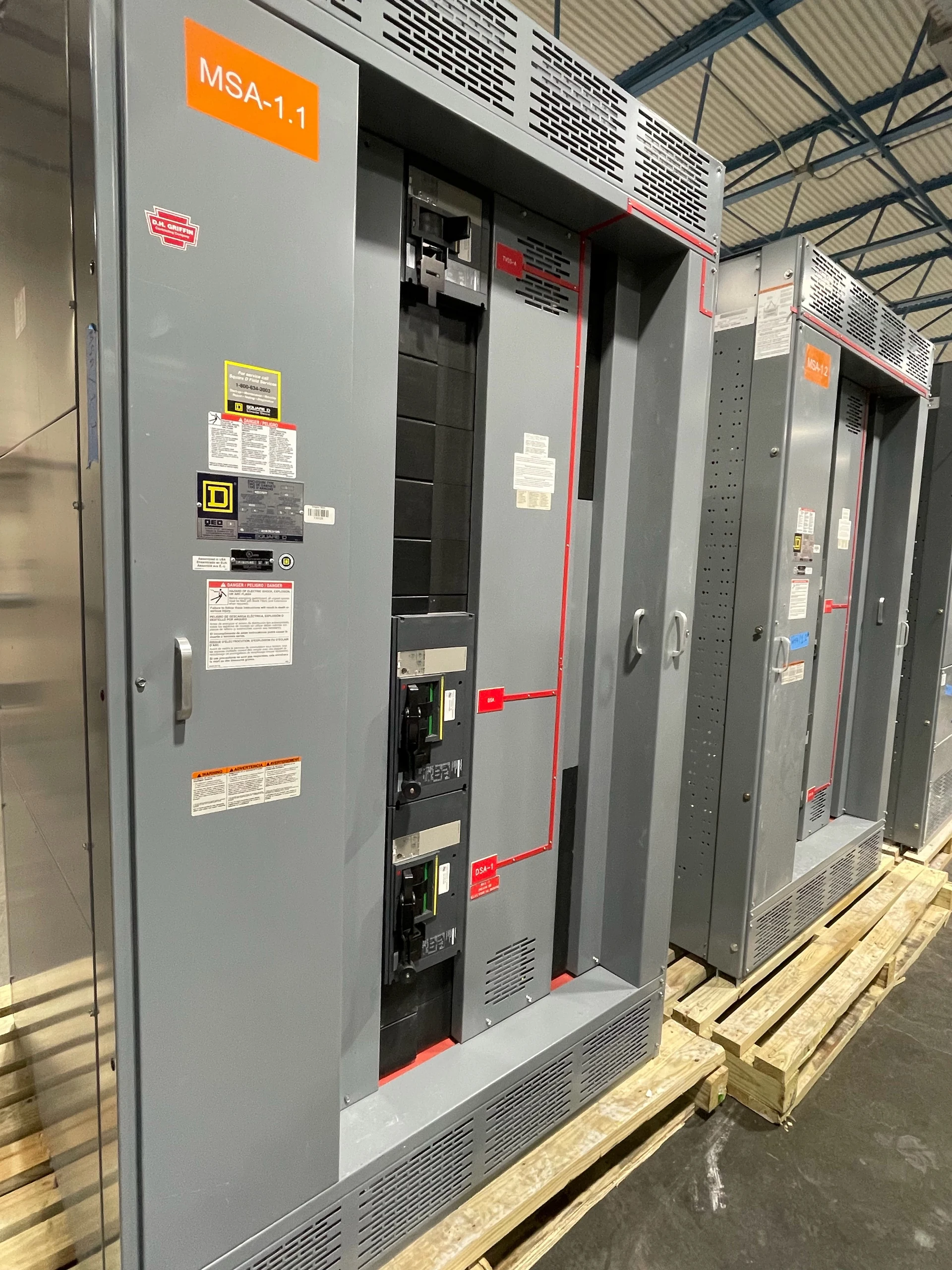
Replacing a motor control center (MCC) is more than matching the width of a lineup. The new assembly must serve the actual motors, fit the available space, connect to power and controls, and support an outage the facility can accommodate. Early coordination among the owner, electrical engineer, contractor, and direct manufacturer turns those constraints into a practical equipment scope.
Build a reliable motor and interface inventory
Start with the latest one-line, MCC elevation, starter schedule, and any marked-up drawings. For each load, identify its name, motor nameplate data, operating duty, starter or drive arrangement, and protective requirements. Note which motors must remain available for process safety or continuity. Field conditions may differ from drawings, so the owner should arrange a qualified survey before dimensions and connections are treated as final.
Record incoming source details, conductor sizes and quantities, cable entry, grounding connections, and every outgoing motor and control circuit. Capture terminal designations, control-power sources, interlocks, alarms, and communications links to the plant control system. Photographs and equipment nameplates are useful evidence, but they do not establish a circuit's function or its suitability for a new design.
Choose the functions, not just the footprint
Group loads by required starting and control method. A motor started directly across the line may need a different combination of components from one using a soft starter or variable-frequency drive. Share starting frequency, starting constraints, overload protection needs, and any process sequencing with the engineer. Drives can add heat, harmonics, and control-interface requirements that affect the wider design.
The engineer and manufacturer should review system voltage, current, available fault current, upstream protection, and the required assembly and component ratings together. A compact lineup can reduce floor space but leave less room for cable bending, heat removal, or future circuits. Spare buckets or prepared spaces may improve flexibility, although bus capacity, approved configurations, and the cost of future additions still require review.
Resolve the physical transition early
A new MCC need not share the exact dimensions or termination positions of the existing lineup. Confirm room access, floor loading, anchorage, working and maintenance clearances, ceiling obstructions, and routes for incoming and motor cables. The installation contractor should assess whether conductors reach the proposed terminals or whether engineered extensions or rerouting will be needed.
The enclosure environment also matters: ambient conditions, moisture, dust, corrosion, and ventilation influence the construction and placement. If a new lineup must occupy the same footprint, the outage may be longer than with an adjacent installation, because removal and preparation compete for the same window. An adjacent location can ease staging but may require more space and longer cable runs.
Develop an owner-led outage strategy
The owner should identify permissible shutdown windows, dependencies between motors, production milestones, and personnel authorized to approve the sequence. The contractor and engineer can then assess a single changeover against phased installation. Phasing may preserve selected operations, but temporary power, additional cable work, segregation, and repeated testing can make it more complex than one planned outage.
Include all potential power and control sources, including remote or externally supplied signals, in the transition review. Define temporary-power responsibilities, protection and interlock requirements, communications with operators, and a contingency if the planned cutover cannot proceed. Qualified personnel must perform electrical work under the site's safety procedures, including required isolation and verification; the manufacturer cannot determine the site's switching sequence from a quote alone.
Compare proposals and protect the schedule
Send bidders the same revised load schedule, one-line, interface records, layout constraints, and desired documentation. Ask each to identify included starters, drives, metering, control components, spare provisions, and communications hardware, as well as exclusions and engineering assumptions. Confirm which equipment standards and any required listing apply to the specified assembly and verify the proposed listing scope for the project.
Compare the complete project scope rather than equipment price alone. Clarify who provides field wiring, cable modifications, temporary power, protection studies and settings, installation, and commissioning. Establish milestones for drawing review, owner approvals, component procurement, fabrication, testing, delivery, and the outage. Long component acquisition or a late control change can shift the schedule, so track decisions and approved substitutions in a shared revision log.
Agree on testing and turnover
Request submittals showing the one-line, elevations, dimensions, connection locations, motor-control and device schedules, and control schematics. Before fabrication, the owner and design team should reconcile those documents with field interfaces and the shutdown plan. Define factory inspection and functional test scope, witness opportunities, acceptance criteria, and the disposition of exceptions in the purchase documents.
For site acceptance, assign responsibility for installation checks, protection settings, control-system point verification, motor rotation checks, and authorization to energize to appropriately qualified parties. Provide final drawings, equipment manuals, test records, device information, and any agreed spare-parts list to the owner. An operator handoff should explain the new control functions and limitations so maintenance and future changes begin with accurate records.
LET'S BUILD SOMETHING RELIABLE — 03
Ready to talk
switchgear?
Tell us about the new equipment your project needs. Include as much or as little detail as you have today.
(951) 403-5738CALL TO DISCUSS YOUR PROJECT