
BUILT IN THE USA. READY FOR YOUR PROJECT.
Adding a Feeder to Existing Switchgear
An unused-looking position in a switchgear lineup is not, by itself, permission to add another feeder.
DIRECT FROM THE MANUFACTURER / NEW EQUIPMENT
THE MANUFACTURER’S PERSPECTIVE — 02
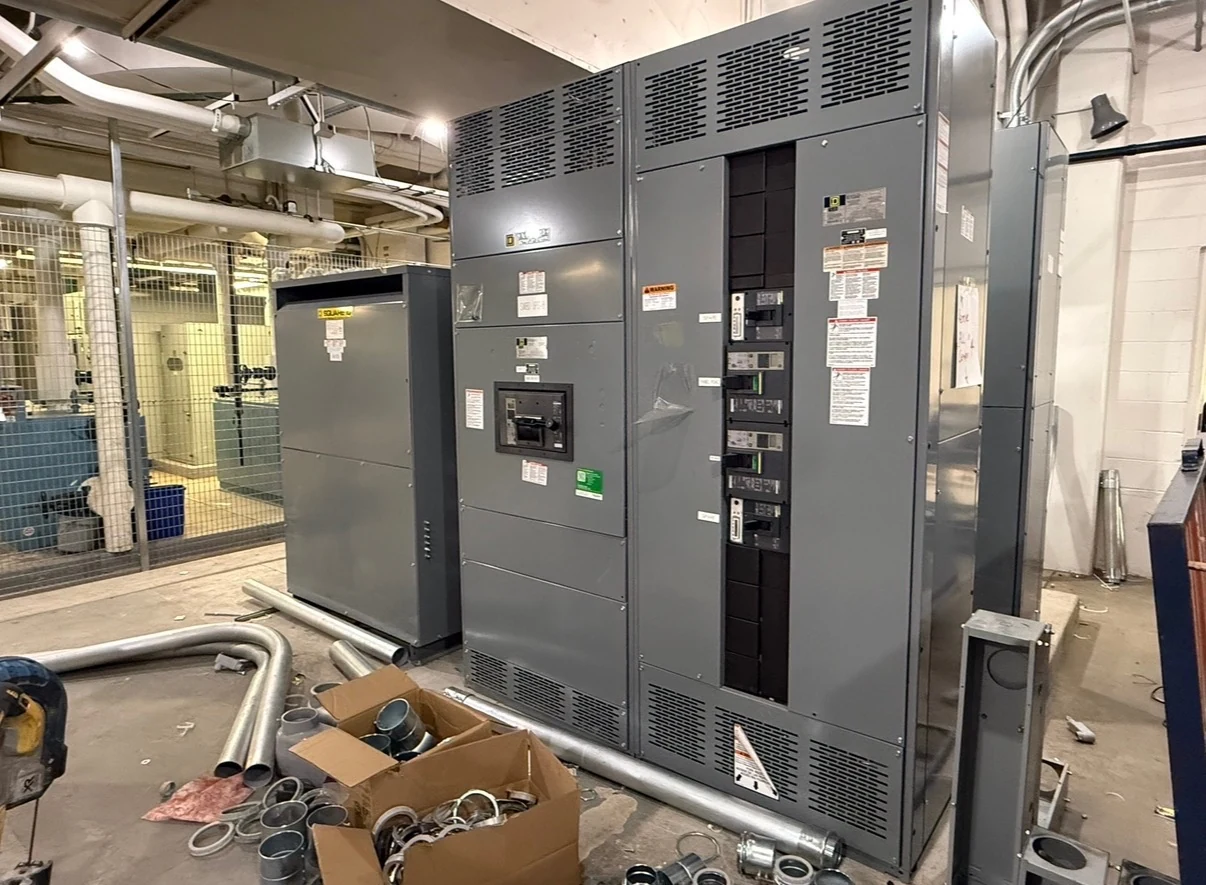
An unused-looking position in a switchgear lineup is not, by itself, permission to add another feeder. The proposed load must fit the electrical capacity, fault duty, physical construction and approval conditions of the particular assembly. For owners, contractors and specifying engineers, an early review can determine whether an addition is practical or whether new distribution equipment is the better project scope.
Establish what is actually installed
Begin with the latest one-line diagram, equipment nameplates, feeder schedules and available manufacturer drawings. Identify the lineup designation, bus arrangement, supply sources and the proposed connection location. Record known changes and reconcile conflicting documents with observations gathered by qualified personnel under the site safety program.
A blank cover may conceal an unfinished compartment or a space reserved for a particular device. Ask the original equipment manufacturer what the position was designed to accept, including bus connections, mounting provisions and barriers. A drawing showing spare space is a starting point, not evidence that a feeder can be installed.
Evaluate loading before counting spare capacity
Provide the new load schedule, expected operating pattern, motor starting information where relevant, and any planned expansion. The engineer should compare present demand and credible coincident future demand with the applicable bus, main device and source limits. The main device rating alone does not establish usable capacity for every operating condition.
Where available, demand records help show how the facility actually operates, but their measurement period and seasonal or process variations matter. Consider neutral loading and nonlinear loads where relevant, along with enclosure and ambient limitations documented for the equipment. If capacity is tight, revising the distribution design may be preferable to assuming that loads never overlap.
Revisit fault duty and protection
Collect current source data from the utility and document transformers, generators and other sources that can contribute to a fault. An engineer can update the short-circuit study for the relevant operating configurations. Compare the resulting duty with the assembly and device ratings, including any applicable withstand duration and interrupting requirements.
A feeder protective device also needs coordination with upstream and downstream protection for the actual system. Trip characteristics, settings and available fault-current ranges influence whether a downstream event unnecessarily interrupts other loads. Provide the proposed device and downstream circuit information to the study provider; do not assume a familiar frame size ensures compatibility or coordination.
Resolve the termination and space interfaces
Give the design team the feeder destination, conductor material and sizes, number of conductors, routing, and proposed entry direction. The connection must suit the approved terminals and available bending and termination space. Grounding and neutral connections, barriers, access, and clearances must also be checked against the actual assembly and applicable requirements.
Physical fit is only one part of compatibility. The proposed device, mounting arrangement and connection provisions need to be suitable for that specific lineup and its electrical duty. If the routing or termination cannot be accommodated, an alternative location or a separately engineered new assembly may be more practical than forcing the initial concept.
Confirm approval and documentation requirements
Ask the original manufacturer to identify approved configurations and documentation for the proposed addition. The engineer and contractor should determine how the work affects the equipment listing or labeling, and whether a field evaluation, permit or other review is required. Confirm the acceptance path with the authority having jurisdiction before committing to a device.
For a switchboard specified under UL 891, verify the listing and permitted configuration for that particular assembly; the standard is not a blanket designation for all switchgear. The project deliverables should include a revised one-line, equipment and feeder schedules, applicable study updates, approval records and final documentation reflecting the completed work.
Compare project scopes and schedule the decision
Compare an approved in-place addition with a new distribution assembly fed from a suitable existing connection, or a new replacement lineup where warranted. Evaluate engineering effort, space, outage exposure, future capacity and the cost of each complete scope rather than comparing device prices alone. Feasibility and equipment availability require project-specific review.
A direct manufacturer of new assemblies can review the proposed new-equipment scope for projects in South Texas and nationwide. Identify who supplies studies, field installation, settings, testing and final records. Allow time for design review, approvals, procurement and a coordinated outage; qualified persons must plan and perform electrical work under applicable safety procedures.
LET'S BUILD SOMETHING RELIABLE — 03
Ready to talk
switchgear?
Tell us about the new equipment your project needs. Include as much or as little detail as you have today.
(951) 403-5738CALL TO DISCUSS YOUR PROJECT