
BUILT IN THE USA. READY FOR YOUR PROJECT.
277/480V Switchgear
A 277/480V distribution system can serve lighting and substantial three-phase loads from one grounded-wye source, but the voltage label alone does not define a suitable assembly.
DIRECT FROM THE MANUFACTURER / NEW EQUIPMENT
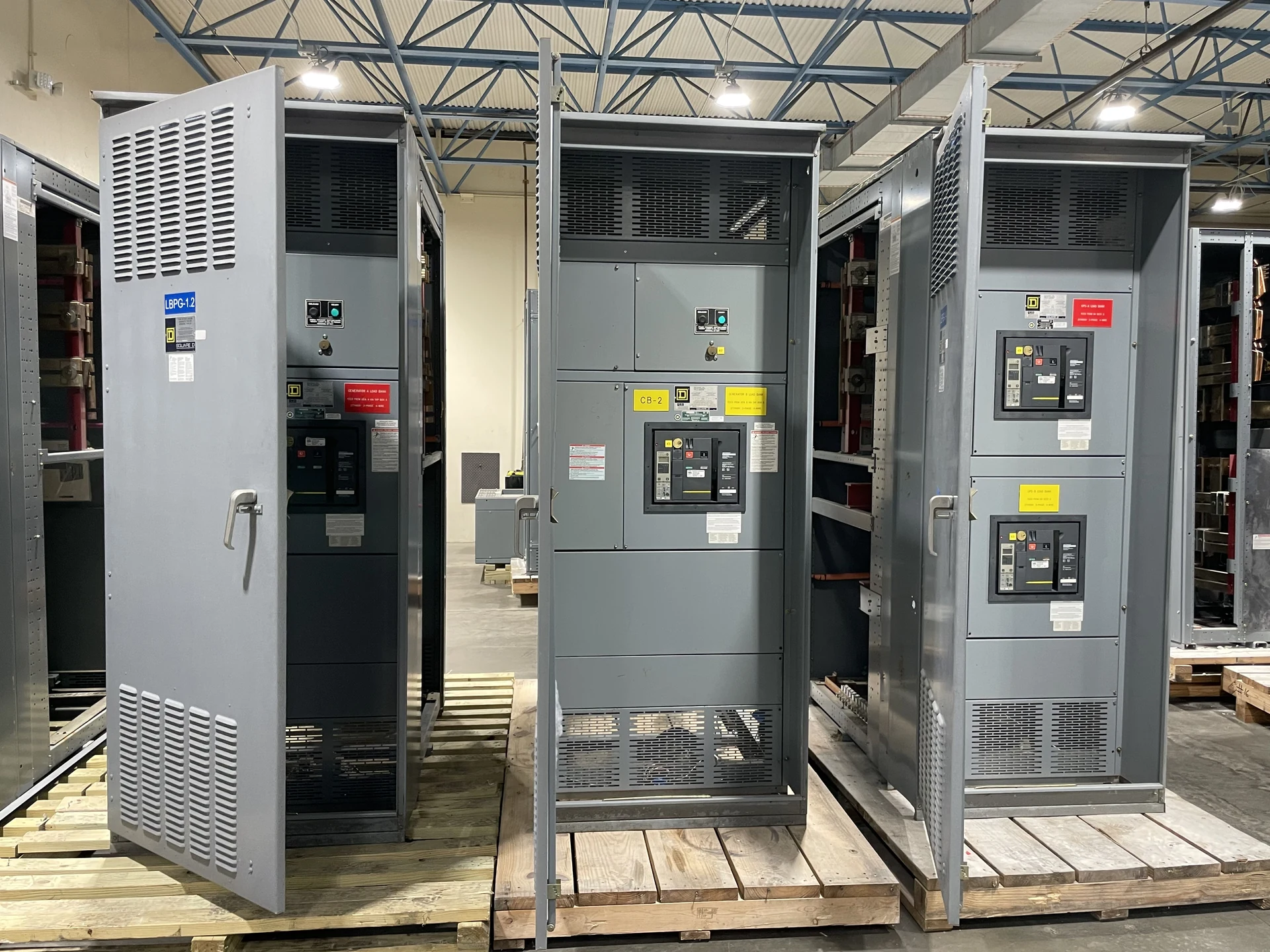
THE MANUFACTURER’S PERSPECTIVE — 02
A 277/480V distribution system can serve lighting and substantial three-phase loads from one grounded-wye source, but the voltage label alone does not define a suitable assembly. Owners, engineers and contractors need to establish the source configuration, protective duties and installation interfaces before specifying new equipment. A direct American manufacturer can review those inputs for projects in San Antonio, South Texas and nationwide.
Define the source and the loads
In a typical three-phase, four-wire grounded-wye system, the nominal voltage is 480 volts between phases and 277 volts from a phase to neutral. Lighting may use the phase-to-neutral supply, while motors and other equipment may use three-phase power. Confirm the actual utility or transformer secondary arrangement rather than assuming every 480-volt source includes a neutral.
Provide a one-line showing each source, transformer, main device, feeder and any tie or alternate supply. Include a load schedule with present demand, motor starting needs and credible expansion plans. Where lower-voltage loads are required, show the transformer and downstream distribution separately; a 277/480V assembly does not itself convert the supply to another voltage.
Match voltage class and insulation to the system
The engineer should verify that the proposed assembly and each connected device are suitable for the system voltage, grounding method and intended duty. Breaker voltage markings, including any slash rating, must be evaluated against the actual system configuration and manufacturer instructions. A device acceptable on a grounded-wye system should not automatically be assumed suitable for another grounding arrangement.
Insulation, barriers and electrical spacing are part of the assembly design, not just a breaker selection. State indoor or outdoor exposure, expected ambient conditions, moisture and contamination concerns. These details affect enclosure construction and heat management; confirm the applicable equipment standard and the specific assembly listing or certification rather than inferring it from the nominal system voltage.
Separate fault duty from operating current
A main bus sized for the expected load is not necessarily suitable for the available short-circuit current. Obtain the utility contribution and transformer data, including impedance, then have a qualified engineer determine fault levels at the assembly under relevant source and tie configurations. Generator contribution and future system changes can also affect the study.
Review breaker interrupting ratings and the assembly short-circuit or withstand ratings together, including any clearing-time conditions. If a series-rated combination is proposed, verify the exact approved combination and its application instead of assuming two devices will coordinate. Compare the proposal with the project study and document any limitations before approving substitutions.
Plan neutral, grounding and cable space
A neutral may be essential for 277-volt lighting and other line-to-neutral loads. Give the designer the number and size of neutral conductors, anticipated imbalance and nonlinear loads so neutral bus and terminations can be evaluated. An equipment grounding conductor has a different purpose; grounding and neutral bonding locations must follow the engineered system design and applicable requirements.
For incoming and outgoing circuits, identify conductor material, quantities, sizes and top or bottom entry. The assembly needs suitable terminals and bending space as well as room for field access. Compare cable routing with the equipment footprint, working clearances and room ventilation; a compact lineup may require more demanding field routing or less room for future feeders.
Coordinate protection, metering and control
Tell the manufacturer whether the project requires selective coordination, ground-fault protection, surge protection or a particular metering interface. Ground-fault requirements depend on the system, service arrangement, applicable code and device characteristics. The protection engineer should specify the sensing scheme and verify coordination; a feature on a drawing is not proof that the complete system meets those requirements.
For utility metering, request the utility’s current requirements for instrument transformers, compartments and access. Separate revenue metering from owner monitoring, and specify communications protocols, control power and the points needed by a building system. Identify who supplies the settings, who performs the studies and who tests the interfaces during commissioning.
Buy against a documented scope
Compare a switchboard with low-voltage switchgear against the specified protection, maintainability, footprint and budget; the names do not describe interchangeable constructions. UL 891 may be relevant to an appropriate switchboard assembly, but verify the particular assembly’s listing and scope. Ask the manufacturer to identify the applicable standard, ratings, equipment exclusions and proposed deviations in its quotation.
Request approval drawings, elevations, connection details, equipment schedules and project-specific inspection or test records. Agree on review cycles, component availability, shipping sections and the responsibilities for field connections and startup before setting the project schedule. Installation, testing and energization belong to qualified personnel under the site safety plan, with owner and utility approvals coordinated as applicable.
LET'S BUILD SOMETHING RELIABLE — 03
Ready to talk
switchgear?
Tell us about the new equipment your project needs. Include as much or as little detail as you have today.
(951) 403-5738CALL TO DISCUSS YOUR PROJECT