
BUILT IN THE USA. READY FOR YOUR PROJECT.
600-Amp Switchgear
A 600-amp switchgear request identifies a current class, not a complete equipment specification.
DIRECT FROM THE MANUFACTURER / NEW EQUIPMENT
THE MANUFACTURER’S PERSPECTIVE — 02
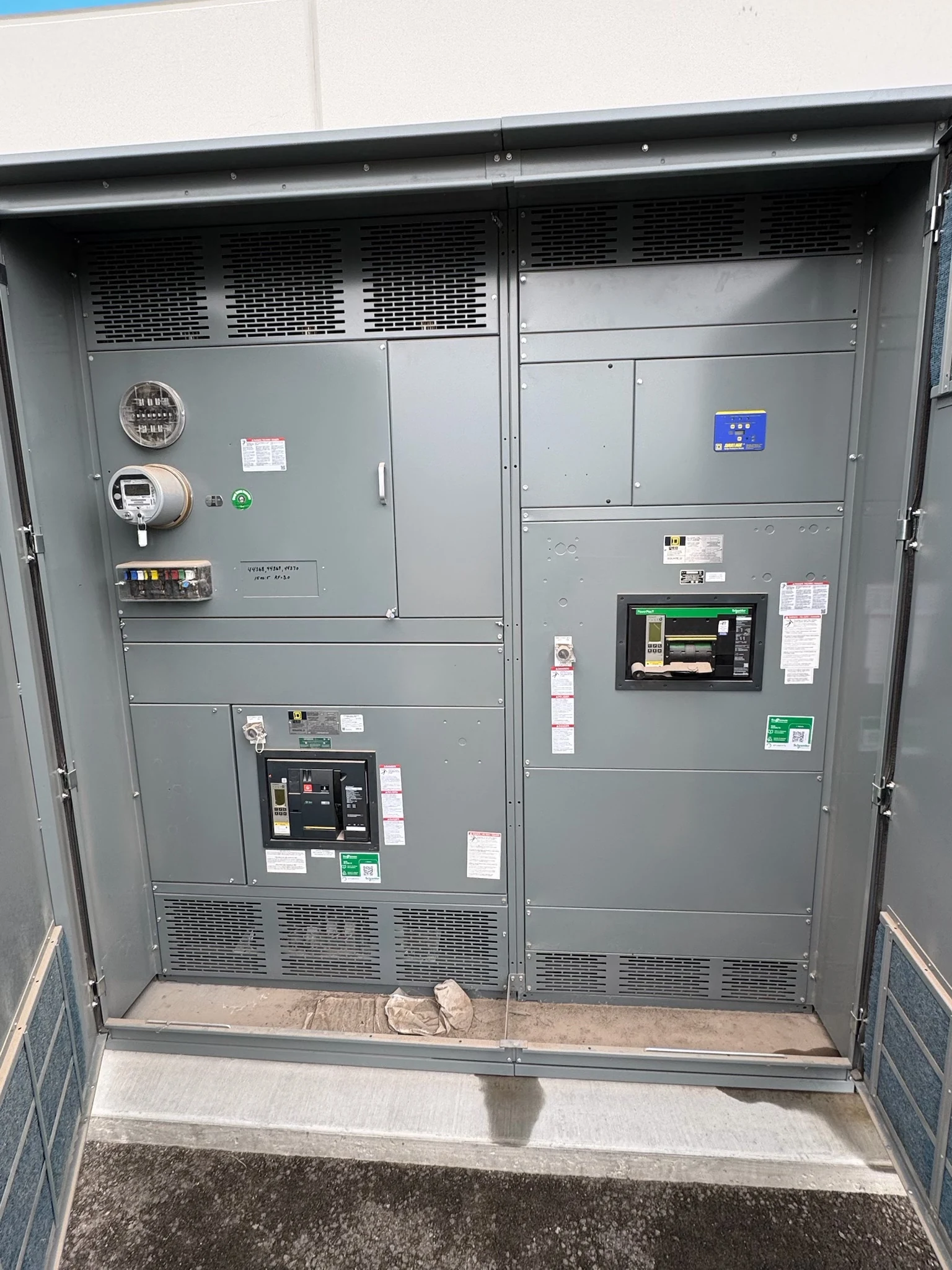
A 600-amp switchgear request identifies a current class, not a complete equipment specification. A facility’s loads, source, fault duty and installation conditions determine whether a proposed assembly is suitable. For projects in San Antonio, South Texas and nationwide, buying new distribution equipment directly from a manufacturer starts with giving engineering enough information to evaluate those details.
Establish the load behind the 600-amp request
Provide a current one-line diagram and a load schedule showing connected equipment, expected demand and planned additions. Distinguish loads that operate together from those that alternate. Motor starting, nonlinear equipment and unusually long operating periods can change the engineering assessment even when a simple sum appears to fit within 600 amperes.
The design professional should apply the relevant load-calculation rules and evaluate continuous loads, device restrictions and installation conditions. A 600-amp main device does not establish the rating of every bus, feeder, neutral or termination. Reserve capacity should be justified by a real expansion plan rather than assumed from an ampere label.
Separate normal current from fault duty
Normal operating current and short-circuit current answer different questions. Supply the available fault current at the equipment location, source characteristics and the assumptions behind that information. The engineer can then evaluate the interrupting ratings of protective devices and the assembly’s applicable short-circuit or withstand ratings against the expected duty.
Protection selection also affects continuity. A main and its downstream devices should be reviewed together using the project’s coordination study, rather than assuming a larger upstream device will isolate every fault selectively. Identify required trip functions and who supplies final settings; any coordination objective must be demonstrated over the relevant fault range.
Define sources, feeders and metering
Identify system voltage, phase and wire configuration, number of sources and the intended location of the main disconnect. List each feeder’s destination, proposed protective device and conductor details. If a generator or transfer switch is involved, show the connection boundary and intended operating states so source interactions can be reviewed.
Metering deserves its own scope. Utility revenue metering may require a different arrangement from owner monitoring, including space for instrument transformers and access to metering equipment. Obtain utility requirements where applicable and specify communications points if the facility expects data to reach a building-management or monitoring system.
Fit the assembly to its environment
A compact lineup may reduce floor area, but it still needs room for terminations, door swing, maintenance and code-required working access. Provide room dimensions, delivery route and desired top or bottom cable entry. Conductor quantity, bending space and connection arrangement can influence section width as much as the current class.
State whether the equipment is indoors or outdoors and describe ambient temperature, moisture, dust, corrosion exposure and ventilation. An enclosure choice is not just a weather label: heat dissipation and accessibility affect the finished design. Engineering should confirm any environmental limitations or adjustments to ratings for the actual arrangement.
Compare proposals on the same scope
Ask for an equipment description, one-line, elevations, device schedule, enclosure details and a list of exceptions. Compare main and feeder ratings, fault duty, metering, spare provisions and field connection points rather than comparing ampere labels alone. Confirm which field materials, installation services and studies are excluded from the quotation.
Specify the applicable equipment standard and any required listing in the purchase documents. UL 891 may be relevant to an appropriate switchboard assembly; confirm the proposed configuration’s listing rather than assuming it applies to all switchgear. If US-made components are required, identify the affected items and verify actual sourcing and availability.
Plan reviews, delivery and safe commissioning
The schedule depends on complete design inputs, approval of drawings, component availability, fabrication and agreed testing. Establish review dates and change-control responsibilities before ordering. Request the proposed inspection and factory test scope, acceptance criteria and records, and identify who will provide final drawings, manuals and the information needed for field turnover.
Coordinate shipping dimensions, lifting provisions, receiving access and any section splits with the installer. For a replacement project, the owner and contractor should plan outages and interfaces around affected loads. Installation, protective settings, testing and energization belong to qualified personnel following site procedures, applicable codes and the equipment instructions.
LET'S BUILD SOMETHING RELIABLE — 03
Ready to talk
switchgear?
Tell us about the new equipment your project needs. Include as much or as little detail as you have today.
(951) 403-5738CALL TO DISCUSS YOUR PROJECT