
BUILT IN THE USA. READY FOR YOUR PROJECT.
800-Amp Switchgear
An 800-amp switchgear specification is a starting point for a power distribution design, not a complete equipment selection.
DIRECT FROM THE MANUFACTURER / NEW EQUIPMENT
THE MANUFACTURER’S PERSPECTIVE — 02
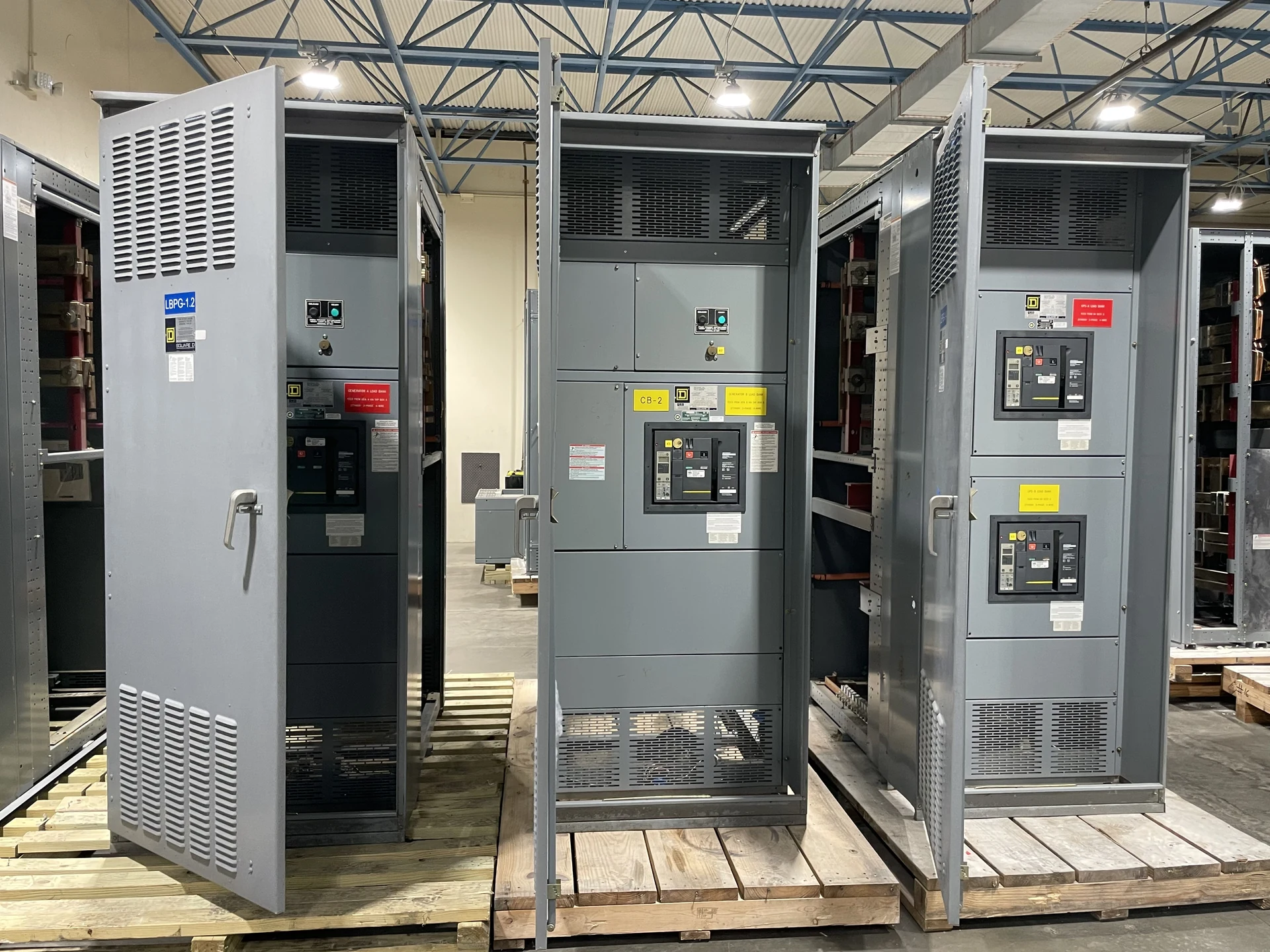
An 800-amp switchgear specification is a starting point for a power distribution design, not a complete equipment selection. The owner, electrical engineer, and contractor must establish the actual loads, source characteristics, protective devices, and site constraints. For projects in San Antonio, South Texas, and nationwide, a direct American manufacturer can review those inputs before defining a new assembly.
Start with the load, not the label
An 800-ampere nominal current class does not mean every feeder can carry 800 amperes or that the facility can add loads without review. Provide a load schedule showing present and planned circuits, operating demand, continuous loads, motor starting characteristics, and any substantial nonlinear loads. Distinguish measured demand from connected load and state the assumptions behind both.
The project engineer should apply the governing code and design criteria to the calculated load and account for future additions. An assembly with spare feeder spaces may still have limited bus or source capacity. Discuss whether the design needs immediate capacity for an expansion or only physical space for a later, separately engineered addition.
Confirm the ratings that carry current
Specify system voltage, phase and wire configuration, frequency, grounding arrangement, and intended service or feeder location. The main bus, incoming device, individual feeder devices, neutral, and terminations can have different ratings. Ask engineering to identify the actual ratings of the proposed assembly and its components rather than treating the page title as a product guarantee.
Ambient temperature, enclosure design, altitude, conductor arrangements, and ventilation can affect an equipment design or its permitted application. Identify these conditions early, especially for outdoor installations or crowded electrical rooms. Where electronic loads may produce significant neutral current, the engineer should evaluate neutral sizing and termination capacity instead of assuming the phase bus description settles that question.
Separate current capacity from fault duty
The 800-ampere current class is not a short-circuit rating. Provide available fault current at the proposed connection, source and transformer data, and the basis and date of the calculation. Where a utility supplies the service, coordinate its contribution and applicable interface requirements with the electrical engineer and utility.
The proposed assembly and protective devices must be evaluated for the available fault duty and their intended application. Interrupting capability, assembly withstand, clearing time, and selective coordination are related but distinct questions. Request device characteristics for the protection study and establish who will complete the study, approve settings, and verify the final design.
Map connections and feeder choices
A current rating alone cannot establish whether the lineup fits the wiring plan. Supply a one-line diagram showing each source, main, feeder, and destination, along with conductor material, size, quantity, and top or bottom entry. The proposed terminations and available bending space must accommodate the field design and the assembly construction.
Decide whether future circuits require installed protective devices, prepared spaces, or a provision for a future section. Installed devices add immediate capability but affect initial scope and cost; space alone does not establish capacity or guarantee a later device will fit. Identify metering, communication, and any transfer-equipment interfaces in the same review.
Make the equipment fit the site
Share the room or outdoor pad layout, delivery route, opening dimensions, desired cable entry, environmental exposure, and any seismic or anchorage criteria. The design team can compare a compact lineup with a larger arrangement that improves access or provides feeder space. Working clearances depend on the actual equipment and applicable rules, not a generic dimension.
Clarify shipping splits, equipment weights, lifting provisions, foundation interfaces, and who will make field connections. For an occupied site, coordinate delivery and any necessary outage with the owner, utility, and installing contractor. Installation, testing, energization, and subsequent electrical work belong to qualified personnel following the approved project and site safety procedures.
Turn the specification into a comparable quote
Submit the one-line, load schedule, fault-duty information, enclosure requirements, feeder list, and required drawings with the quote request. Identify applicable equipment standards and any listing requirement. UL 891 may be relevant to an appropriate switchboard assembly; confirm the proposed assembly’s specific listing and scope rather than assuming the standard applies to every type of switchgear.
Ask the manufacturer to distinguish included equipment from field labor, studies, settings, freight, and commissioning. Compare drawings, device schedules, test records, manuals, and stated exceptions as well as cost. Reserve time for submittal review, utility approval where applicable, component procurement, fabrication, inspection, and shipping; changes after approval can affect both the design and schedule.
LET'S BUILD SOMETHING RELIABLE — 03
Ready to talk
switchgear?
Tell us about the new equipment your project needs. Include as much or as little detail as you have today.
(951) 403-5738CALL TO DISCUSS YOUR PROJECT