
BUILT IN THE USA. READY FOR YOUR PROJECT.
Electrical Panelboards for Industrial Facilities
Industrial panelboards distribute power from an upstream feeder to branch circuits serving production equipment, controls and plant support loads.
DIRECT FROM THE MANUFACTURER / NEW EQUIPMENT
THE MANUFACTURER’S PERSPECTIVE — 02
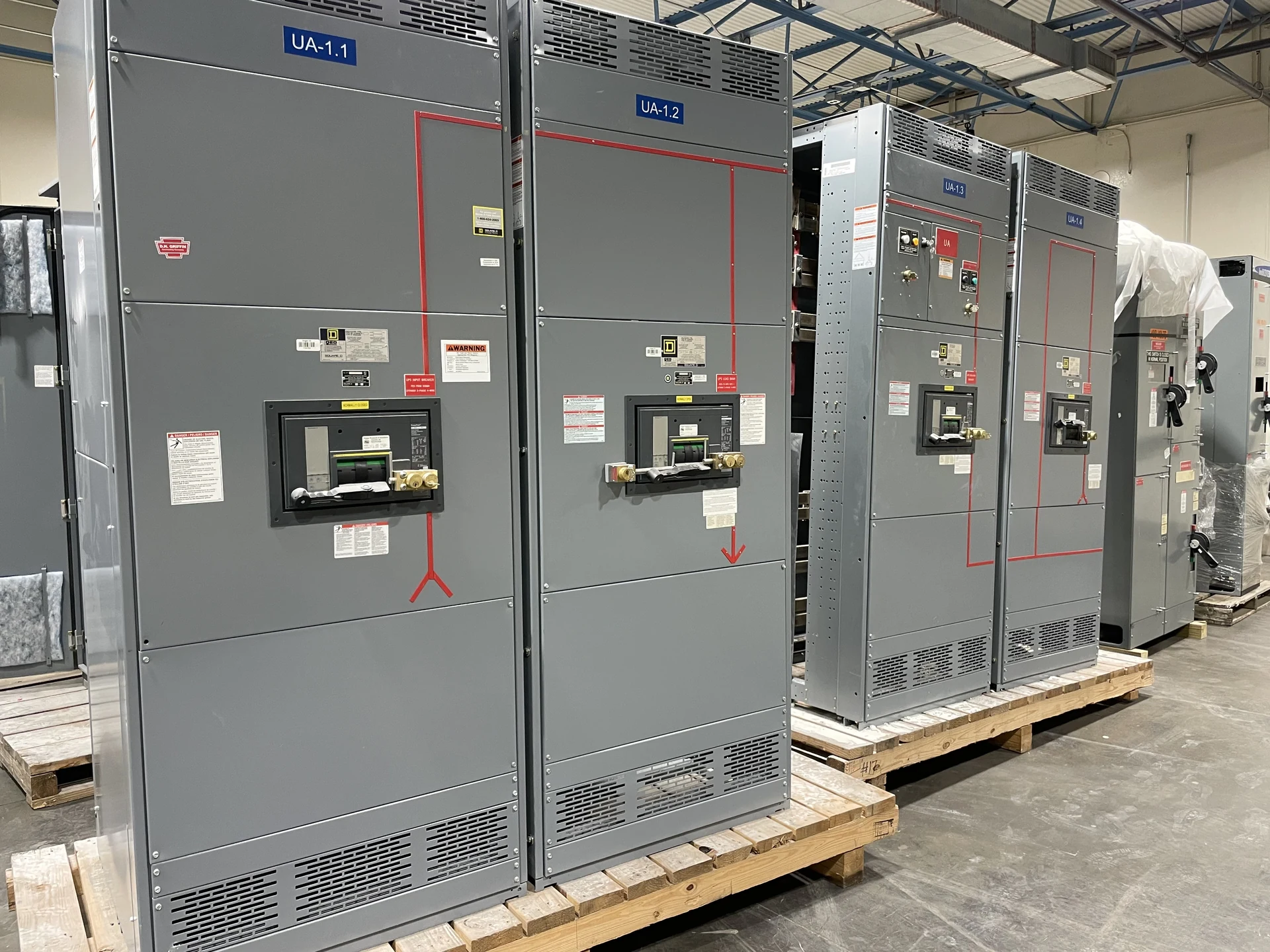
Industrial panelboards distribute power from an upstream feeder to branch circuits serving production equipment, controls and plant support loads. The right arrangement depends on what those circuits supply and how a fault or planned outage affects the process. Owners and specifying engineers can work directly with an American manufacturer of new power-distribution assemblies serving San Antonio, South Texas and projects nationwide to define the equipment and its interfaces.
Map the loads before choosing the panel
Build a circuit schedule that identifies each load, its operating current, voltage, phases, duty and location. Distinguish continuous process loads from equipment that starts intermittently. Motor nameplate data, starting method and expected simultaneous operation help the engineer evaluate demand and voltage drop rather than treating every connected load as if it operates identically.
A panelboard may feed individual motor circuits or a separate motor control center, but a branch breaker alone does not necessarily provide every motor control and overload function. Identify which starter, drive, disconnect and protective functions are supplied elsewhere. For drive and electronic loads, discuss harmonics and neutral needs with the design engineer before specifying the assembly.
Coordinate feeder and branch protection
Provide the available fault current at the proposed panel location, source and transformer information, feeder characteristics, and upstream device details. The engineer must check the panel assembly short-circuit rating and each device’s interrupting or withstand duty against the applicable system conditions. A high branch-breaker rating by itself does not establish the rating of the complete assembly.
Time-current curves and the expected fault-current range inform coordination between branch and feeder devices. A selective arrangement can limit the extent of a shutdown, but coordination is not automatic across every fault level. If a series-rated combination is proposed, verify its tested, listed application and any restrictions before accepting it.
Separate circuits by process consequence
A panel serving a production cell can also supply lighting, instrumentation and auxiliary equipment; grouping everything together may make installation simpler but enlarge the impact of a feeder outage. Map which loads must remain available during maintenance or a fault. Separate distribution paths or panels can improve isolation, provided the upstream sources and protection support the intended arrangement.
For critical controls or process support, document any normal and alternate sources, transfer equipment and load priorities. Have the engineer assess protective coordination and available fault current in each operating configuration, including generator operation if applicable. The controls designer should define what happens to the process on loss or restoration of power; a branch breaker is not a substitute for a designed safety-control system.
Fit the enclosure to the plant
Describe the installation area: dust, washdown, moisture, corrosive agents, ambient temperature and any formally classified hazardous location. The required enclosure and construction must suit the actual exposure and applicable rules. An ingress designation alone does not resolve internal heat buildup, so coordinate equipment losses and ventilation assumptions with the facility design team.
Share room dimensions, mounting restrictions, cable entry direction and feeder conductor quantities. Review termination and wire-bending space, door swing and applicable working clearances on the proposed drawings. A compact panel can simplify placement, while extra space for larger conductors and future circuits may make installation and later access more practical.
Make the quotation and submittal comparable
Send the manufacturer a current one-line diagram and panel schedule showing source voltage, phase and wire arrangement, grounding scheme, main or main-lug arrangement, feeder protection, branch device poles and intended loads. Identify available fault-current data, enclosure conditions, spare circuit positions, labeling conventions and any metering or communication interfaces. Clearly mark assumptions and information still awaiting engineering.
Ask each bidder to identify included devices, ratings, enclosure, terminations, accessories and exclusions, alongside proposed drawings and inspection or test records. Specify applicable codes and standards, including any required panelboard listing such as UL 67, and verify the listing scope for the proposed configuration. Spare spaces alone do not prove that bus capacity or future protective devices will be adequate.
Plan approvals, installation and turnover
Set a schedule around the approval of drawings, release for manufacturing, component availability, inspection, delivery and the plant’s installation window. Resolve who provides field conductors, supports, control wiring and protection settings. When production cannot stop at once, the owner and contractor should assess a phased cutover and any temporary power arrangement against process and protection requirements.
Request final drawings, circuit identification, device information and agreed factory test documentation for the facility records. The installing contractor and qualified electrical personnel should perform site checks and commissioning under the approved procedures, applicable codes and manufacturer instructions. The owner’s operations team should authorize outages and confirm that the panel schedule and protection study reflect the final installation.
LET'S BUILD SOMETHING RELIABLE — 03
Ready to talk
switchgear?
Tell us about the new equipment your project needs. Include as much or as little detail as you have today.
(951) 403-5738CALL TO DISCUSS YOUR PROJECT