
BUILT IN THE USA. READY FOR YOUR PROJECT.
Low-Voltage Switchgear for Industrial Facilities
Industrial power distribution has to accommodate more than a total plant load.
DIRECT FROM THE MANUFACTURER / NEW EQUIPMENT
THE MANUFACTURER’S PERSPECTIVE — 02
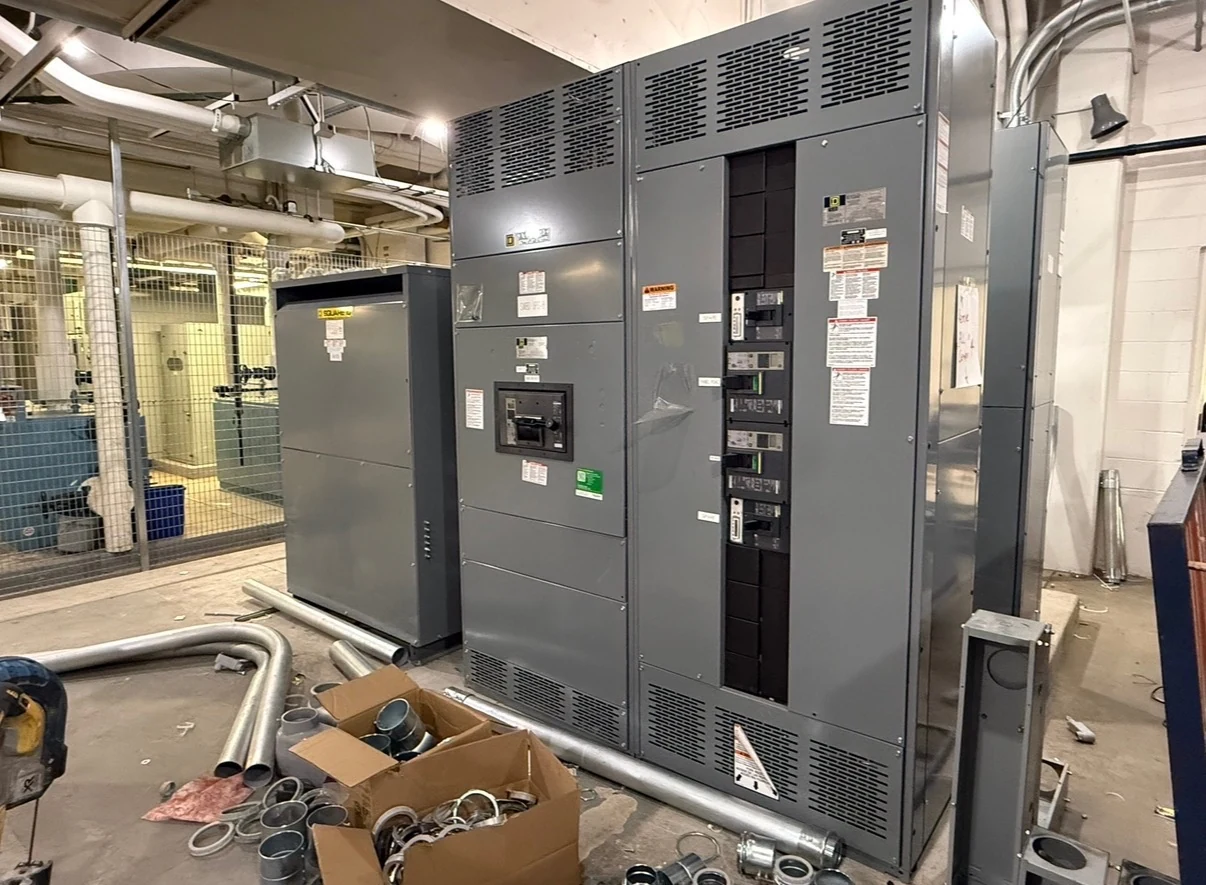
Industrial power distribution has to accommodate more than a total plant load. Motors start at different times, drives introduce nonlinear currents, and a feeder trip can stop an entire process. For owners and specifiers, a low-voltage power circuit breaker switchgear lineup should be selected around these operating realities as well as the electrical system and available installation space.
Translate process loads into a lineup
Begin with a current one-line diagram and a feeder schedule showing normal demand, expected growth, system voltage and phase configuration. Identify motor control centers, large individual motors, drives, process heaters and essential auxiliaries. Note which loads run together and which must restart after an interruption; a list of nameplate currents alone does not describe the operating duty.
Motor starting method and sequence matter. Direct starting can produce a temporary current and voltage dip unlike a drive-controlled start. The engineer should evaluate starting and running conditions, transformer capacity and feeder voltage drop before assigning bus and breaker requirements. Reserve capacity for a documented expansion plan rather than assuming any empty space can serve a future load.
Balance protection and process continuity
Obtain available fault-current information for each source and have the design team evaluate both breaker interrupting capability and the assembly's short-circuit duty. A low-voltage power circuit breaker may offer adjustable protective functions, but its trip unit and the completed assembly must be suitable for the actual application. Settings are not a substitute for adequate equipment ratings.
A coordination study compares protective-device characteristics across the relevant fault-current range so that a feeder fault can be isolated as selectively as practical. Greater selectivity may require a deliberate time delay, which can affect incident energy and equipment withstand. The owner and engineer should resolve that tradeoff, including applicable code requirements, rather than promise that every disturbance will leave the rest of the plant running.
Choose an arrangement for maintenance windows
Group feeders with an understanding of which process areas can tolerate a shutdown. Where the source arrangement supports it, a main-tie-main configuration can offer operating flexibility, but requires an engineered operating philosophy, source-capacity review and interlocks appropriate to the intended states. It also adds equipment, controls and physical space compared with a simpler lineup.
Drawout breakers may improve access for planned maintenance compared with fixed devices, subject to the selected construction and site procedures; they also affect cost, footprint and handling requirements. Specify clearance for doors, breaker removal, cable work and lifting equipment. Qualified personnel must follow the site electrical safety program and manufacturer instructions; a drawout feature does not eliminate electrical hazards.
Account for the plant environment and connections
Describe ambient temperature, altitude, dust, moisture, corrosive chemicals and washdown exposure, along with indoor or outdoor placement. Enclosure selection and ventilation must work together: restricting contaminants while removing equipment heat may require a different room or enclosure strategy. Verify the actual enclosure requirements and any environmental effects on ratings with the manufacturer and engineer.
Cable or busway connections can determine the section dimensions as much as the devices do. Provide entry direction, conductor sizes and quantities, termination details, grounding and neutral requirements, plus room dimensions and access routes. For drive-heavy facilities, ask the engineer to evaluate harmonics and associated heating rather than assuming the distribution equipment will see only sinusoidal current.
Define controls and information boundaries
A production team may need breaker status, trip alarms, power metering and selected remote commands in its supervisory system. Provide a point list, communications protocol, network boundary and control-authority requirements. Specify what happens if communications or control power is lost, and identify any independent trip supply, monitoring and external control wiring that the project requires.
Agree on the interface between the lineup and motor control centers, generators or transfer equipment without assuming the switchgear itself performs every motor-control or transfer function. The engineer should document interlocks, permissives, alarm ownership and source-switching logic. Include functional verification of those interfaces in the commissioning plan, with the parties responsible for field devices and integration clearly identified.
Purchase against a complete scope and schedule
A direct manufacturer of new assemblies serving San Antonio, South Texas and nationwide can develop a meaningful proposal when the request includes the one-line, load schedule, fault data, specifications, site constraints and required delivery destination. Ask for a device schedule, outline dimensions, connection locations, applicable standards and listing documentation for the proposed equipment, plus explicit exceptions and responsibilities.
Plan time for drawing review, approved design changes, component procurement, fabrication, agreed factory inspection and shipping. Coordinate receiving, installation, protection settings, field testing and outage windows with the contractor and facility. Before energization, qualified personnel should complete the approved checks and authorization process; retain final drawings, test records and operating instructions for plant turnover.
LET'S BUILD SOMETHING RELIABLE — 03
Ready to talk
switchgear?
Tell us about the new equipment your project needs. Include as much or as little detail as you have today.
(951) 403-5738CALL TO DISCUSS YOUR PROJECT