
BUILT IN THE USA. READY FOR YOUR PROJECT.
Low-Voltage Switchgear for Hospitals
Hospital power distribution must support clinical operations even while equipment is inspected, tested, or taken out of service.
DIRECT FROM THE MANUFACTURER / NEW EQUIPMENT
THE MANUFACTURER’S PERSPECTIVE — 02
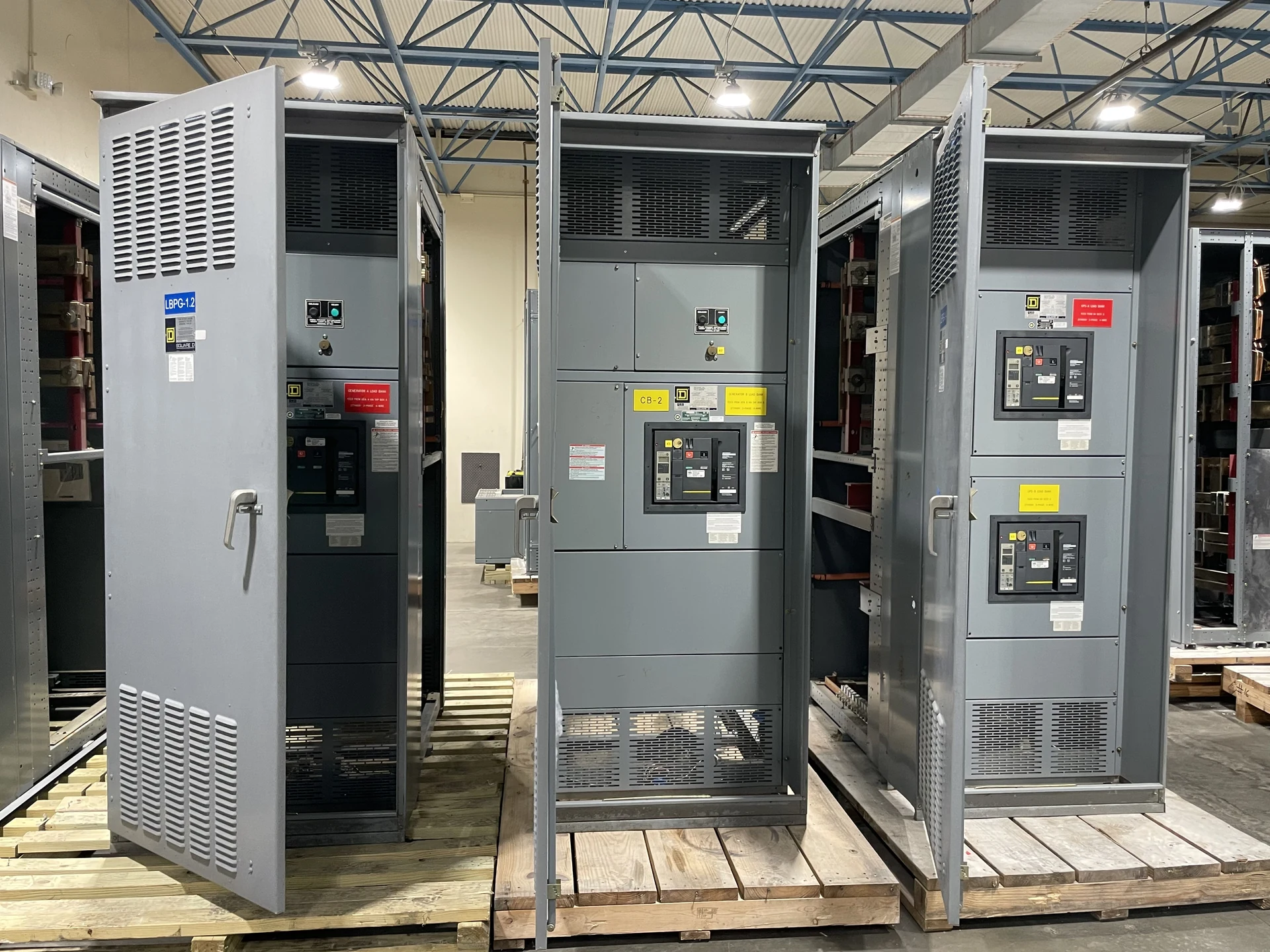
Hospital power distribution must support clinical operations even while equipment is inspected, tested, or taken out of service. Low-voltage power circuit breaker switchgear is one option for protecting and distributing facility power, but its value depends on the entire source and transfer arrangement. Owners and designers can work directly with a U.S. manufacturer serving San Antonio, South Texas, and nationwide to define a new assembly around those dependencies.
Map patient-care dependencies before choosing a lineup
Begin with an updated one-line diagram showing utility and generator sources, transformer connections, switchgear buses, transfer equipment, and downstream distribution. Identify which feeders support patient-care spaces, operating rooms, imaging, building systems, and other critical functions. A load schedule should distinguish present demand from planned additions and identify motor starting or large nonlinear loads.
The design team should classify loads and the essential electrical system branches under the requirements applicable to the facility and jurisdiction. Equipment serving life safety, critical, and equipment functions may have different transfer and separation needs. Do not assume that a single common bus provides independent paths merely because multiple feeders leave it.
Choose breaker construction around maintainability
Low-voltage power circuit breaker switchgear can provide compartmented construction and drawout breakers where the specified design supports them. Compared with a simpler distribution assembly, that approach may offer useful maintenance flexibility but can require more floor space and a larger initial investment. Confirm actual compartmentation, access arrangements, and breaker features in the proposed design.
Specify system voltage and configuration, continuous load and bus requirements, available fault current at the installation point, enclosure conditions, and anticipated growth. The engineer must check interrupting and assembly withstand duties against the study and clearing times, not simply compare nominal amperes. Identify applicable standards, such as IEEE C37.20.1 or UL 1558 where specified, and verify any required listing for the proposed assembly.
Coordinate protection with continuity goals
A feeder fault should not unnecessarily interrupt a broad group of hospital loads. Provide the protection engineer with source impedances, transformer data, generator contributions, breaker trip-unit characteristics, and downstream device information. The coordination study evaluates device behavior across the relevant current range; the engineer must establish where selective coordination is required and verify that the proposed settings support it.
Coordination and arc-flash risk reduction can pull in different directions: an intentional delay may help a downstream device clear a fault but may increase incident energy in some conditions. Review time-current curves, equipment short-time withstand, maintenance provisions, and any approved settings or operating modes together. A qualified study provider should document limitations rather than promise complete selectivity.
Define transfer and generator interfaces
Switchgear distributes and protects power; automatic transfer equipment selects between sources for assigned loads. Show each transfer switch, its normal and alternate supply, connected branch, and point of connection on the one-line. The engineer should verify that source capacity, transfer equipment ratings, neutral and grounding design, and protection remain appropriate in each intended operating state.
For multiple sources or a main-tie-main arrangement, specify permissible operating states, interlocks, control power, status contacts, alarms, and any load-shedding signals. Decide which supplier provides each control device and who tests the interfaces with generator and transfer-system controls. Redundant sources do not eliminate a shared-bus failure or replace a documented continuity plan.
Design the installation and outage around a live hospital
Give the manufacturer room dimensions, equipment access routes, cable or busway entry, conductor quantities, and required working clearances. Confirm shipping splits, section weights, lifting provisions, anchorage, ventilation, and pathways for removing breakers. The installer and design team should check that doors, corridors, and delivery routes accommodate the proposed sections before approving the drawings.
For a new replacement lineup, the owner and contractor should identify affected clinical services, approved outage windows, temporary power needs, and a rollback decision before scheduling field work. Include infection-control and facilities stakeholders when construction affects occupied areas. Qualified personnel plan isolation, installation, testing, and energization under site procedures; the equipment purchase alone does not provide an outage plan.
Purchase with clear submittals and handoffs
Request a proposal identifying the one-line and equipment elevation, breaker and trip functions, metering, control interfaces, spare provisions, applicable ratings, and exceptions. Ask for an interface matrix covering utility coordination, field wiring, protection settings, temporary power, and commissioning. Confirm the assembly scope, component availability, and any project-specific sourcing requirements before comparing offers.
Build the schedule around approved drawings, component procurement, fabrication, agreed factory tests, delivery, installation, and integrated site testing. Define test scope, acceptance criteria, witnesses, and records in advance; distinguish factory checks from hospital-wide transfer testing. Turnover should include final drawings, operating and maintenance instructions, test results, and the protection study or settings documentation supplied by the responsible party.
LET'S BUILD SOMETHING RELIABLE — 03
Ready to talk
switchgear?
Tell us about the new equipment your project needs. Include as much or as little detail as you have today.
(951) 403-5738CALL TO DISCUSS YOUR PROJECT