
BUILT IN THE USA. READY FOR YOUR PROJECT.
Low-Voltage Switchgear: Testing and Documentation
A low-voltage power circuit breaker switchgear purchase is not complete when the lineup looks finished.
DIRECT FROM THE MANUFACTURER / NEW EQUIPMENT
THE MANUFACTURER’S PERSPECTIVE — 02
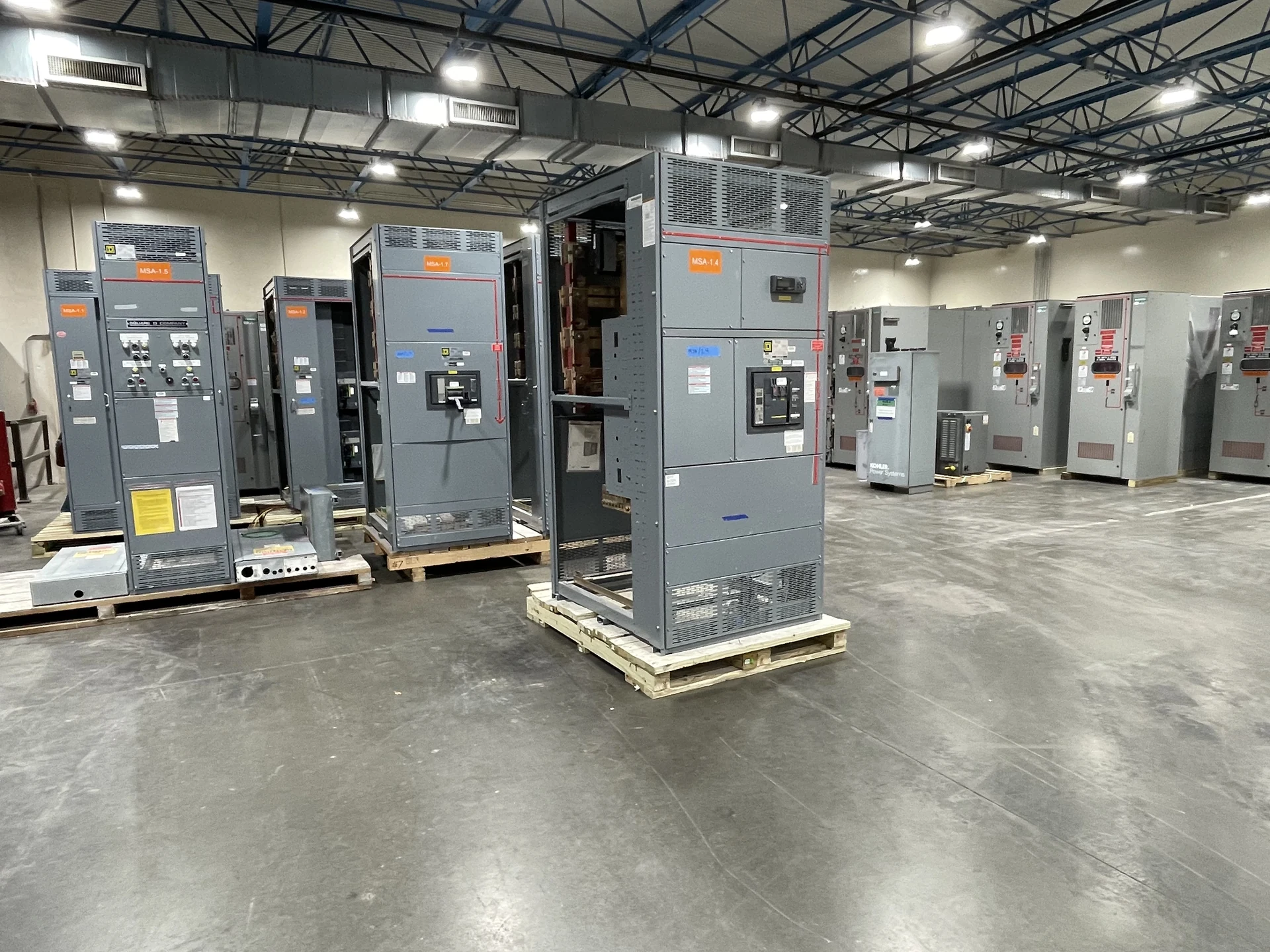
A low-voltage power circuit breaker switchgear purchase is not complete when the lineup looks finished. Owners, engineers and contractors also need evidence that its construction and controls match the approved design, plus a plan for checks after installation. Define testing and records before ordering so the manufacturer and field team know what must be demonstrated, witnessed and handed over.
Set the acceptance basis early
Start with the one-line diagram, source arrangements, available fault current, load schedule and required operating sequence. Identify the applicable product standard, such as IEEE C37.20.1 where relevant, and the contract's specified testing standards and editions. The engineer should confirm the actual assembly and breaker ratings against system duty; a test report cannot substitute for that design review.
Separate equipment design qualification from routine production checks, project-specific factory acceptance testing and field acceptance testing. A factory functional demonstration does not independently prove every short-circuit withstand rating. Ask which existing design evidence supports the proposed configuration and which checks will be performed on the actual lineup, with acceptance criteria agreed before testing.
Inspect the physical lineup
Compare the completed sections with approved elevations, the equipment schedule and nameplate information. Inspection can cover section identification, barriers, labels, conductor termination provisions, visible workmanship and shipping splits. For drawout breakers, agree on checks of position indication and mechanical interlocks appropriate to the design; fixed-mounted breakers have different access and verification needs.
A shipping split creates an interface that cannot be treated as fully finished at the factory. The documents should identify field-assembled connections, alignment requirements and the party responsible for reinspection. Record deficiencies against identifiable sections and require documented disposition, rather than accepting a general statement that the assembly passed inspection.
Define electrical and protection checks
Specify which insulation-resistance, continuity and contact-resistance checks apply to the equipment and its components. The test plan should identify the procedure, measurement points, applicable conditions and acceptance basis. Results are more useful when the report identifies the instrument, calibration status and relevant environmental conditions; a single resistance reading alone does not establish the health of every connection.
For protective functions, distinguish verifying a breaker's trip unit or relay from confirming the complete trip path and associated indications. Identify whether injection testing, ground-fault functions or other checks are included, and who supplies approved settings. The coordination study and final settings remain the responsibility of the designated engineer or specialist, not an assumption made by the factory.
Prove controls and external interfaces
A main-tie-main lineup may need demonstrations of permissives, interlocks, breaker status and alarms for each specified operating state. The control narrative should also address loss of control power and restoration behavior. Define which signals can be simulated at the factory and which require connected equipment at the site; an isolated panel test cannot prove an entire facility sequence.
For remote monitoring, agree on the communications protocol, point list, network boundary and ownership of point-to-point verification. Metering and current-transformer inputs need traceable device information and an appropriate test method. Record observations against each expected response so a controls integrator can resolve mismatches without guessing what was actually checked.
Request useful submittals and records
The purchasing package should call for an equipment one-line, elevations, wiring and control schematics, terminal schedules, device data and a test plan. Review these against the specification, including listed exceptions and any proposed substitutions. Where a listing is required, verify the listing and scope for the particular assembly; UL 891 is relevant to appropriate switchboards, not a blanket designation for switchgear.
At turnover, request results tied to equipment and device identifiers, signed inspection records, approved settings or references to them, and marked-up as-built drawings reflecting accepted changes. Include manuals, component information and any open-item register. Agree who closes outstanding items and issues the final documentation package after site work is complete.
Plan the witness and field handoff
A witnessed factory test can reveal interpretation differences before shipment, but adds coordination for notice, attendees and review of findings. Define the witness or hold points, retest rules and acceptable remote participation in the purchase order. Allow schedule time for drawing approval, test-plan review, corrective work and report acceptance rather than treating testing as a last-day formality.
After delivery, installation and field acceptance responsibilities should be explicit: the contractor handles assigned installation work, while qualified testing personnel perform the agreed checks under site safety procedures and manufacturer instructions. Confirm who integrates external controls, authorizes energization and resolves factory-to-field discrepancies. The owner can then assemble the records needed for operating and maintaining the new equipment.
LET'S BUILD SOMETHING RELIABLE — 03
Ready to talk
switchgear?
Tell us about the new equipment your project needs. Include as much or as little detail as you have today.
(951) 403-5738CALL TO DISCUSS YOUR PROJECT