
BUILT IN THE USA. READY FOR YOUR PROJECT.
Electrical Switchboards for Manufacturing Plants
A manufacturing plant needs low-voltage distribution that follows the way its production lines actually run.
DIRECT FROM THE MANUFACTURER / NEW EQUIPMENT
THE MANUFACTURER’S PERSPECTIVE — 02
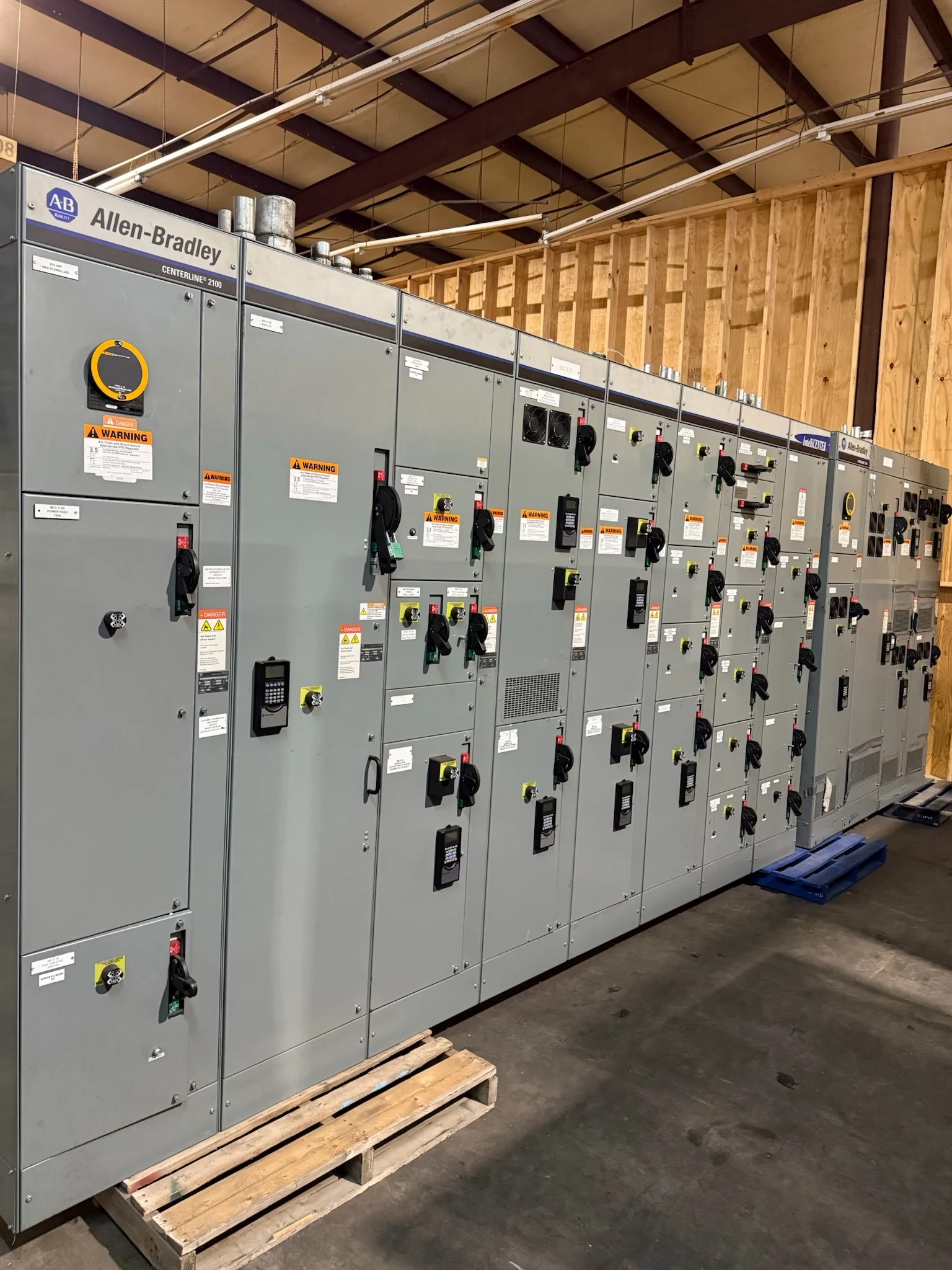
A manufacturing plant needs low-voltage distribution that follows the way its production lines actually run. A switchboard can divide service or other incoming power among feeders to motor control centers, process equipment, panelboards, and other loads. For owners and specifiers, the best arrangement balances electrical duty, future changes, maintenance access, and the cost of an interruption—not simply the largest bus that will fit.
Start with the production load profile
Provide a current one-line diagram and a load schedule identifying each line, motor group, drive, heating process, and auxiliary system. Include system voltage, phase and wire configuration, normal demand, and expected operating patterns. Loads that rarely run together may have a different demand from their combined nameplate values; the engineer should document the basis for any diversity assumption.
Motor starting and variable-frequency drives deserve separate attention. Starting current can affect voltage at other process equipment, while drives can introduce harmonic currents and heating concerns. Give the design team motor sizes, starting methods, simultaneous-start assumptions, and drive information so it can evaluate the feeder arrangement and decide whether further power-quality analysis is needed.
Organize feeders around plant operations
A switchboard distributes power; it does not necessarily replace the starters and controls in a motor control center. Group feeders by production area, critical utility, or shutdown boundary, then identify their destinations and protective devices. Separating a packaging line from a process cooling system, for example, can give the owner more flexibility when an authorized outage is required.
Feeder grouping also changes cost and space. More individually protected circuits can improve isolation but require additional devices, terminations, and enclosure width. Compare that expense with the operational consequence of losing several loads together. Mark essential process dependencies on the one-line so the design does not accidentally put a line and its supporting utility on an unsuitable common feeder.
Match protection to the source and load
The engineer needs available fault-current information at the proposed installation, including utility and other source contributions where applicable. Breaker interrupting ratings and the switchboard assembly short-circuit rating must be evaluated together for that duty. Any reliance on a particular upstream protective device or a listed combination should be explicit in the submitted design, not assumed from the breaker label alone.
Request a protection and coordination review that considers upstream devices, downstream feeders, and motor starting conditions. Selectivity across every fault level is not automatic: improving coordination can affect equipment choices and settings. Define who supplies the study, approves settings, and incorporates resulting information into commissioning and the facility’s electrical safety documentation.
Make expansion an engineered allowance
A planned production cell may justify a spare feeder device, a prepared space for a future device, or a provision for an additional section. These options are not equivalent: an empty space does not establish that the bus, source, short-circuit duty, or future device will be adequate. Provide the anticipated load, connection timing, and any uncertainty before selecting the allowance.
Reserve physical room for the likely expansion path as well as electrical capacity. Document cable or busway entry direction, conductor quantity and size, termination space, and the boundaries between the switchboard and downstream equipment. Confirm who furnishes transition pieces, supports, field cabling, and any future engineering review rather than leaving those interfaces to the installation phase.
Protect access in an active factory
Plant floor layouts can change after electrical rooms are designed. Show the proposed equipment footprint, doors, lifting route, cable approach, and required working and access clearances on coordinated plans. Consider whether a shipping split is needed to reach the room and who will handle receiving, rigging, alignment, and field connections.
Describe ambient temperature, ventilation, dust, moisture, and process contaminants so the enclosure and heat-management approach can be reviewed for the actual environment. Denser layouts may save floor space but restrict cable work or future maintenance. Qualified electrical personnel should plan isolation and maintenance under site procedures, applicable codes, and manufacturer instructions; ordinary production access is not a substitute for safe electrical working space.
Turn the specification into a workable purchase
When requesting a quotation from a direct manufacturer serving San Antonio, South Texas, and nationwide, include the one-line, load schedule, fault-current data, equipment location, enclosure conditions, and desired delivery sequence. Identify required metering, communications, drawings, inspection, and any component-origin requirements. Confirm component sourcing and availability instead of assuming a particular origin or make.
Ask for proposal exceptions, dimensional and electrical submittals, a device and feeder schedule, project-specific test records, and operation and maintenance information. If UL 891 listing is specified for the switchboard, verify the proposed assembly’s listing and scope. Build the schedule around design review, approvals, component availability, fabrication, testing, delivery, and owner-coordinated installation and commissioning; reserve production outage windows with the responsible plant team.
LET'S BUILD SOMETHING RELIABLE — 03
Ready to talk
switchgear?
Tell us about the new equipment your project needs. Include as much or as little detail as you have today.
(951) 403-5738CALL TO DISCUSS YOUR PROJECT