
BUILT IN THE USA. READY FOR YOUR PROJECT.
Electrical Switchboards for Power Plants
A power plant relies on more than its generating unit: pumps, fans, controls and supporting systems all need dependable distribution during startup, generation and shutdown.
DIRECT FROM THE MANUFACTURER / NEW EQUIPMENT
THE MANUFACTURER’S PERSPECTIVE — 02
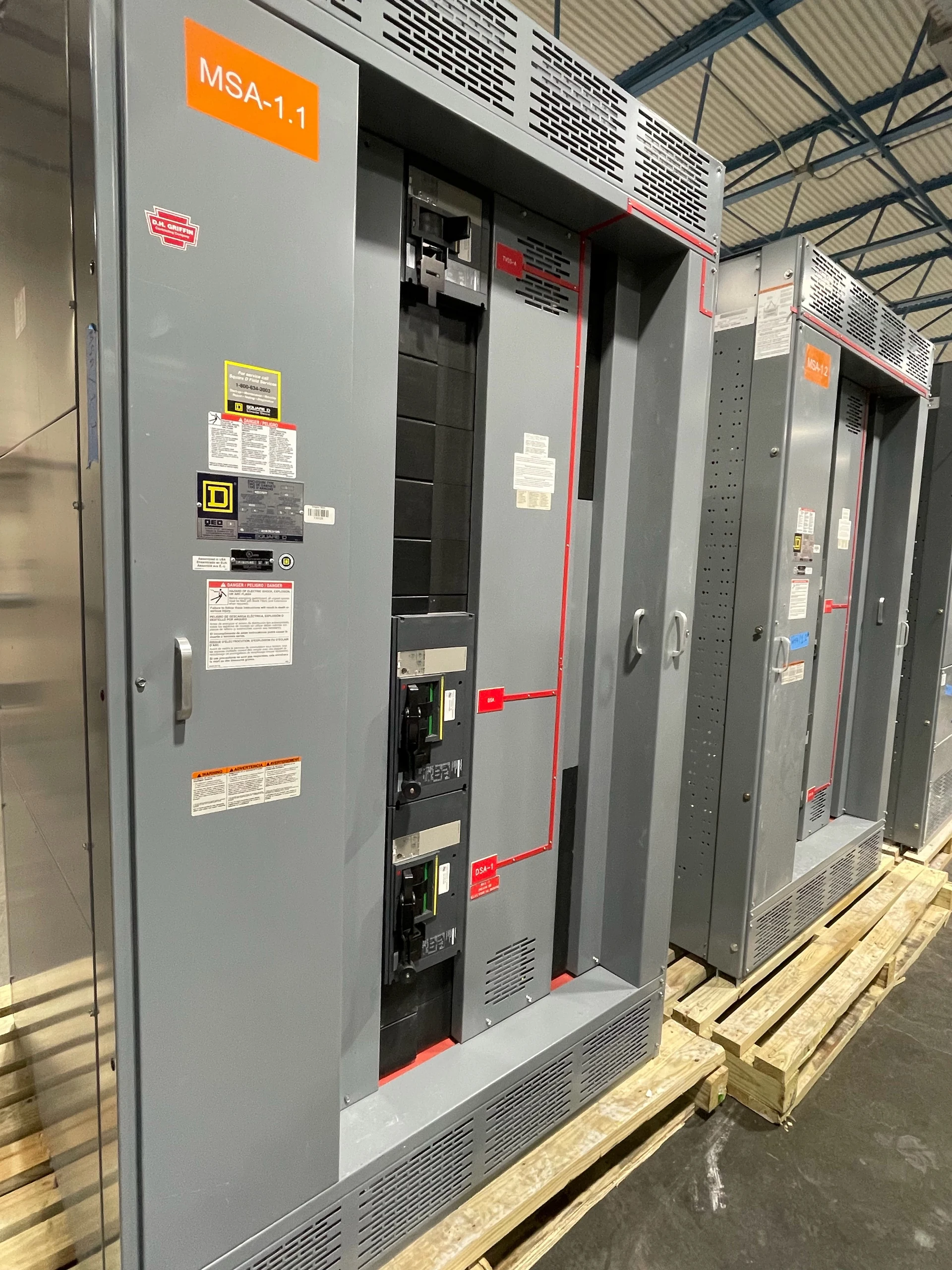
A power plant relies on more than its generating unit: pumps, fans, controls and supporting systems all need dependable distribution during startup, generation and shutdown. A new low-voltage switchboard can organize those auxiliary feeders, but its usefulness depends on how well it fits the plant’s sources, protection strategy and operating philosophy. Owners and specifying engineers should resolve those interfaces before comparing equipment proposals.
Map the sources and essential loads
Begin with a one-line showing every proposed source, transformer, incoming connection, bus, tie and outgoing feeder. Identify whether the board receives station service, an auxiliary transformer supply, a standby source or another engineered arrangement. The design must distinguish normal and abnormal operating states rather than assume the generator supplies every load at all times.
A feeder schedule should identify pumps, cooling fans, battery chargers, control power and other auxiliary loads, including voltage, demand, starting characteristics and priority. Some loads may require a separate uninterruptible or other dedicated supply. The plant engineer should decide which loads must remain available in each operating state and which can be shed.
Choose the distribution and switching arrangement
A single main with feeders can be compact, while a main-tie-main arrangement can provide alternative distribution paths when the sources and operating plan support them. Extra switching devices and a bus tie add space, controls and coordination work. They do not, by themselves, establish redundancy or make every load continuously available.
Document permitted source combinations and whether paralleling is allowed. Interlocks and control logic can help prevent unintended source combinations, but their design must account for actual devices and failure modes. Specify switching duty and expected operating frequency so the engineer can evaluate devices for their intended role, not merely their continuous-current rating.
Study fault duty and protective coordination
Provide source and transformer data, available fault-current calculations, grounding arrangements and the anticipated range of plant configurations. Generator contribution can differ from the utility contribution and change with time; the protection study must evaluate the relevant conditions. Assembly short-circuit capability and the interrupting duty of each protective device both require review.
Coordinate upstream and downstream protection against the operating states, motor starting requirements and the owner’s continuity objectives. A coordination study may reveal tradeoffs between limiting outages and clearing faults quickly; selective operation should not be assumed across every fault level. A qualified study provider also needs final equipment data for an arc-flash assessment.
Specify controls and plant-system interfaces
Give the manufacturer an operating narrative covering source availability, transfer permissions, abnormal conditions and operator authority. Define the control-power source, required loss-of-power behavior and the division between local controls and the plant control system. A sequence matrix makes assumptions visible before wiring and devices are finalized.
For remote monitoring or control, agree on hardwired signals or communications protocols, status and alarm points, network boundaries and cybersecurity responsibilities. Assign ownership of relay settings, integration and end-to-end checks. Factory functional testing can verify agreed switchboard functions, while site commissioning must also address the connected plant systems.
Fit the equipment to its plant environment
Share room drawings, ambient conditions, ventilation assumptions and exposure to moisture, dust or corrosive contaminants. Enclosure selection affects protection from the environment as well as heat dissipation and access. Identify cable or busway entry, conductor quantities, termination space, grounding connections and any transformer interface early in the layout.
Check the delivery route, lifting constraints, shipping splits and working space with the installation team. If a switchboard cannot satisfy the plant’s specified maintainability, device construction or operating requirements, the engineer should evaluate another equipment type. Where a UL 891 switchboard is specified, confirm the actual assembly’s listing and scope for the project.
Buy against a defined scope and schedule
For a direct-manufacturer quotation, include the one-line, load schedule, fault and protection information, enclosure needs, device preferences, drawings and required documentation. Ask each proposal to identify exclusions, approved alternatives, test scope and responsibility for field cabling, settings and integration. Comparisons are meaningful only when the included functions and duties are equivalent.
Schedule engineering review, submittal approval, component procurement, fabrication, testing, delivery and the plant’s commissioning window as linked activities. Request final drawings, device information, test records and operating manuals as agreed deliverables. Qualified personnel should plan and perform installation, testing and energization under site procedures, applicable codes and manufacturer instructions.
LET'S BUILD SOMETHING RELIABLE — 03
Ready to talk
switchgear?
Tell us about the new equipment your project needs. Include as much or as little detail as you have today.
(951) 403-5738CALL TO DISCUSS YOUR PROJECT