
BUILT IN THE USA. READY FOR YOUR PROJECT.
Service Entrance Switchgear for Electric Utilities
A service entrance at an electric utility facility is more than the point where power arrives.
DIRECT FROM THE MANUFACTURER / NEW EQUIPMENT
THE MANUFACTURER’S PERSPECTIVE — 02
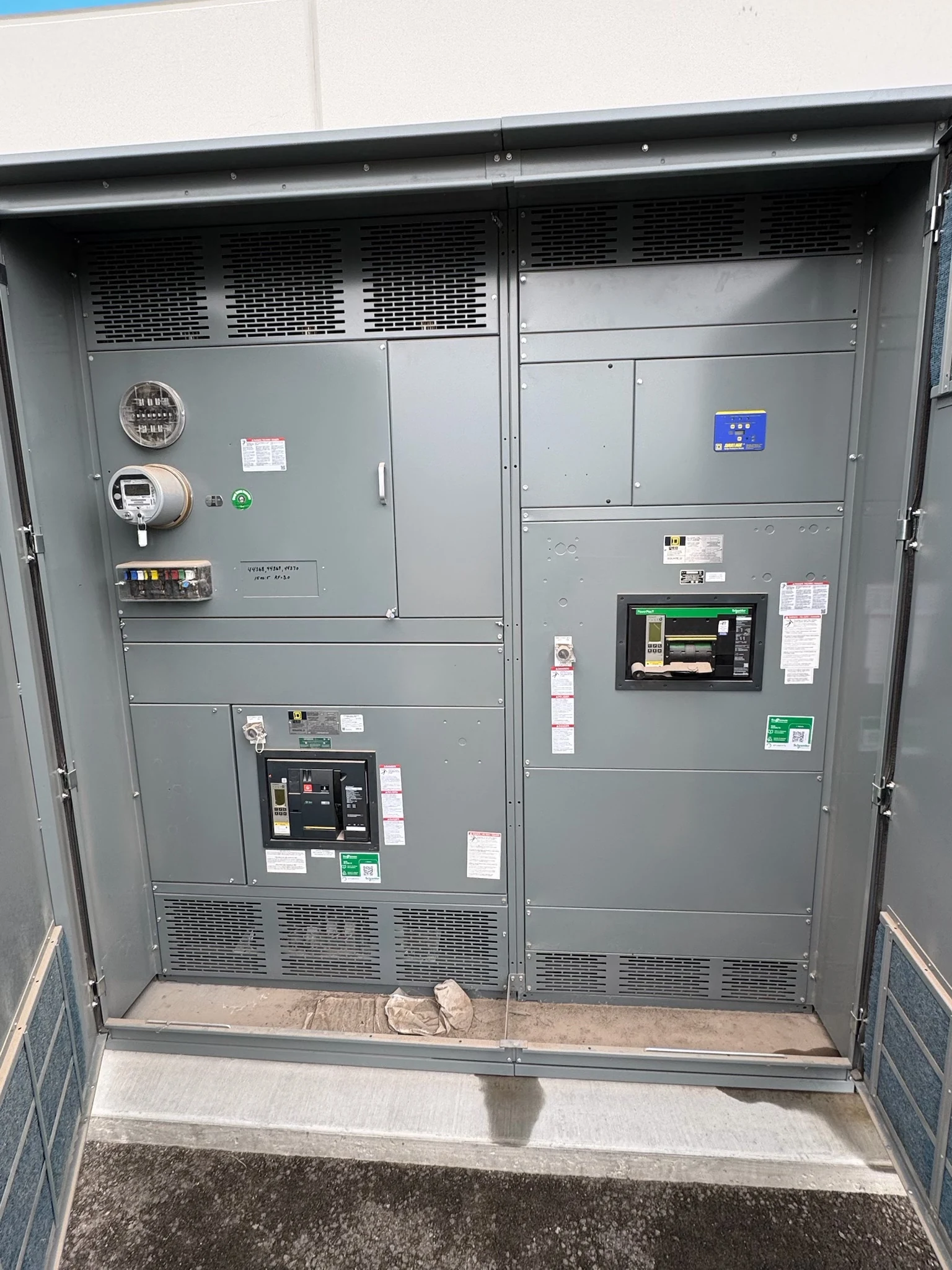
A service entrance at an electric utility facility is more than the point where power arrives. It is also an operating boundary between the supplying system, revenue metering, protective devices and the facility’s own distribution. A new assembly for a control center, maintenance building or substation auxiliary load should reflect who owns each connection and who has authority over switching, testing and approvals.
Identify the service and its boundaries
Begin with a one-line diagram showing the source, transformer or service conductors, service disconnect, metering and downstream feeders. Identify the service point and the equipment on each side of it. Even when the same utility organization supplies and occupies the facility, its service, metering and operations groups may have different approval and access requirements.
Clarify whether the purchase covers a service switchboard, another form of switchgear or a coordinated group of assemblies. A facility’s station service should not automatically be treated as the utility’s primary distribution switching equipment. The system voltage, required switching duty and governing specifications determine which construction is suitable; availability and feasibility need engineering review.
Collect the electrical design basis
Provide the nominal voltage, phase and wire arrangement, grounding method, load schedule, demand assumptions and any planned additions. Describe conductor quantities and sizes, entry direction, transformer connections and available space. A utility operations building with communications and battery-charger loads may have different continuity and harmonic concerns from a maintenance shop with large motor loads.
Request documented available fault current at the intended connection and the assumptions behind it, including transformer and source contributions. The engineer must compare the prospective duty with the interrupting and withstand capabilities of the proposed devices and complete assembly. Ratings are selected as a coordinated system, not inferred from a feeder’s continuous current alone.
Separate utility metering from facility monitoring
Revenue metering and internal power monitoring often serve different purposes. Confirm the supplying utility’s requirements for meter sockets or cabinets, instrument transformers, ratios, accuracy, wiring, sealing and access. Establish who furnishes each device and who approves its placement. The utility may require specific arrangements that cannot be decided from a generic equipment drawing.
For the facility’s own meters, define measured quantities, communications protocol, network connection, data ownership and the intended building or supervisory system interface. Separate terminal blocks and clearly identified wiring can make responsibility easier to trace. The design team should confirm whether instrument-transformer circuits, burdens and physical space support the specified metering and protection functions.
Coordinate protection and operating authority
The service disconnect and downstream devices need a protection philosophy that considers upstream utility protection as well as feeder requirements. Provide fault-study data, protective-device characteristics and any continuity objectives to the engineer responsible for coordination. Selectivity can depend on fault magnitude and available settings; a proposal should not assume complete coordination without a study.
Document which organization owns settings, approves changes and directs switching. If alternate sources or a tie are planned, define permitted operating states, interlocks, control power and the treatment of an unintended parallel connection. Remote indications or controls also need an agreed point list and an explicit division between local authority and supervisory commands.
Turn the design into a comparable purchase
Ask the direct manufacturer for a proposal based on the one-line, equipment schedule, environmental conditions and applicable utility standards. Compare included main and feeder devices, metering provisions, enclosure, cable termination space, spare capacity and shipping sections. Indoor room access and outdoor exposure can change the footprint, ventilation and maintenance arrangements substantially.
Request elevations, connection details, a device schedule and a written list of exceptions for review. Identify required codes, standards and any listing before award; UL 891 may be relevant to an appropriate switchboard, but the actual assembly and listing scope must be verified. Define responsibility for foundations, field conductors, settings, installation and site acceptance rather than leaving gaps between contracts.
Plan approvals, delivery and turnover
Build the schedule around utility design review, manufacturer submittal approval, component procurement, fabrication, agreed factory tests and delivery. Reserve time for revisions and any witness or inspection requirements. For an occupied utility facility, coordinate outage windows and temporary supply decisions with the owner and supplying utility; an unapproved interface can delay the entire sequence.
Before handover, agree on test records, final drawings, device documentation, settings records and any outstanding punch-list items. Qualified personnel should perform installation, inspection and commissioning under the owner’s safety procedures and applicable requirements. Energization should follow the responsible parties’ authorization and acceptance process, not merely the arrival of equipment at the site.
LET'S BUILD SOMETHING RELIABLE — 03
Ready to talk
switchgear?
Tell us about the new equipment your project needs. Include as much or as little detail as you have today.
(951) 403-5738CALL TO DISCUSS YOUR PROJECT