
BUILT IN THE USA. READY FOR YOUR PROJECT.
Electrical Switchboards for Electric Utilities
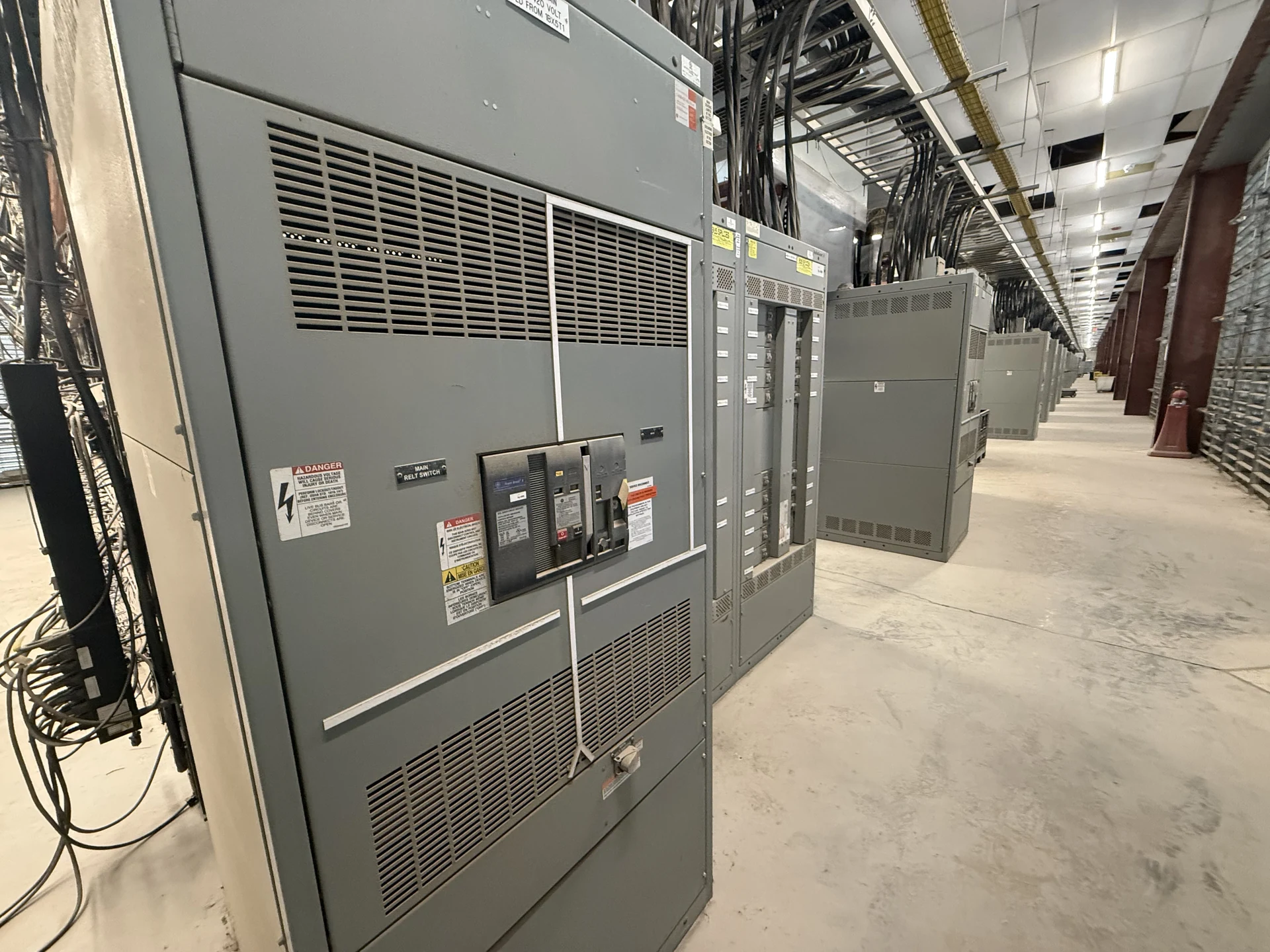
An electric utility may need a low-voltage switchboard to distribute power within a substation building, operations center, or other facility.
DIRECT FROM THE MANUFACTURER / NEW EQUIPMENT
THE MANUFACTURER’S PERSPECTIVE — 02
An electric utility may need a low-voltage switchboard to distribute power within a substation building, operations center, or other facility. The assembly must serve its own loads while fitting the utility’s protection, metering, and operating practices. Owners and specifiers can purchase a newly manufactured board directly from the manufacturer, with its configuration developed around documented project conditions.
Start with the facility distribution boundary
A switchboard distributes incoming power to feeders; it is not automatically a substitute for equipment specified for the utility’s distribution network. A substation auxiliary-power board, for example, may supply building services, battery chargers, and control equipment. Identify which loads require continuity, which can tolerate an outage, and whether another source serves critical circuits.
Provide a current one-line, load and feeder schedules, system voltage, phase and wire configuration, and the service or transformer connection details. Identify normal and alternate sources, expected demand, future circuits, and whether the board is service equipment or downstream distribution. These inputs determine the configuration to review, rather than treating every utility facility as having the same service arrangement.
Agree on the service and metering interface
Define the boundary between the entity supplying power and the facility owner; in some projects those roles sit within the same utility organization. Obtain the applicable service requirements and approval process for the actual site. Show responsibility for the incoming conductors, termination space, disconnect, grounding and bonding connections, and any compartments requiring controlled access.
Revenue metering and internal power monitoring can have different owners and requirements. Specify who supplies the meter and instrument transformers, their intended ratios and accuracy, the available mounting space, test provisions, and sealing arrangements where required. Confirm metering drawings with the responsible utility group before releasing the layout; a monitoring meter alone does not establish revenue-metering acceptance.
Match protection to each operating state
Provide available fault-current information at the board for credible source and tie configurations, along with upstream device characteristics and proposed feeder protection. The engineer must evaluate device interrupting ratings and the assembly’s short-circuit rating for the actual application. A protective device with an adequate individual rating does not by itself establish the suitability of the complete assembly.
Compare breaker and fused-switch arrangements against the facility’s protection philosophy, coordination objectives, maintenance approach, and space constraints. If alternate sources or a bus tie are planned, specify interlocking and permitted source combinations. The owner’s qualified protection engineer establishes settings and studies coordination; the manufacturer needs the resulting requirements to finalize compatible devices and interfaces.
Specify indications, controls, and authority
An operations center may want feeder status, alarms, and measured values at a supervisory system, while a small auxiliary board may need only local indication. Identify the points, signal types, communications protocol, control-power source, and terminal boundaries. Include meter and communications power requirements and state what happens when control power or communications are lost.
For any remote switching request, document who has command authority, required permissives, local-versus-remote selection, and interlocks. Agree on network and cybersecurity requirements with the utility’s responsible team. A point list and functional narrative give the manufacturer and integrator a common basis for testing; operating procedures and field switching remain the owner’s responsibility.
Balance enclosure, access, and expansion
Room dimensions alone are not enough. Supply cable entry direction, conductor sizes and quantities, termination requirements, door and delivery-route dimensions, and the available working and service clearances. Coordinate equipment heat rejection with the building design. Outdoor or harsh locations also require an enclosure and finish suited to the documented exposure, plus a plan for condensation management where needed.
For anticipated growth, compare an installed spare feeder with a prepared space or a future section. Each choice affects initial scope, footprint, bus capacity, and the work needed later. The engineer should verify that the selected provisions support the expected future load and fault duty; an empty compartment does not automatically provide usable electrical capacity.
Purchase against a defined review and test plan
Ask the manufacturer for a proposal that identifies the one-line, device schedule, ratings, enclosure, metering provisions, interfaces, and deviations from the specification. Where a switchboard listing is required, identify the applicable standard, such as UL 891 when appropriate, and verify the proposed assembly’s listing and scope for the project. Listing does not replace local approval or the system study.
Set milestones for drawing review, equipment release, factory inspection, delivery, and owner-led commissioning; component availability and revisions can change the schedule. Define factory test scope and acceptance criteria, witness requirements, and delivery of drawings, manuals, and test records. Assign installation, field testing, settings, and energization authorization to qualified parties under the site’s electrical safety procedures.
LET'S BUILD SOMETHING RELIABLE — 03
Ready to talk
switchgear?
Tell us about the new equipment your project needs. Include as much or as little detail as you have today.
(951) 403-5738CALL TO DISCUSS YOUR PROJECT