
BUILT IN THE USA. READY FOR YOUR PROJECT.
120/240V Switchgear: Procurement and Submittal Checklist
A 120/240V label is a starting point, not a complete purchase specification.
DIRECT FROM THE MANUFACTURER / NEW EQUIPMENT
THE MANUFACTURER’S PERSPECTIVE — 02
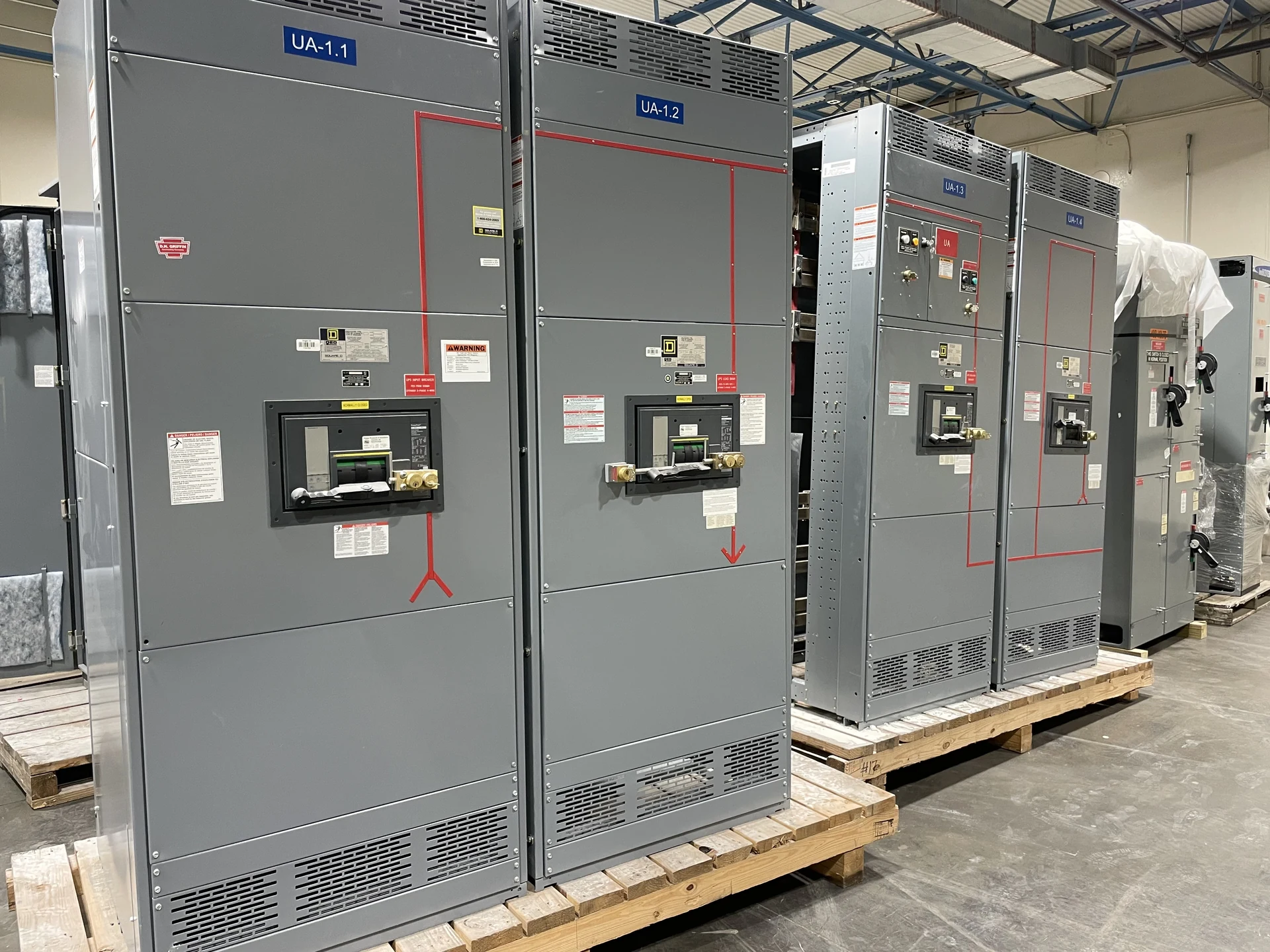
A 120/240V label is a starting point, not a complete purchase specification. An owner, contractor, or engineer requesting a new distribution assembly needs to describe the source, loads, fault duty, physical interfaces, and required approvals. A disciplined quote package helps the manufacturer identify whether a proposed design is suitable before the project commits to drawings, components, and a delivery sequence.
Define the system behind the voltage
Send a current one-line diagram showing the utility or transformer source, disconnects, grounding arrangement, and all proposed feeders. State the nominal voltage, phase and wire configuration, frequency, and whether the assembly is service equipment or downstream distribution. Identify missing data rather than letting the quotation rely on assumptions that may later change.
A single-phase, three-wire system and a three-phase, four-wire high-leg delta system are not interchangeable just because both may be described as 120/240V. Identify the high leg where applicable and document line-to-line and line-to-ground voltages. The engineer and utility should confirm the actual configuration and any service-specific requirements.
Request a coordinated electrical design
Include a load schedule with present demand, planned additions, motor starting conditions where relevant, and feeder quantities and sizes. Identify neutral loads, including nonlinear loads, so the engineer can evaluate neutral capacity and terminations. Specify spare feeder spaces or installed devices separately: they offer different degrees of readiness and may change the enclosure and cost.
Ask the manufacturer to identify the proposed assembly voltage and continuous-current ratings and the insulation and component suitability for the stated system. A device with a slash voltage marking needs review against the grounding configuration and maximum voltage to ground; a high-leg system makes that distinction particularly important. Availability at any named rating requires project-specific confirmation.
Provide fault and protection information
Supply the available short-circuit current at the proposed connection point, the source and date of that information, and any anticipated changes. Include upstream protective device details and the intended downstream devices. The engineer needs these inputs to evaluate interrupting duty, assembly short-circuit rating, and protection coordination; continuous-current capacity alone does not establish fault suitability.
Request device schedules, ratings, trip functions, and any assumptions or proposed series-rated combinations for engineering review. A series combination should not be inferred from individual component ratings; its suitability and acceptance must be verified for the actual application. Clarify who prepares the coordination study and who determines and documents final protective settings.
Describe the installation interfaces
Provide room or pad drawings, maximum shipping dimensions, access routes, and the intended indoor or outdoor environment. Show top or bottom cable entry, conduit space, conductor quantities and material, and the locations of adjacent equipment. These details affect section dimensions, termination arrangements, installation access, and the feasibility of bringing the lineup into the site.
For a service assembly, obtain utility metering requirements, meter or current-transformer provisions, sealing access, and the division of ownership before design approval. Identify the grounding and bonding interfaces on the drawings and specify who supplies conductors, lugs, supports, and field connections. The engineer and installer must verify required working space and applicable local approvals.
Set submittal and acceptance expectations
Ask for a submittal package that shows a one-line, elevations, dimensions, device and rating schedules, terminal details, enclosure designation, and shipping sections. Control diagrams, meter communications information, and a point list are useful when the assembly has monitoring or controls. Compare those documents to the quote and record every exception for disposition.
Specify the applicable equipment standard and listing requirements by assembly type. UL 891 may be relevant to a specified switchboard, but it is not a blanket listing for all switchgear; confirm the proposed assembly’s actual listing and scope. Agree on factory inspection or testing, witness needs, acceptance criteria, and the records to be delivered.
Close scope gaps before ordering
Compare quotations on the same boundaries: engineering, equipment, metering, freight, field assembly, commissioning support, and documentation. Note whether requested components or US-made sourcing requirements have been confirmed, and review alternatives rather than assuming equivalence. Reserve a register for open questions, drawing revisions, approvals, and changes affecting cost or equipment suitability.
Build the schedule around release of complete design information, utility review, submittal approval, component availability, fabrication, testing, and transportation. Assign dates and decision owners without treating an estimate as a guarantee. Installation, verification, protective settings, and energization belong to qualified personnel following the approved project design, site procedures, applicable codes, and manufacturer instructions.
LET'S BUILD SOMETHING RELIABLE — 03
Ready to talk
switchgear?
Tell us about the new equipment your project needs. Include as much or as little detail as you have today.
(951) 403-5738CALL TO DISCUSS YOUR PROJECT