
BUILT IN THE USA. READY FOR YOUR PROJECT.
1,600-Amp Switchgear: Protection and Fault-Duty Review
A 1,600-ampere designation describes a nominal continuous-current class, not the amount of fault current an assembly can safely withstand or interrupt.
DIRECT FROM THE MANUFACTURER / NEW EQUIPMENT
THE MANUFACTURER’S PERSPECTIVE — 02
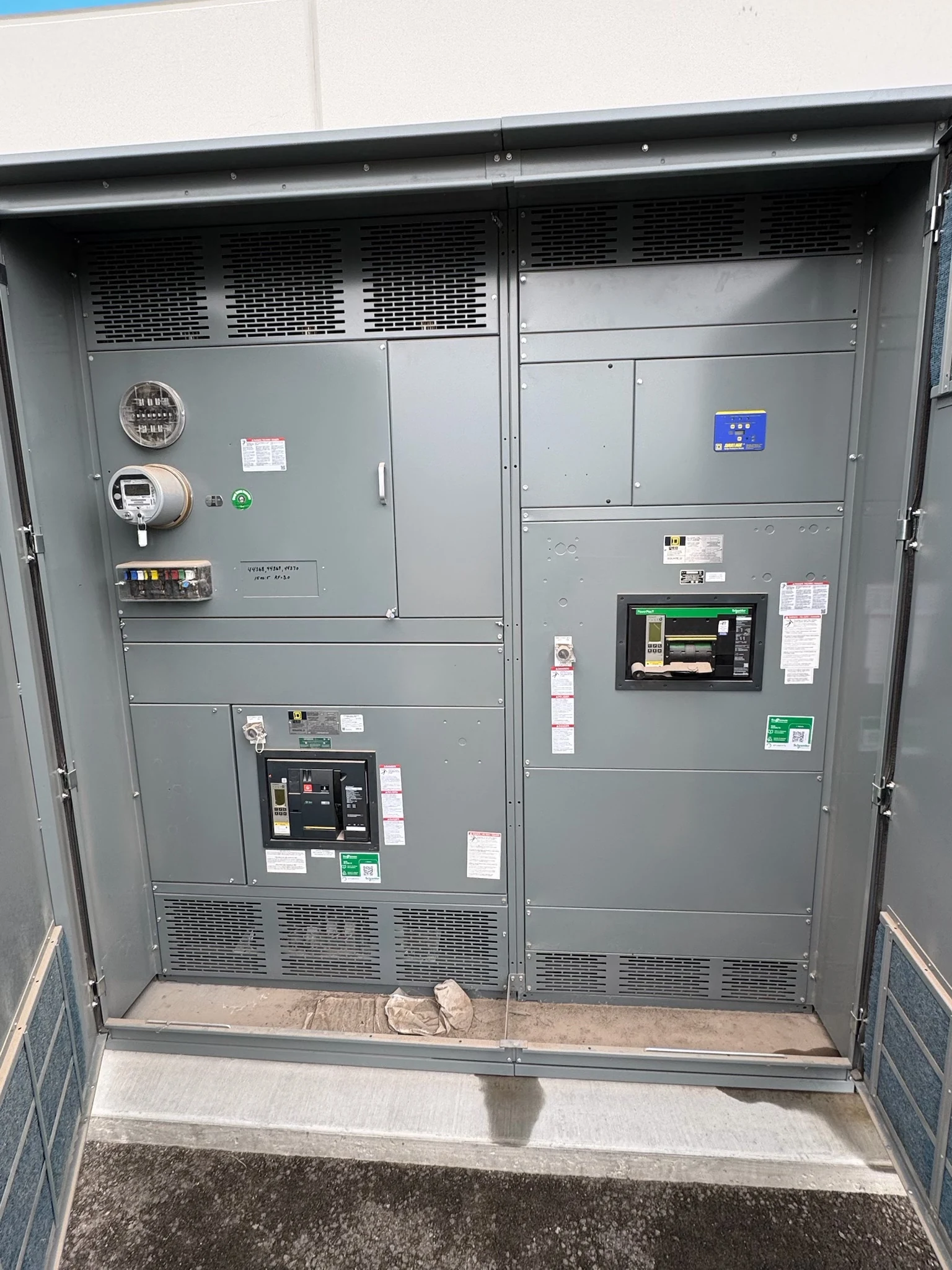
A 1,600-ampere designation describes a nominal continuous-current class, not the amount of fault current an assembly can safely withstand or interrupt. Engineers, contractors and owners planning a new distribution lineup should evaluate those separate duties together. The direct manufacturer can then review the proposed construction and device options against the actual system and project requirements; availability at this current class is not assumed.
Separate load capacity from protective duty
Start with a load schedule and one-line showing the main, feeder circuits and expected operating configurations. A main bus specified at 1,600 amperes does not mean every feeder or protective device has that continuous-current rating. Device frames, trip ratings, bus connections and conductor terminations must suit their individual circuits and the complete assembly.
Provide demand assumptions, anticipated expansion, ambient conditions and any unusual operating duty. The engineer should check the applicable equipment ratings and installation conditions rather than assuming a catalog number alone establishes usable capacity. Temperature, enclosure arrangement and the selected devices can influence the design and require manufacturer review.
Establish available fault current at the lineup
Ask the utility or supplying system owner for fault information at the relevant source connection, including the basis and anticipated changes. The study engineer also needs transformer impedance and capacity, conductor lengths and sizes, and the arrangement of motors, generators or other sources that may contribute. Calculate duty at the equipment location, not just at the utility point.
Review both maximum and minimum credible fault conditions and operating modes. For example, an alternate source or a closed tie can change fault magnitude and the timing of protective operation. Document assumptions about source strength, system voltage and the X/R ratio so the equipment evaluation and future updates use a consistent basis.
Match interruption and assembly withstand
A protective device must be appropriate for the circuit voltage and available interrupting duty; its ampere trip rating is a different selection. The assembly also needs an appropriate short-circuit rating for its configuration. Where a time-dependent withstand rating applies, the study must consider the current and duration the equipment may experience before a fault is cleared.
Compare the study results with manufacturer documentation for the specific device and assembly combination, including any conditions or limits attached to the rating. Current-limiting devices or a series-rated arrangement may be considered only where the proposed combination is specifically recognized for the application and accepted by the engineer and authority having jurisdiction. Do not infer an assembly rating from one breaker alone.
Balance coordination with fault-clearing time
Selective coordination seeks to have the protective device nearest a fault operate before upstream protection, limiting the outage to the affected circuit. The engineer compares time-current curves and device characteristics over the applicable current range. A main and feeder can coordinate at lower fault levels yet overlap at higher currents, especially when instantaneous functions operate.
Delaying upstream operation may improve coordination but can increase fault duration and affect equipment withstand and arc-flash exposure. Conversely, faster clearing can reduce exposure while making a wider outage more likely. The owner should identify critical loads and continuity priorities; the protection and arc-flash studies should resolve the tradeoff rather than presume either objective is automatically achieved.
Coordinate ground-fault and source interfaces
Describe the grounding arrangement, neutral connections and source transfer or tie configurations in the one-line. If ground-fault protection is required or requested, the engineer must coordinate its sensing method and settings with the actual neutral and grounding design and downstream devices. Incorrect assumptions about those interfaces can undermine the intended protection or coordination.
Clarify who supplies relays, current sensors, control power, trip connections and any interlocks. With utility and generator sources, identify operating states, protective responsibilities and communication points at each boundary. The manufacturer can incorporate agreed interfaces into the new assembly drawings, while the engineer of record and source suppliers resolve system-level protection and compatibility.
Buy against a documented protection scope
For a meaningful quotation, provide the latest one-line, load schedule, fault study or source data, device preferences, physical constraints and required protection functions. Request a device schedule, assembly ratings, drawings and a clear list of exceptions. Identify the applicable equipment standard and verify any listing for the specific proposed construction; UL 891 is relevant to appropriate switchboard assemblies, not automatically to every switchgear product.
Agree on responsibility for the coordination and arc-flash studies, final settings, factory checks, field testing and energization authorization. Build the schedule around data collection, drawing review, component availability, approved changes and site outage windows rather than an assumed lead time. Qualified electrical personnel should perform installation, testing and commissioning under the applicable safety procedures, using approved settings and project documentation.
LET'S BUILD SOMETHING RELIABLE — 03
Ready to talk
switchgear?
Tell us about the new equipment your project needs. Include as much or as little detail as you have today.
(951) 403-5738CALL TO DISCUSS YOUR PROJECT