
BUILT IN THE USA. READY FOR YOUR PROJECT.
Motor Control Centers
A motor control center (MCC) groups motor starters, protective devices and associated controls in an organized assembly.
DIRECT FROM THE MANUFACTURER / NEW EQUIPMENT
THE MANUFACTURER’S PERSPECTIVE — 02
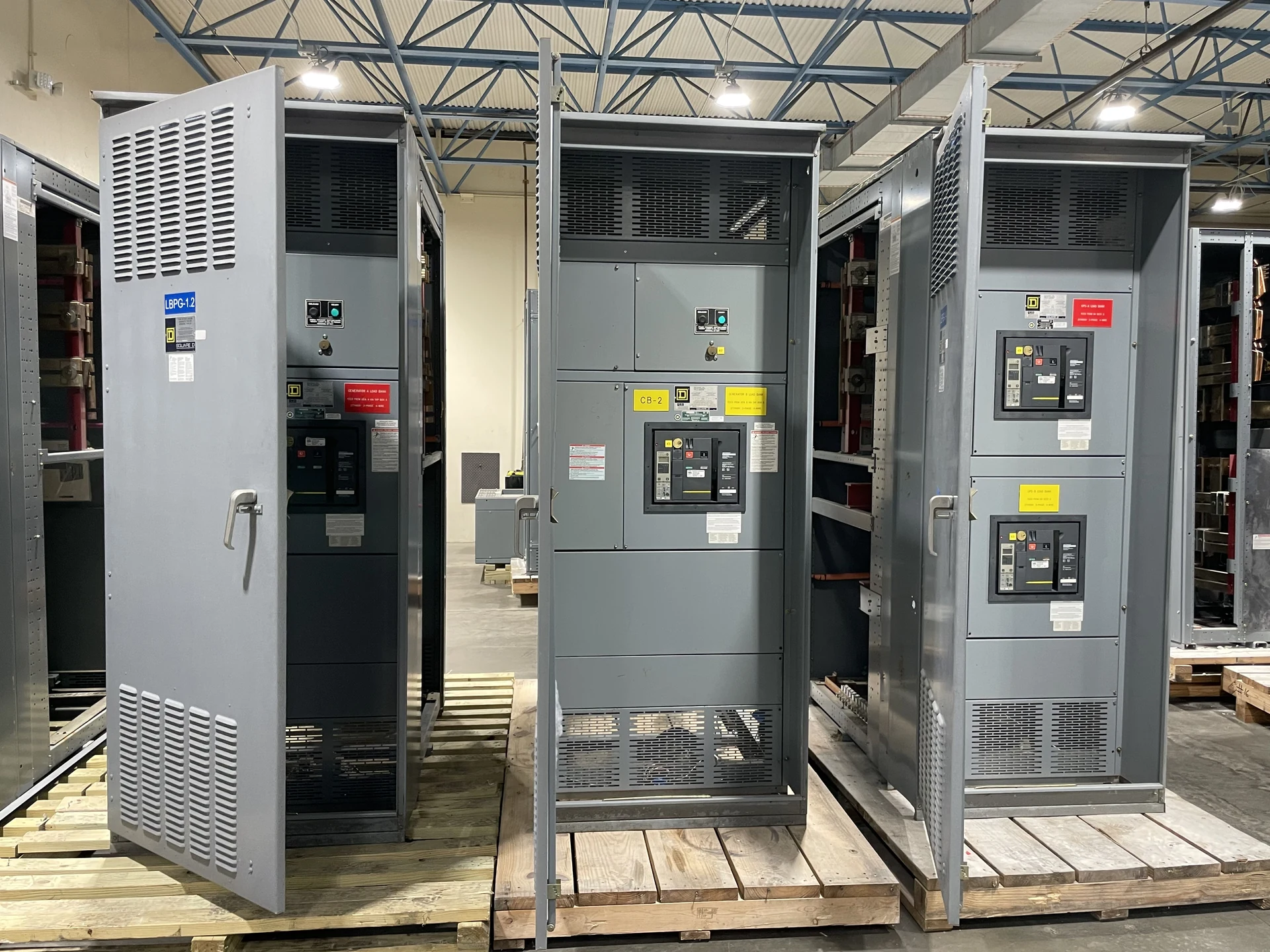
A motor control center (MCC) groups motor starters, protective devices and associated controls in an organized assembly. For engineers, contractors and facility owners, the buying decision begins with how each motor must start, stop and communicate—not simply how many motors fit in a row. A well-defined load schedule and operating philosophy help a manufacturer design a new lineup around the actual process and installation.
Decide what belongs in the lineup
An MCC brings multiple motor circuits together, often in individual units fed from a common bus. It can serve pumps, fans, conveyors or other process loads while putting their controls in a consistent location. Unlike general distribution switchgear, its central purpose includes the control and protection of individual motors, not just feeder switching.
Start with a one-line diagram showing the source, upstream protection, motor circuits and any non-motor loads. Identify circuits that must remain independent and future loads that are reasonably planned. Grouping simplifies coordination at one location, but a common supply can also concentrate the consequences of an outage; the engineer should assess continuity requirements.
Build a useful motor schedule
For each motor, provide its tag, horsepower, nameplate full-load current, system voltage and phase, duty, starting frequency and driven equipment. Note starting torque or acceleration concerns, reversing requirements and whether the load can start across the line. These details guide selection of starters and protective devices rather than treating every unit as interchangeable.
A variable-frequency drive may provide speed control and gentler acceleration where the process needs them, but it adds heat, controls and power-quality considerations. Identify motor cable lengths, control objectives and any harmonic limits early. The design team should evaluate drive placement, ventilation, grounding and filtering against the selected devices and project requirements.
Match protection to the power system
Give the manufacturer the available fault current at the MCC location, source and transformer data, and applicable project protection criteria. Device interrupting capabilities and the short-circuit current rating of the complete assembly must be suitable for the system. A motor overload device and branch-circuit short-circuit protection perform different functions and must be coordinated.
Ask the engineer to review upstream and downstream protection together, including motor starting characteristics and any selective-coordination objective. A proposed device combination should be evaluated as part of the assembly, not merely by comparing individual nameplate numbers. The final settings and any required studies remain project-specific responsibilities to assign in the purchase documents.
Define the controls and communication boundary
Describe which commands originate locally and which come from a programmable controller or plant system. A point list can identify run commands, status, overload indication, faults, permissives and any required analog signals. State the control power source, terminal interfaces and who supplies field wiring, network hardware and programming.
Networked monitoring can reduce individual signal wiring and provide richer diagnostics, while hardwired signals may be simpler for some interfaces. Neither choice resolves the operating sequence by itself. Document behavior after loss or restoration of control power, command priority and safety-related functions; the responsible engineer must verify the complete control architecture.
Fit the enclosure to the installation
Provide room dimensions, access routes, cable entry direction and the intended indoor or outdoor environment. Ambient conditions, dust, moisture, corrosion and heat removal influence enclosure and component choices. The contractor and engineer should check working clearances, ventilation, anchorage, cable bending space and the path for delivering each shipping section.
Reserve space for expected growth deliberately: an empty compartment is useful only if the bus, supply and physical arrangement can support a later addition. Compare spare installed units with prepared spaces, accounting for present expenditure, future work and component availability. Confirm the proposed construction and expansion provisions with the manufacturer.
Buy against a defined scope and handoff
Request a proposal identifying the unit schedule, protective devices, control interfaces, enclosure, ratings, exceptions and applicable listing requirements. Ask for drawings showing elevations, one-line, wiring and terminal points, along with inspection or factory test scope and acceptance criteria. If domestic component origin is specified, identify the requirement and verify sourcing and availability.
Coordinate drawing approval, component procurement, fabrication, testing, shipment and site readiness as linked schedule milestones, rather than assuming a fixed lead time. Assign responsibility for unloading, installation, field connections, programming, studies and commissioning. Qualified electrical personnel must plan and perform site work under applicable codes, site safety procedures and manufacturer instructions.
LET'S BUILD SOMETHING RELIABLE — 03
Ready to talk
switchgear?
Tell us about the new equipment your project needs. Include as much or as little detail as you have today.
(951) 403-5738CALL TO DISCUSS YOUR PROJECT