
BUILT IN THE USA. READY FOR YOUR PROJECT.
Fused Switches in Distribution
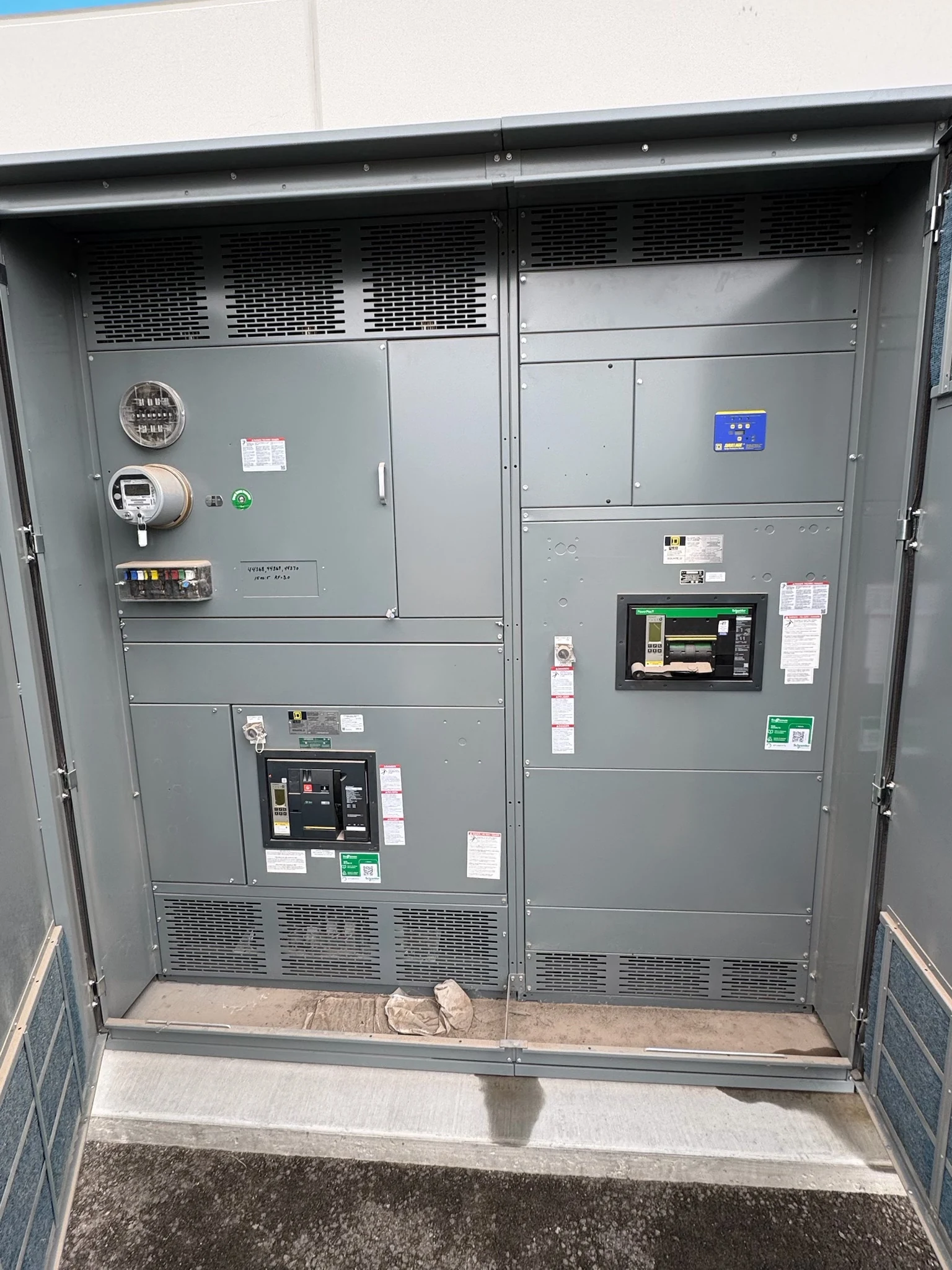
A fused switch combines a switching device with replaceable fuses, offering a way to disconnect and protect a distribution circuit when the complete assembly is appropriately selected.
DIRECT FROM THE MANUFACTURER / NEW EQUIPMENT
THE MANUFACTURER’S PERSPECTIVE — 02
A fused switch combines a switching device with replaceable fuses, offering a way to disconnect and protect a distribution circuit when the complete assembly is appropriately selected. For specifying engineers, contractors and owners, the important decision is not simply whether to use fuses: it is how the switch, fuse, available fault current and downstream loads work together.
Start with the circuit and switching duty
Identify the source, system voltage and frequency, phase and wire configuration, load type, and expected continuous and operating currents. A feeder serving a transformer or motors can have temporary energizing or starting current that differs from normal running demand. The engineer evaluates those characteristics against protection requirements rather than choosing a fuse solely by the load nameplate.
The switch must also be suitable for the intended voltage, current, number of poles and duty, including load switching where required. Check termination capacity, conductor arrangement and any service-entrance requirements. A fuse provides overcurrent protection; the switch provides its specified switching or disconnect function. Neither component alone establishes the suitability of the complete assembly.
Match fuse class to the application
Fuse classes have defined physical and performance characteristics, but individual products can differ in time-current response and application. For example, a design may consider Class J, Class RK or Class T fuses, subject to the switch manufacturer’s approved fuse provisions. Compare voltage and AC or DC suitability, current rating, interrupting rating and manufacturer data before selecting a specific part.
Time-delay characteristics can help accommodate normal motor starting or transformer energization while providing protection within the engineered design. A faster-acting choice may fit a different load, but is not automatically better coordination. Fuseholder compatibility, rejection features and available replacement stock matter; a physically fitting fuse is not proof that it is an approved substitute.
Check fault current at the actual location
Ask the utility and project engineer for the available short-circuit current at the proposed equipment, including assumptions about transformers, conductors, motors and alternate sources. A fuse’s interrupting rating must be adequate for the available fault duty at its location. Confirm that the switch and complete assembly also have a suitable short-circuit current rating for the specified configuration.
Some fuses limit the energy and peak current passed during certain high-current faults, but the benefit depends on the actual fault and the tested combination. Do not infer an assembly rating from the fuse rating alone. Any series or combination rating should be documented for the exact devices and arrangement, then checked against project requirements.
Coordinate protection across the system
A coordination study compares the fuse’s manufacturer-provided time-current curves with upstream and downstream protective devices across the relevant fault-current range. The goal may be to isolate the affected feeder while preserving power elsewhere. Achieving that outcome depends on device characteristics and the actual system; adjacent fuse ratings or a single ratio do not establish coordination by themselves.
Consider both normal and alternate-source conditions because generator fault contribution can differ from utility supply. Where selective coordination is required by the project or applicable rules, obtain the study and resolve exceptions before purchasing. Arc-flash analysis is a separate qualified assessment; using a current-limiting fuse does not by itself guarantee a particular incident-energy result.
Plan maintenance without assuming live access
A cleared fuse must be replaced with an approved equivalent, so owners should plan compatible spares, identification and storage. On a three-phase circuit, a single operated fuse can leave an unacceptable operating condition for some loads. Discuss phase-loss detection, indication or other protective measures with the engineer according to the equipment and consequences of interruption.
Provide room for safe access and consider the effect of shutting down each feeder for inspection or replacement. Qualified electrical personnel should plan isolation, verification and maintenance under site procedures, applicable requirements and manufacturer instructions. The documentation should identify fuse classes and catalog information as well as the intended limits of switching and access.
Specify the package and project handoff
For a direct manufacturing inquiry, provide a one-line diagram, load and feeder schedule, fault-current study or source data, enclosure environment, cable entry, space constraints and required spare provisions. Identify fuse class preferences, coordination objectives and any required listing. If the project calls for a UL 891 switchboard, verify that the proposed assembly’s project-specific listing and configuration cover the intended use.
Request drawings showing switch and fuse details, ratings, terminations and deviations, plus applicable test records and maintenance information. Agree on who supplies initial and spare fuses, completes the coordination study, installs field wiring and performs commissioning. For projects in San Antonio, South Texas or nationwide, schedule procurement around drawing approval, component availability, installation windows and qualified-person turnover rather than an assumed lead time.
LET'S BUILD SOMETHING RELIABLE — 03
Ready to talk
switchgear?
Tell us about the new equipment your project needs. Include as much or as little detail as you have today.
(951) 403-5738CALL TO DISCUSS YOUR PROJECT