
BUILT IN THE USA. READY FOR YOUR PROJECT.
Main-Tie-Main Switchgear
A main-tie-main arrangement divides a distribution lineup into two bus sections, each with its own source connection and a breaker linking the sections.
DIRECT FROM THE MANUFACTURER / NEW EQUIPMENT
THE MANUFACTURER’S PERSPECTIVE — 02
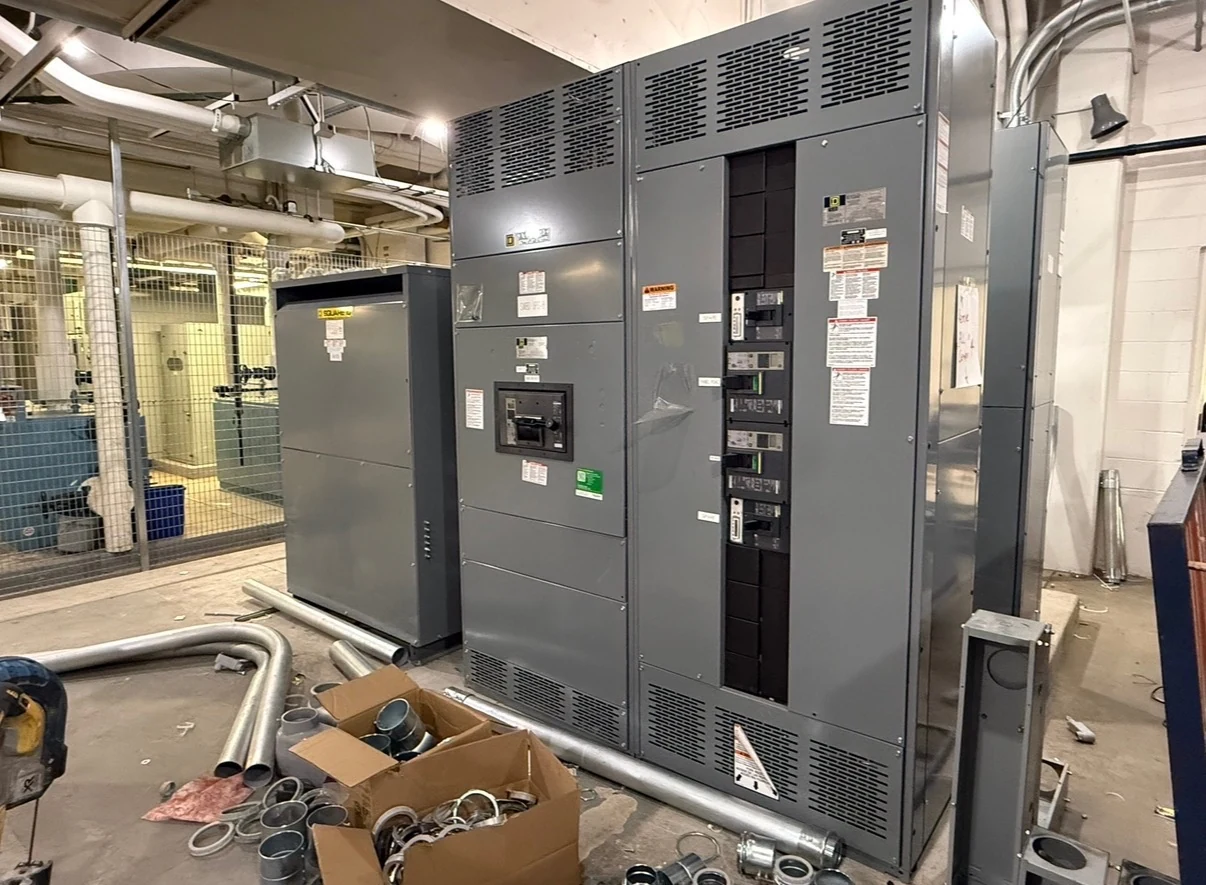
A main-tie-main arrangement divides a distribution lineup into two bus sections, each with its own source connection and a breaker linking the sections. It can support continuity and maintenance flexibility, but the tie does not create extra source capacity or make every transfer safe. Engineers, contractors and facility owners should agree on permitted operating states before selecting the equipment and its controls.
Define the states the facility actually needs
A common normal state has both main breakers closed and the tie open, so each source supplies its own section. Another intended state may have one main open and the tie closed, with the remaining source supplying both sections. A state table should show breaker positions, source availability, control mode and which loads remain energized.
Distinguish a planned maintenance transfer from a response to source failure. The controls and protection must address whether a source has disappeared or a bus fault is present; energizing a faulted section from the other side can make the incident worse. Decide whether transfer is manual or automatic and who authorizes restoration.
Check the duty on the remaining source
When the tie carries load across sections, one transformer, utility supply or other source may carry more demand than in normal operation. Give the engineer coincident demand, essential and deferrable loads, expected growth and any time limits on alternate-source operation. A single aggregate connected-load figure rarely captures the actual operating burden.
The review should consider the main and tie devices, bus sections, upstream source and cables together. Motor starting, voltage drop and a generator’s transient response may constrain transfer even when steady-state demand appears acceptable. If necessary, specify load shedding and its recovery logic rather than assuming both sections can remain fully served.
Make interlocks and control behavior explicit
If sources must not operate in parallel, a mechanical, electrical or combined interlocking scheme can restrict breaker combinations, such as preventing both mains and the tie from being closed simultaneously. The proposed scheme must cover local and remote commands as well as the actual breaker position feedback used to establish permissives.
Document the response to lost control power, failed position indication, unavailable source sensing and communications failure. If a project requires a momentary or sustained parallel state, it needs a separately engineered scheme, suitable protective and synchronization functions, and source-owner approval where applicable; ordinary interlocks alone do not establish permission to parallel.
Study protection for each source arrangement
Available fault current and current direction can change when a bus section is supplied through the tie. Provide source contribution, transformer impedance, grounding configuration and motor data to the study engineer. Evaluate relevant normal, alternate and, only if permitted, parallel configurations against device interrupting capability and assembly withstand duty.
Coordination studies should examine main, tie and feeder protection over the applicable fault range, including ground-fault behavior and the potential for reverse power flow. Identify instrument transformer locations and relay or trip-unit requirements early. The responsible engineer determines settings; the manufacturer needs the agreed requirements to integrate and test the specified functions.
Turn maintenance goals into physical requirements
Ask which section, device or control component must be accessible while other loads remain supplied. That objective affects section boundaries, barriers, breaker construction and the ability to isolate equipment. A tie does not by itself make work safe or eliminate the possibility that adjacent components remain energized.
Coordinate equipment footprint, ventilation, cable entry, shipping sections and working clearances with the building layout. Qualified personnel must plan isolation, verification and maintenance under site procedures and applicable electrical safety rules. The owner should also consider whether the desired outage strategy is realistic for connected loads and available temporary power.
Put the operating philosophy into the purchase
For a new custom assembly, provide a one-line diagram, load schedule, source and fault information, desired state table, control voltage, enclosure conditions and field connection details. State the applicable equipment standard and any required listing; verify the proposed assembly’s project-specific scope rather than treating a switchboard standard as universal for switchgear.
Ask the direct manufacturer to identify exceptions, drawings, breaker and protection schedules, interlock logic, terminal interfaces and factory test records in its proposal. Agree on functional test scenarios and who owns field wiring, settings, commissioning and operator training. Allow time for design review, component availability, testing and owner approvals before scheduling installation.
LET'S BUILD SOMETHING RELIABLE — 03
Ready to talk
switchgear?
Tell us about the new equipment your project needs. Include as much or as little detail as you have today.
(951) 403-5738CALL TO DISCUSS YOUR PROJECT