
BUILT IN THE USA. READY FOR YOUR PROJECT.
Low-Voltage Switchgear for Airports
Airport electrical distribution must support facilities that often operate around the clock while accommodating security, access and operational constraints.
DIRECT FROM THE MANUFACTURER / NEW EQUIPMENT
THE MANUFACTURER’S PERSPECTIVE — 02
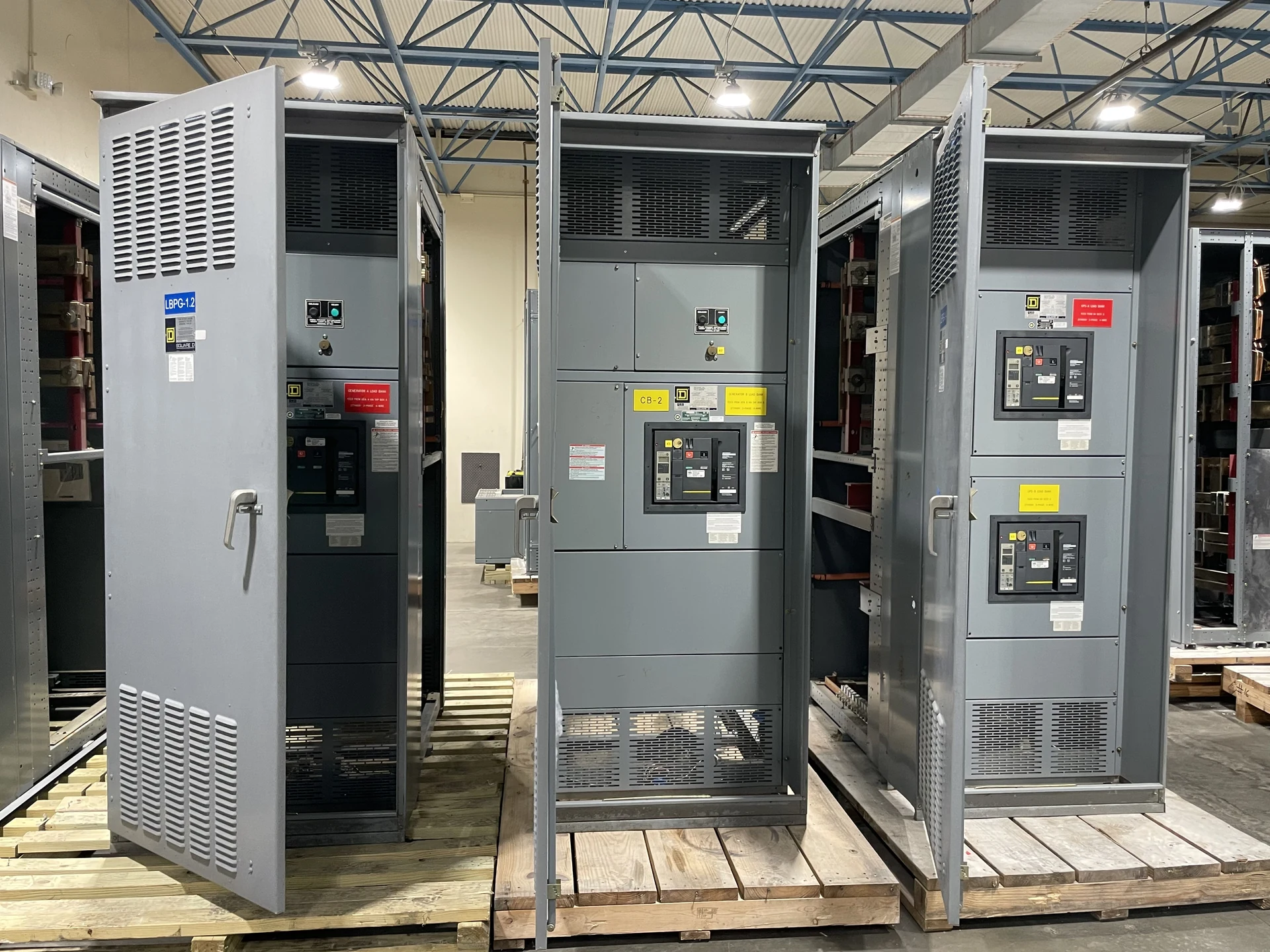
Airport electrical distribution must support facilities that often operate around the clock while accommodating security, access and operational constraints. Low-voltage power circuit breaker switchgear can provide a central point for protection and distribution where the design calls for it. For owners and specifiers, the important decision is not simply the lineup size: it is how the new assembly fits the airport’s sources, loads and construction plan.
Map the airport distribution boundaries
Begin with a current one-line diagram showing utility and transformer connections, source configurations and feeder destinations. Identify terminal systems such as baggage handling, passenger processing, ventilation and tenant distribution, along with any airfield facilities served through the proposed lineup. Record demand, planned growth and operating priorities rather than assuming every load has the same continuity requirement.
Some airfield lighting, navigation or other operational systems may be supplied or controlled through separate facilities or responsible entities. Establish the actual electrical and ownership boundary before assigning a feeder to the new switchgear. Provide circuit schedules, connection details and applicable airport or agency requirements so designers can coordinate interfaces without implying that the switchgear performs those specialized systems’ control functions.
Choose protection and breaker construction
Power circuit breakers and their trip functions should be selected against the project’s system voltage, current and available fault duty. The engineer should compare upstream and downstream protective devices across relevant operating conditions, including alternate-source operation. Selective coordination can limit the extent of an outage, but it depends on actual device characteristics and settings, not on breaker type alone.
Drawout construction may simplify certain maintenance and replacement activities, but it can require additional space and investment; fixed construction may suit a different maintenance strategy. Assess the assembly’s short-time withstand and breaker interrupting capability together with the protection study. Specify the applicable equipment standard, such as the relevant IEEE C37 series standard, and verify the proposed construction and any required certification for the project.
Define the standby power interface
Show which loads require an alternate source and where automatic transfer switches or other transfer equipment sit relative to the switchgear. Identify normal and generator source capacity, starting signals, load sequencing, control power and the intended behavior on source failure. The engineer must determine applicable requirements for emergency, legally required standby and optional standby loads; these categories are not interchangeable.
Where multiple sources or a bus tie are contemplated, document permitted operating states and interlocking requirements, including whether paralleling is intended and engineered. Generator fault contribution, neutral treatment and grounding arrangements affect protection and transfer decisions. Agree on responsibility for source controls and field integration so a gap between equipment suppliers does not become a commissioning surprise.
Fit the lineup to terminal and airfield routes
Provide room dimensions, equipment access paths, working clearances, cable entry direction and conductor quantities with the inquiry. A larger lineup or drawout breaker may affect doorways, lifting access and space for maintenance. The project team should also account for equipment heat, ventilation and the environmental conditions of the intended room or outdoor location.
Long routes between terminal distribution and remote airfield loads can influence voltage-drop calculations, feeder sizing and downstream protective-device selection. Show the proposed termination and conduit interfaces instead of treating the entire airport as a single electrical room. If status or metering data will reach an airport monitoring system, specify the point list, protocol, network boundary and responsible integration party.
Plan construction around airport operations
For an occupied facility, the owner and contractor should develop phases around approved outage windows, passenger activity, security restrictions and access to operational areas. Identify which feeders move in each phase, who approves interruptions and how affected airport stakeholders are notified. Construction sequencing must be coordinated with utility, airport operations and any other authority responsible for the affected systems.
If temporary power is needed, its source capacity, connection points, protection and transfer arrangements require an engineered plan and necessary approvals. Include hold points for readiness checks, functional verification and any return-to-service decision. Electrical isolation, testing, installation and energization belong to qualified personnel working under the site’s safety procedures; the equipment order alone cannot establish a safe outage plan.
Buy against a documented scope
A useful request to a direct manufacturer includes the one-line, load and feeder schedules, source and fault-current information, physical constraints, specifications and desired delivery sequence. Identify required drawings, review cycles, witness testing and records, and distinguish the factory scope from foundations, field cabling, settings and commissioning. The manufacturer serves projects in San Antonio, South Texas and nationwide with newly manufactured assemblies.
Compare quotations for breaker configuration, protective functions, spare capacity, interface details and explicit exceptions rather than price alone. Ask for submittals showing dimensions, connections and control schematics, plus agreed inspection and factory test documentation. Coordinate approval dates, component availability, shipping splits and site readiness as schedule dependencies; confirm the project-specific listing or certification and acceptance requirements before release.
LET'S BUILD SOMETHING RELIABLE — 03
Ready to talk
switchgear?
Tell us about the new equipment your project needs. Include as much or as little detail as you have today.
(951) 403-5738CALL TO DISCUSS YOUR PROJECT