
BUILT IN THE USA. READY FOR YOUR PROJECT.
Low-Voltage Switchgear for Military Bases
A military base may depend on one electrical distribution system to support facilities with very different missions and outage tolerances.
DIRECT FROM THE MANUFACTURER / NEW EQUIPMENT
THE MANUFACTURER’S PERSPECTIVE — 02
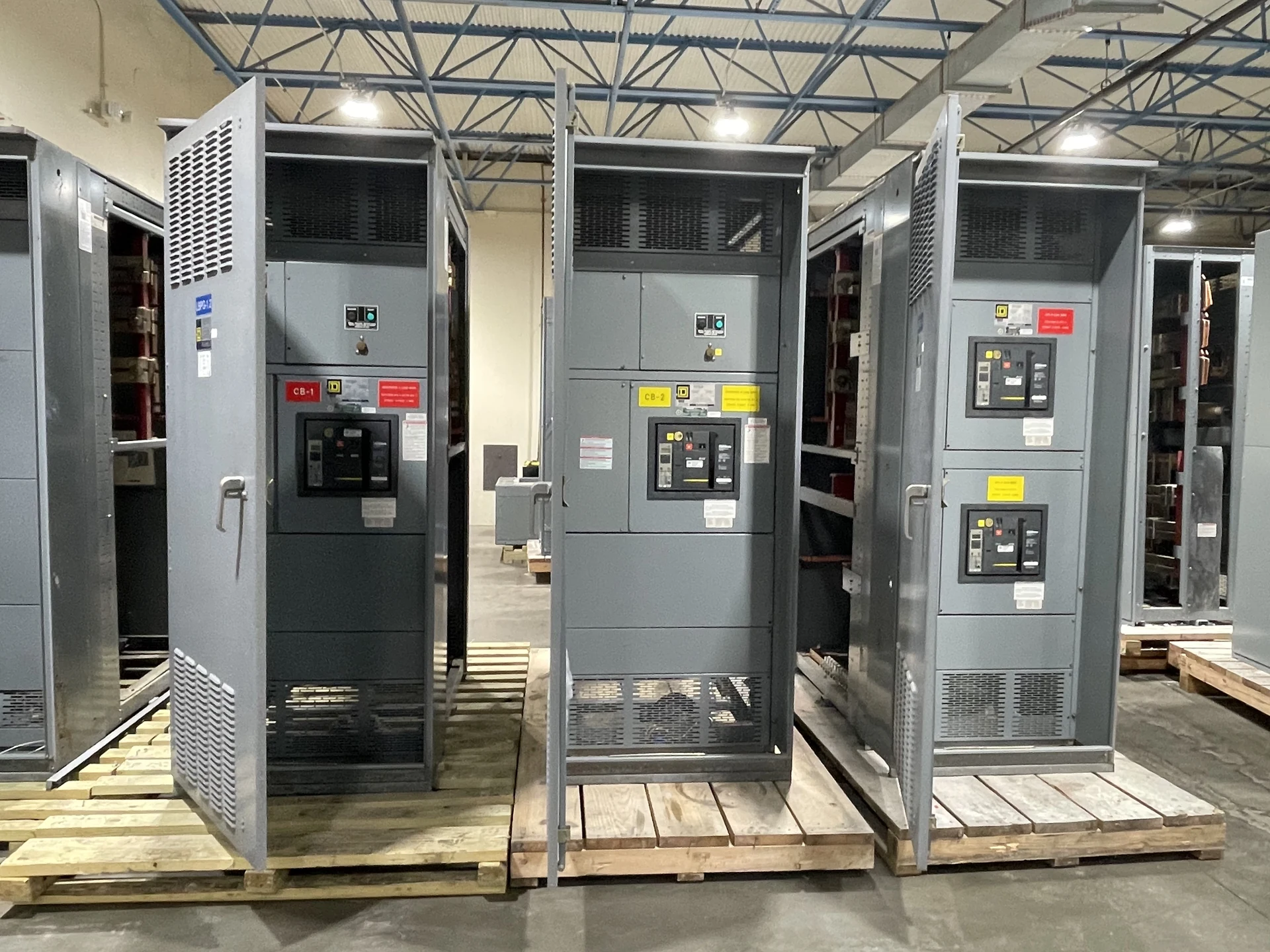
A military base may depend on one electrical distribution system to support facilities with very different missions and outage tolerances. As a direct American manufacturer of new switchgear and power-distribution assemblies serving San Antonio, South Texas, and nationwide, we start with the project requirements rather than assuming every installation needs the same arrangement. Owners and specifiers should establish continuity priorities before selecting low-voltage power circuit breaker switchgear.
Map loads to mission priorities
Begin with a current one-line diagram and a feeder schedule identifying each served facility, its present and anticipated demand, and its operational importance. Communications, security, housing and maintenance functions may have different restoration priorities. The owner should define which loads require alternate power, permissible outage durations and any restrictions on interrupting shared infrastructure.
Add the service configuration, system voltage and phase, grounding arrangement, transformer data, and available fault-current information at the proposed equipment. Include major motor starting and nonlinear loads where relevant. These inputs let the design team assess the assembly and feeder ratings rather than extrapolating from a building name or a single connected-load total.
Choose a source arrangement deliberately
A single main with feeders may suit a facility with an acceptable outage window, while a main-tie-main arrangement can offer different ways to distribute power between sections. The latter adds devices, controls, space and coordination work. Separate sources do not automatically provide full redundancy: each source and its associated path must be evaluated against the loads it is expected to support.
Document allowed operating states, transfer responsibilities and whether sources may ever operate in parallel. Coordinate interlocks, generator controls and any separate automatic transfer equipment with the owner’s operating philosophy. For maintainability, compare fixed and drawout breakers against footprint, access and specified isolation provisions; neither choice removes the need for a qualified maintenance plan.
Connect protection to the base distribution study
The engineer should evaluate available fault current for normal and alternate source configurations, including possible future changes. Breaker interrupting capability and the assembly’s short-circuit withstand characteristics must suit the actual system duty and protective clearing times. A generator-fed condition can behave differently from utility supply, so one fault value or trip setting cannot represent every state.
Request a protection and coordination study using the proposed device data, upstream protection and downstream feeder characteristics. Identify the party responsible for settings, arc-flash analysis and final field verification. Selective coordination may improve continuity by limiting the extent of an outage, but achievable performance must be demonstrated over the relevant conditions rather than assumed.
Fit the lineup to the installation
Provide the equipment-room layout, access route, floor loading, foundation constraints and required working clearances. Cable entry direction, conductor size and number, terminal space, and any transformer or busway connection influence section dimensions. Show the locations of future feeders on the design rather than treating an empty wall as proof that expansion will be easy.
Specify indoor or outdoor exposure, ambient conditions, ventilation, moisture control and corrosion concerns. Where the owner calls for seismic anchorage or other special construction criteria, identify the governing requirements and who provides supporting documentation. Breaker removal space, door swing and shipping splits should be coordinated with the installation contractor before the layout is approved.
Put security and procurement rules in the request
Military projects can impose installation access controls, document-handling limits and owner-specific cybersecurity requirements. Identify who may receive drawings, how controlled information must be transmitted, and whether factory witnesses or delivery personnel require advance authorization. Share sensitive site details only through owner-approved channels; a generic equipment quote does not establish compliance with a security program.
For remote monitoring or control, specify the point list, protocol, network boundary, control authority and loss-of-communications response. The owner’s security and controls teams should approve the interface before integration. Include applicable contract clauses, component-origin requirements and approved substitution procedures; actual component sourcing and availability must be confirmed against those requirements.
Define deliverables, handoffs and schedule
Ask the manufacturer for a proposal that separates equipment scope, exceptions, drawings, device data, test records and manuals from field responsibilities. Review the one-line, elevations, protective functions, terminal details and shipping divisions during submittals. Specify any required listing and applicable equipment standard for the actual assembly, and verify that the proposed construction and documentation meet the project’s requirements.
Build the schedule around design approval, component availability, fabrication, agreed factory tests, delivery access and owner-approved outage windows. Assign the foundation, cable installation, field connections, protection settings and commissioning to named parties. Qualified electrical personnel must plan and perform installation, isolation, testing and energization under site procedures; the owner should authorize the final turnover and retain the as-built records.
LET'S BUILD SOMETHING RELIABLE — 03
Ready to talk
switchgear?
Tell us about the new equipment your project needs. Include as much or as little detail as you have today.
(951) 403-5738CALL TO DISCUSS YOUR PROJECT