
BUILT IN THE USA. READY FOR YOUR PROJECT.
Medium-Voltage Switchgear for Manufacturing Plants
Manufacturing plants depend on electrical distribution that supports production without making every maintenance event a plantwide problem.
DIRECT FROM THE MANUFACTURER / NEW EQUIPMENT
THE MANUFACTURER’S PERSPECTIVE — 02
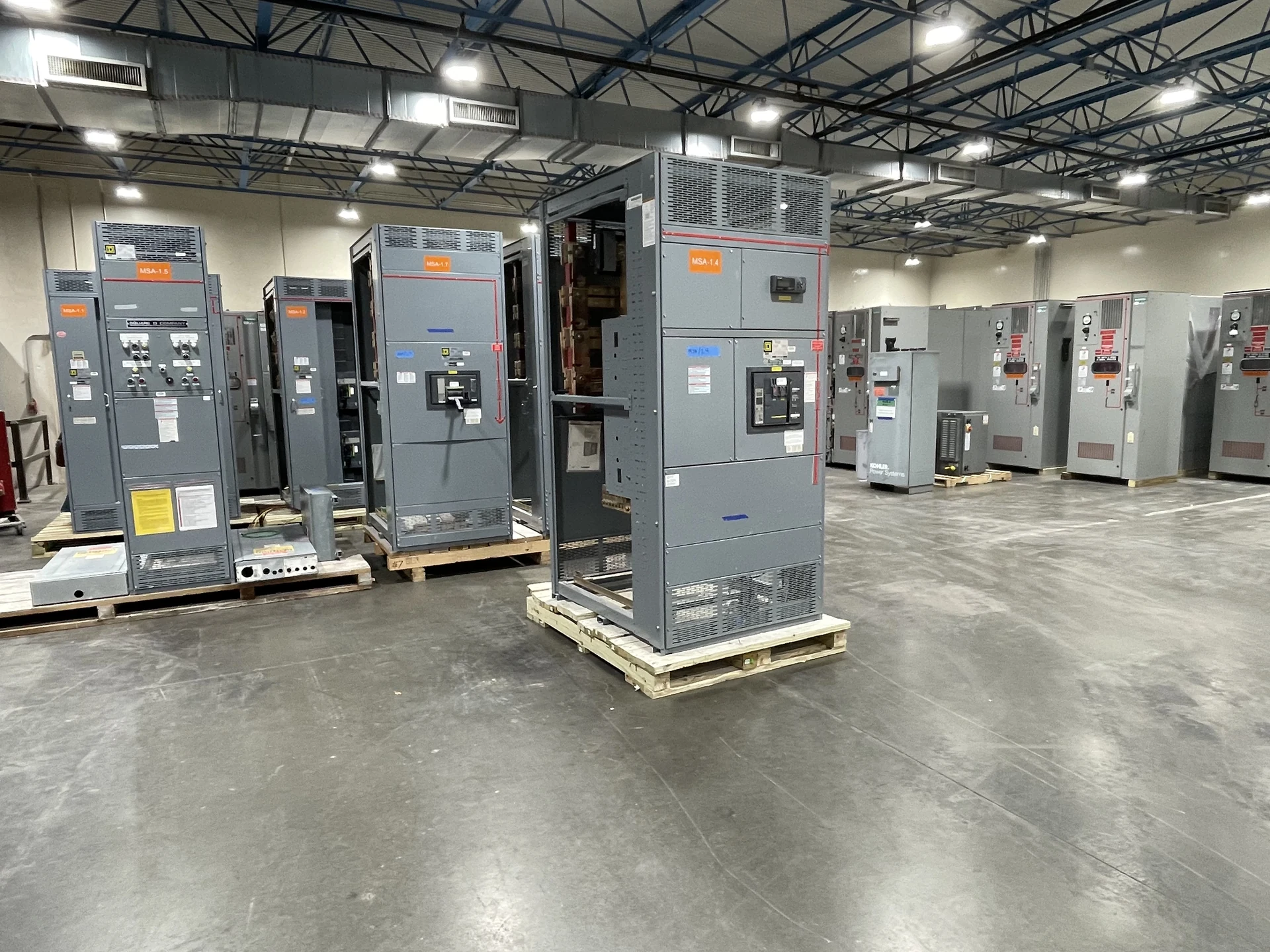
Manufacturing plants depend on electrical distribution that supports production without making every maintenance event a plantwide problem. Medium-voltage switchgear can organize incoming power and feeders serving transformers or large process equipment. For an owner or specifier, the useful starting point is not a catalog label but a clear description of the loads, operating priorities, physical constraints and future changes the new assembly must accommodate.
Organize feeders around production consequences
Map each feeder to the production lines, utilities and support systems it serves. A fault on a feeder supplying a critical compressor may stop several processes even if each line has its own distribution downstream. Grouping loads by operational dependency helps the engineer evaluate whether separate feeders or additional switching points justify their space and cost.
A main-and-tie arrangement may provide flexibility where independent sources and the plant operating plan support it, but it also adds equipment, interlocks and protection complexity. The owner should identify acceptable outage scenarios and whether sources may ever operate in parallel. The engineer can then define switching states and check source and equipment duties for each credible configuration.
Choose protection for the actual system
Provide the nominal system voltage, grounding method, normal and maximum load, and available fault information at the proposed location. The specifying engineer must evaluate equipment voltage class, continuous current, interrupting duty and short-time withstand against the complete system. The assembly and its switching devices need compatible ratings; selecting a breaker alone does not establish the lineup’s overall capability.
Circuit breakers with protective relays and fused switching devices offer different protection characteristics, maintenance considerations and coordination options. The appropriate arrangement depends on the feeder and the study results, not a universal rule. Specify applicable equipment standards and any required listing or certification, then confirm that the proposed construction and documented scope meet project requirements.
Account for motors and production drives
A load schedule should identify large motors, starting methods, starting frequency, starting current and acceleration requirements where known. Simultaneous starts or a difficult process start can cause voltage dips that affect sensitive controls and other lines. The engineer can assess the source, transformers and feeder arrangement against those conditions before settling on equipment and protective functions.
For variable-frequency drives, identify the drive input arrangement, expected harmonics and any filters or transformers supplied with the process package. Coordinate feeder protection and monitoring with the drive supplier’s requirements rather than assuming a conventional motor feeder is equivalent. Confirm which party supplies interface signals, alarms and control power, especially when production controls depend on switchgear status.
Make room for installation and maintenance
Give the manufacturer a dimensioned room or site plan showing doors, delivery routes, floor loading, cable entry and adjacent equipment. Cable size, quantity, shielding and termination details influence compartment space and routing. The electrical and structural teams should coordinate foundations, anchorage, shipping sections and field connections before layout is frozen.
Production dust, humidity, heat and corrosive processes can change enclosure and room requirements. Compare indoor and outdoor placement alongside ventilation, condensation control and access needs. Required working clearances and space for removable components depend on the actual equipment and applicable rules; the owner’s maintenance plan should allow qualified personnel appropriate access without obstructing operating areas.
Reserve expansion capacity deliberately
Identify planned lines and likely transformer or motor additions on the one-line and load forecast. A spare equipped feeder supports a different expansion plan from an empty provision or a future lineup extension. Compare the initial investment with the disruption of a later shutdown, and verify that the bus, source and protection can support the proposed growth.
A spare compartment is not proof that any future device will fit or that upstream capacity exists. Document the intended feeder duty, termination space, controls and limits of the proposed provision in the submittal. Changes to production schedules or equipment loads should trigger engineering review before the project team commits to the expansion.
Buy against coordinated drawings and milestones
Request a proposal from a direct manufacturer for a new assembly using a current one-line, load schedule, fault study inputs, site conditions and expected operating scenarios. Compare proposals for switching devices, relay functions, metering, communications, enclosure construction and exclusions. Agree who provides settings, primary cables, installation, field testing and integration with plant controls.
Set milestones for design review, drawing approval, component availability, fabrication, factory inspection and site readiness; changes or components with longer procurement times can affect the schedule. Specify the required drawings, equipment ratings, test records, manuals and point lists for turnover. Commissioning and energization must be planned and performed by qualified personnel under the owner’s safety procedures, with protection settings and field interfaces verified.
LET'S BUILD SOMETHING RELIABLE — 03
Ready to talk
switchgear?
Tell us about the new equipment your project needs. Include as much or as little detail as you have today.
(951) 403-5738CALL TO DISCUSS YOUR PROJECT