
BUILT IN THE USA. READY FOR YOUR PROJECT.
Service Entrance Switchgear for Manufacturing Plants
A manufacturing plant’s service entrance is the meeting point between the utility supply and the distribution system that keeps production moving.
DIRECT FROM THE MANUFACTURER / NEW EQUIPMENT
THE MANUFACTURER’S PERSPECTIVE — 02
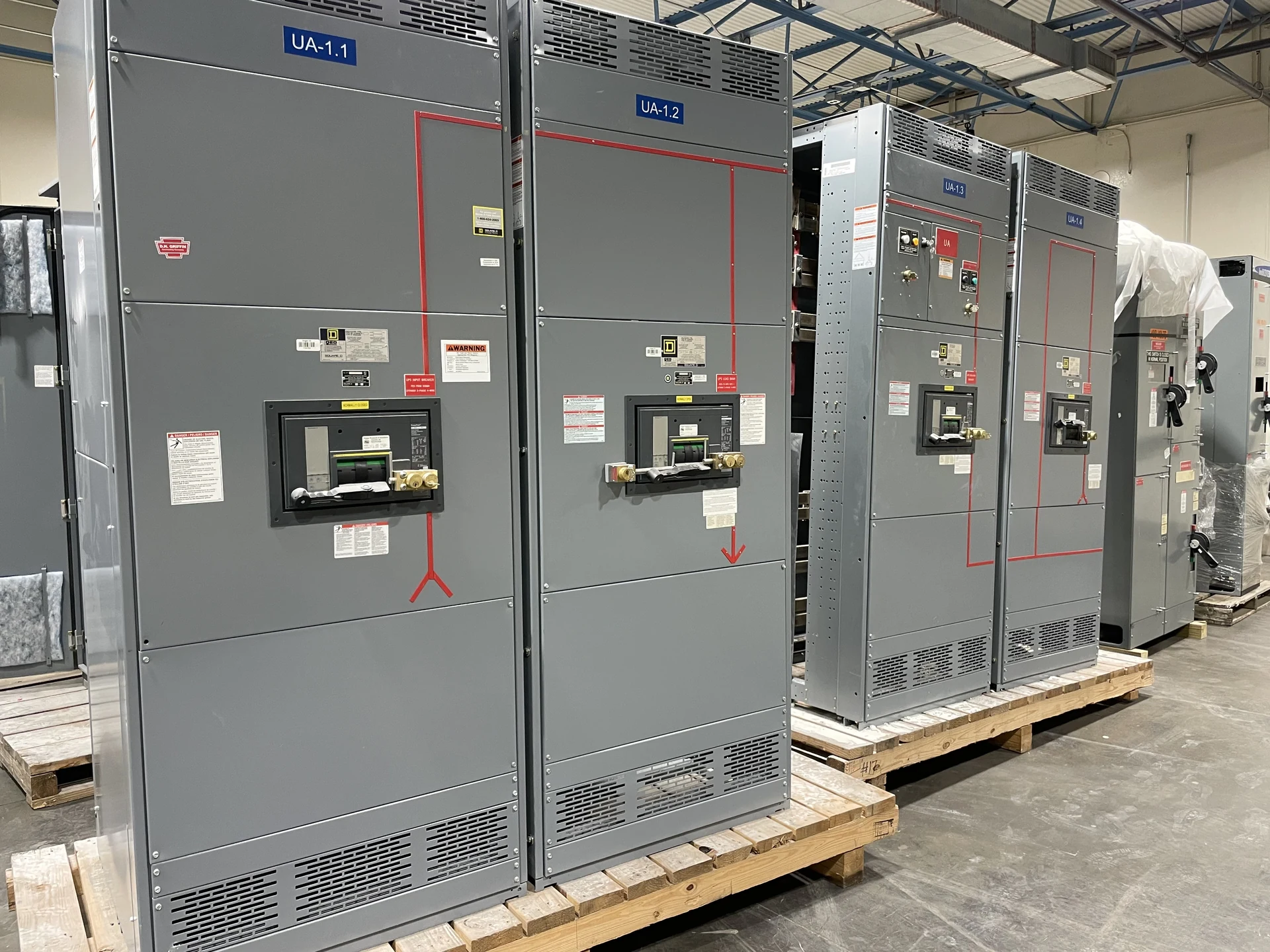
A manufacturing plant’s service entrance is the meeting point between the utility supply and the distribution system that keeps production moving. Choosing the assembly involves more than estimating total plant demand: motor starting, feeder organization, metering, maintenance access and future lines all affect the design. A direct manufacturer of new electrical distribution assemblies can review those requirements with the owner, engineer and electrical contractor before a purchase is finalized.
Start with the utility boundary
Ask the utility to confirm the proposed service configuration, available fault current, metering arrangement and its requirements for equipment access and approval. Identify where utility responsibility ends and customer equipment begins. The electrical engineer can then evaluate the service disconnect, protection and grounding provisions against the applicable code and the utility’s project-specific requirements.
Revenue metering may require dedicated instrument transformers, compartments or wiring arrangements that differ from the plant’s own power-monitoring system. Show those interfaces on the one-line and identify who supplies each component. Early utility review can prevent a completed lineup from conflicting with the meter location or service conductor routing.
Translate production demand into service capacity
Provide a load schedule that distinguishes continuous process demand from motors that start intermittently, planned production additions and loads unlikely to operate together. Motor starting method, starting current and sequence matter because a service sized only from running demand may still experience objectionable voltage dips. The design engineer should evaluate those conditions with the utility and downstream equipment suppliers.
Separate critical process loads from less consequential plant services when mapping feeders. For example, a dedicated feeder to a motor control center can organize a group of line motors, while separate feeders serve building systems or another production area. Circuit boundaries and protective-device choices should reflect the desired response to a fault, not just available physical space.
Select protection with the whole plant in view
The specified assembly, main protective device and downstream devices need ratings suitable for the actual system voltage and available fault duty. Provide the latest short-circuit information and identify any alternate sources that can change the duty. A qualified engineer should review both device interrupting capability and the assembly’s applicable short-circuit ratings; they are not interchangeable.
Request a coordination study covering the service and major feeders where required by the design. Better selectivity can limit the equipment affected by a downstream fault, but the result depends on device characteristics and the fault-current range. Settings, ground-fault protection where applicable and arc-flash evaluation should be assigned to qualified study and commissioning personnel.
Make expansion and maintenance deliberate
A future production line may need a prepared feeder position, a spare device or an additional section. These choices carry different initial costs and space requirements. State the anticipated load and installation horizon rather than assuming that an empty compartment proves the main bus, service capacity or utility supply can support every future addition.
Plan the lineup around the room and the people who will maintain it. Cable entry, door swing, ventilation, lifting access and required working space can influence the arrangement. A design with separate feeder sections may simplify a planned outage, but actual isolation and continuity depend on the approved equipment configuration and the site’s operating plan.
Define the new assembly and its interfaces
Give the manufacturer the one-line, load and feeder schedules, site dimensions, available fault data, conductor quantities and sizes, entry direction, enclosure environment and any metering or communications needs. Identify applicable standards and whether the project requires a listed assembly. UL 891 may be relevant to an appropriate switchboard; confirm the proposed assembly’s actual listing and scope rather than assuming it applies to all switchgear.
Ask for drawings showing elevations, equipment footprint, shipping splits, terminal locations, device schedules and identified deviations. Coordinate foundations, anchor details, raceways, utility connections and field wiring with the parties responsible for each. If domestic component origin is a purchasing condition, specify the documentation needed and verify component sourcing and availability for the proposed build.
Purchase around reviews and production windows
Compare quotations on the same basis: service equipment scope, protective devices, metering provisions, spare capacity, testing, documentation, delivery and exclusions. Confirm who owns utility submissions, study updates and field commissioning. Drawing review, component availability and changes after approval can affect the schedule, so agree on decision dates and a process for evaluating revisions.
For an operating plant, align delivery, installation and commissioning with the owner’s production and outage plans. The contractor and qualified electrical personnel should follow approved site safety procedures, applicable codes and manufacturer instructions; the utility and authority having jurisdiction may also have acceptance roles. Projects in San Antonio, South Texas and nationwide benefit from confirming local utility and delivery requirements during procurement.
LET'S BUILD SOMETHING RELIABLE — 03
Ready to talk
switchgear?
Tell us about the new equipment your project needs. Include as much or as little detail as you have today.
(951) 403-5738CALL TO DISCUSS YOUR PROJECT