
BUILT IN THE USA. READY FOR YOUR PROJECT.
Electrical Panelboards for Manufacturing Plants
Panelboards bring branch-circuit protection close to the production loads that need it, but a plant’s distribution plan must account for more than a list of breakers.
DIRECT FROM THE MANUFACTURER / NEW EQUIPMENT
THE MANUFACTURER’S PERSPECTIVE — 02
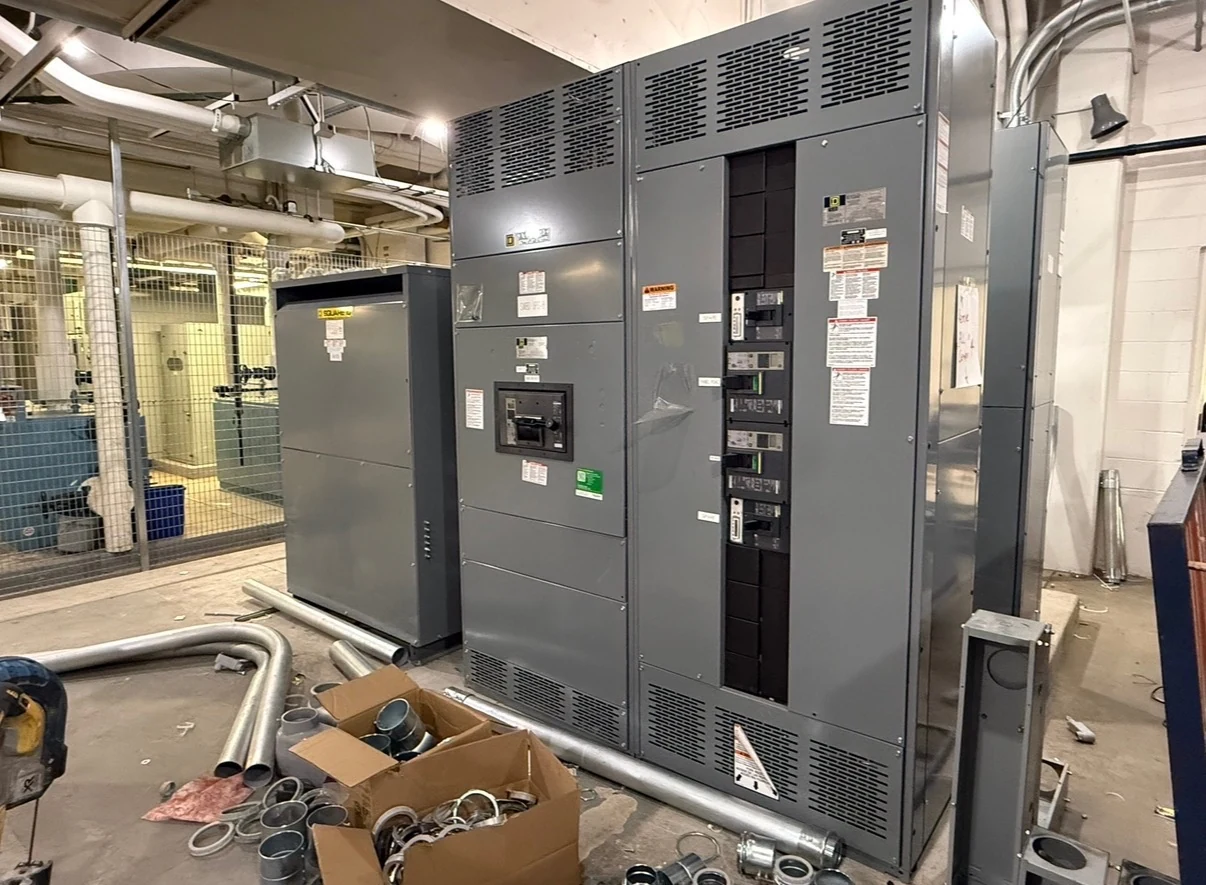
Panelboards bring branch-circuit protection close to the production loads that need it, but a plant’s distribution plan must account for more than a list of breakers. Motor starting, line changes and shutdown windows can influence where a panel belongs and how it is configured. A direct manufacturer of new distribution assemblies can work from the engineer’s design and project requirements.
Place branch distribution around the production process
Start with a current one-line diagram and a load schedule showing each machine, auxiliary load and intended feeder. Group circuits by production area and operational dependency: a packaging line, for example, may have conveyors, controls and receptacles that must be identified separately. Circuit identification helps the plant understand the consequences of an interruption.
A panelboard distributes power and provides branch-circuit protection; it is not automatically a substitute for a motor control center. Where a motor needs a starter, overload protection, a variable-frequency drive or a machine disconnect, the engineer should define which equipment provides each function and how the panelboard feeder interfaces with it.
Translate motor and process loads into a credible schedule
For each circuit, provide the load type, voltage and phase, operating current, protective-device needs and expected duty. Motor nameplate data, starting method and simultaneous operating assumptions help the designer evaluate feeder loading and potential voltage drop. A large motor starting intermittently can affect nearby sensitive controls even when average plant demand appears modest.
Separate established loads from planned equipment and identify uncertainty in the schedule. Drives, welders and other nonlinear loads may require attention to harmonics, neutral loading or heat. The engineer should assess actual conditions rather than applying a generic expansion percentage, and confirm the selected assembly and components are suitable for the resulting duty.
Coordinate protection with the upstream system
Provide the available fault-current information at the proposed panel location, upstream protective-device details and the intended system configuration. The designer can then evaluate assembly short-circuit rating, individual breaker interrupting ratings and coordination with upstream devices. A breaker’s current rating alone does not establish that the panel is suitable for the available fault duty.
If the design relies on a series combination, its specific application and listing need confirmation; it should not be assumed from component names. Similarly, the short-circuit rating of a machine control panel is a separate interface to review. A coordination study can show where an upstream device may also open for a downstream fault.
Make expansion space usable, not merely visible
Compare installed spare breakers with empty spaces reserved for future circuits. Installed devices provide defined present connection capacity but add initial cost; empty spaces offer flexibility while leaving device availability and approval for later. Neither approach guarantees spare feeder, bus or source capacity. Document the anticipated additions so those capacities can be evaluated together.
Include circuit pole counts, conductor quantities, neutral requirements and cable entry preferences in the request. An apparent spare position may not suit the eventual breaker arrangement or termination. Where production layouts are expected to change, ask for a panel schedule and drawings that clearly distinguish connected loads, spare devices and prepared spaces.
Design for plant conditions and maintenance access
Share the proposed location, footprint, access route and working-space constraints early. Heat, dust, washdown, corrosive exposure and vibration can affect enclosure selection and equipment placement. A panel closer to machines can simplify branch routing, but placing it in a congested or dirty production zone may complicate access and environmental protection.
The facility team should identify which production areas can be isolated together and what access is needed for inspection or future work. Applicable clearances, disconnect arrangements and maintenance methods belong in the project design. Qualified electrical personnel must plan and perform work under site procedures, applicable codes and manufacturer instructions.
Align the purchase, submittals and shutdown plan
For a useful quote, send the one-line, load and circuit schedules, fault-duty data, enclosure conditions, dimensions and required documentation. Specify the applicable panelboard standard and any required listing, with project-specific scope confirmed during review. Identify who supplies upstream feeders, machine connections, labels, field installation and commissioning; omissions at these boundaries can derail an otherwise complete order.
Compare proposals for device selection, ratings, spare capacity, exclusions and drawing revisions rather than price alone. Request an agreed submittal package, including equipment drawings, circuit schedules, installation information and applicable inspection or test records. For projects in San Antonio, South Texas or elsewhere nationwide, coordinate review and component availability with the owner’s production outage and contractor’s installation schedule; delivery timing depends on project details.
LET'S BUILD SOMETHING RELIABLE — 03
Ready to talk
switchgear?
Tell us about the new equipment your project needs. Include as much or as little detail as you have today.
(951) 403-5738CALL TO DISCUSS YOUR PROJECT