
BUILT IN THE USA. READY FOR YOUR PROJECT.
Electrical Panelboards for Universities
University panelboards connect campus feeders to the branch circuits that support classrooms, laboratories, residence halls and shared facilities.
DIRECT FROM THE MANUFACTURER / NEW EQUIPMENT
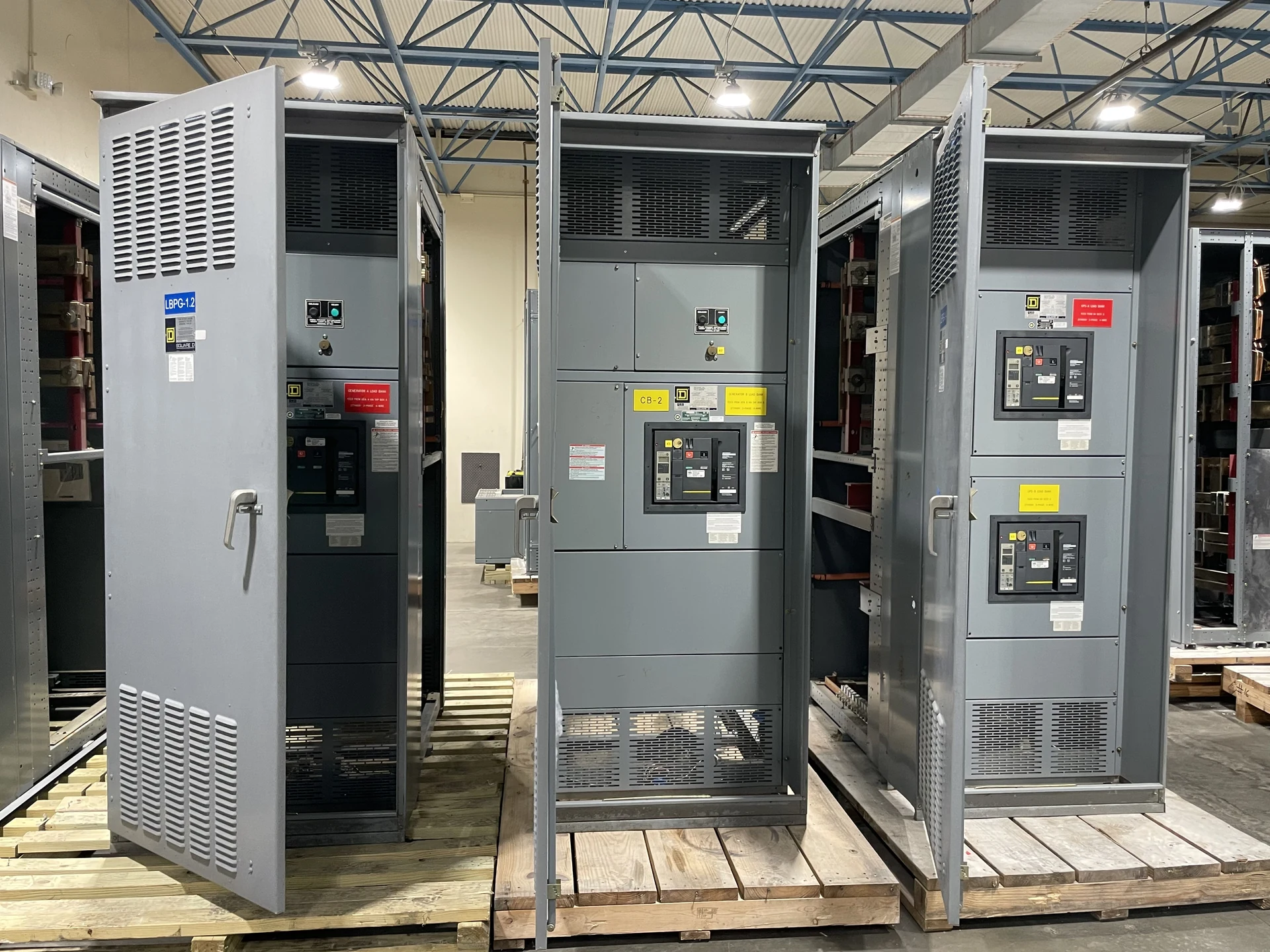
THE MANUFACTURER’S PERSPECTIVE — 02
University panelboards connect campus feeders to the branch circuits that support classrooms, laboratories, residence halls and shared facilities. Choosing a new assembly requires more than counting breakers: owners and specifiers must reconcile building loads, available fault current, physical access and academic schedules. A direct American manufacturer of new power-distribution assemblies can coordinate these requirements for projects in San Antonio, South Texas and nationwide.
Trace the feeder to the rooms it serves
Begin with the campus one-line and identify the source, upstream protective device, feeder route and panelboard location. Record system voltage, phase and wire configuration, grounding arrangement, conductor quantities and termination requirements. Indicate whether the panel serves general-purpose circuits or a defined group of loads, and flag uncertainties in existing documentation for field verification.
Build a circuit schedule around actual use: teaching rooms may change equipment frequently, while research laboratories can have dedicated loads and sensitive experiments. Supply connected and expected demand loads, applicable continuous-load assumptions and metered history where available. The design engineer should evaluate nonlinear loads and their effect on the neutral rather than assuming unused breaker positions mean adequate electrical capacity.
Match protective devices to the campus system
The engineer needs available short-circuit current at the proposed panel, including relevant source configurations, to select an assembly and devices with suitable ratings. Breaker interrupting ratings and the panelboard assembly short-circuit rating are related but not interchangeable. Coordinate the specified device combination and upstream protection with the project fault and protective-device studies.
A main breaker at the panel can provide a local disconnect and overcurrent protection, while a main-lug configuration relies on appropriate upstream protection. That choice affects space, cost and coordination, so compare it against the distribution design and applicable requirements. Verify that selected breakers, bus, neutral and accessories are compatible with the proposed assembly and its required listing.
Plan work around occupied buildings
An outage affecting a panel may also interrupt lab ventilation, network rooms, accessibility equipment or refrigeration. Map each circuit to its occupants and dependencies before selecting a construction window. Coordinate with facilities, researchers, housing and campus safety personnel; an apparently convenient academic break may still contain experiments, events or critical building operations.
If temporary power is needed, the owner and electrical design team should define the source, capacity, connection interfaces, protection and transfer responsibilities before procurement. Include time for approvals, testing and a contingency if the window is missed. Qualified electrical personnel must perform field work under site safety procedures, including planned isolation and verification, not rely on a panel schedule alone.
Fit the assembly to the building
Room surveys should establish wall construction, mounting method, available depth, door swing and a delivery route. Show required working space and access on the layout using the applicable code and the actual equipment arrangement. A recessed panel may save room projection but can complicate wall coordination; a surface-mounted enclosure needs its own clearance review.
Specify top or bottom feeder entry, branch conduit routes, lug sizes and wire-bending space alongside the intended number of circuits. Identify moisture, dust, ambient temperature and ventilation conditions so the enclosure is appropriate for its location. Coordinate penetrations and any fire-resistance requirements with the building design team rather than treating the electrical drawing as a complete installation plan.
Reserve useful capacity for the next semester
Compare installed spare breakers with prepared spaces for later circuits. Spare breakers cost more initially but can reduce the scope of a future change; spaces alone do not provide a protective device or prove that the bus, feeder and upstream equipment can support another load. The engineer should test proposed expansion against demand, circuit poles, fault duty and physical capacity.
Where departments need energy visibility, specify whether panel or circuit metering is required, what quantities will be measured and who will use the information. Metering can consume enclosure space and introduce communications and data-security interfaces. A useful design assigns ownership of network connections and commissioning and distinguishes monitoring for campus planning from any required revenue metering.
Turn the design into a comparable purchase
Send the manufacturer the one-line, load and circuit schedules, available fault-current data, drawings, environmental conditions and required delivery constraints. Request an itemized scope with panel schedules, dimensions, feeder and branch termination details, applicable standards and listing information. UL 67 may be relevant to panelboards; verify the specific assembly and listing required by the project and the authority having jurisdiction.
Compare proposals for included breakers, spare provisions, submittal drawings, inspection records and documentation, as well as exclusions for field wiring, mounting, protective-device settings and commissioning. Build the schedule around design review, component availability, fabrication, delivery and the campus outage calendar. At handoff, reconcile approved drawings and circuit identification with the installer’s field records so facilities staff have dependable documentation.
LET'S BUILD SOMETHING RELIABLE — 03
Ready to talk
switchgear?
Tell us about the new equipment your project needs. Include as much or as little detail as you have today.
(951) 403-5738CALL TO DISCUSS YOUR PROJECT