
BUILT IN THE USA. READY FOR YOUR PROJECT.
Switchgear Terms and Definitions
Switchgear terminology affects what goes into a quotation, what an engineer must verify, and what the installer receives.
DIRECT FROM THE MANUFACTURER / NEW EQUIPMENT
THE MANUFACTURER’S PERSPECTIVE — 02
Switchgear terminology affects what goes into a quotation, what an engineer must verify, and what the installer receives. The definitions below give owners, contractors and design teams a shared vocabulary for ordering new power-distribution equipment. Use them alongside the project one-line diagram and specifications: a familiar term alone does not establish an assembly’s suitability, rating or availability.
Assemblies and their roles
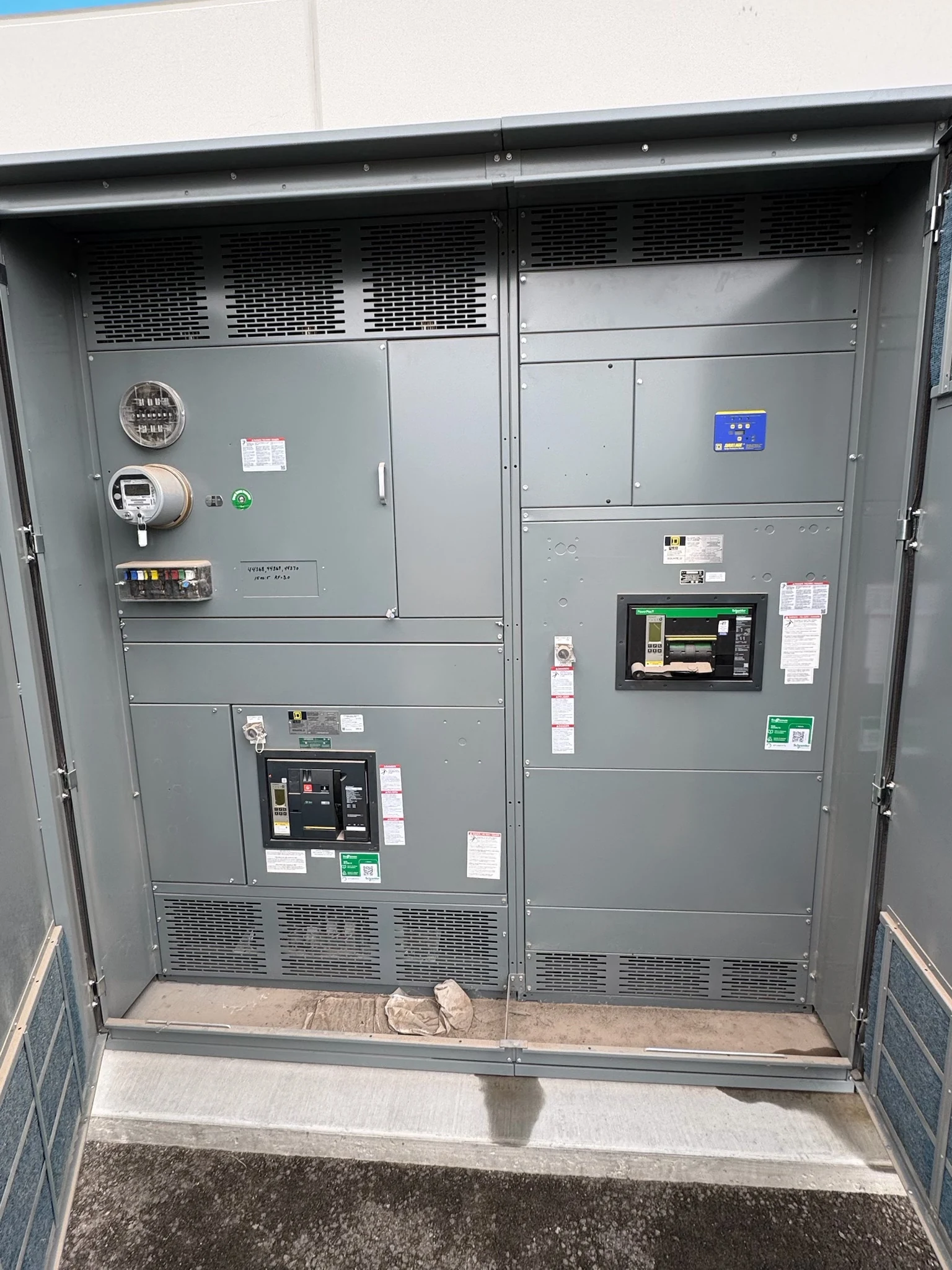
Switchgear is an assembly of switching, protective and control equipment used in an electrical power system; its construction and applicable standard depend on the equipment specified. A switchboard is a distribution assembly that can contain switches, circuit breakers and metering. They are not automatically interchangeable: compare protective devices, construction, service access and the intended application before requesting either.
A panelboard generally distributes power to downstream circuits in a cabinet, while a motor control center groups equipment for controlling and protecting motors. A lineup is a group of connected equipment sections. On a request for quotation, identify which sections and functions are included rather than assuming the assembly name describes every component.
System and load language
A one-line diagram is a simplified electrical drawing showing sources, protective devices, buses and outgoing circuits. A feeder carries power to downstream equipment; a load schedule describes the connected equipment and its electrical requirements. Send both with the source arrangement, present loads and credible expansion plans so that an engineer can evaluate the proposed configuration.
Nominal system voltage describes the system being served; equipment voltage class and ratings must be suitable for that system and its application. Continuous current rating describes current equipment can carry under specified conditions, not its ability to interrupt a fault. Phase and wire configuration, neutral requirements, ambient conditions and expected load behavior also inform the review.
Fault duty and protective coordination
Available fault current is the calculated or supplied estimate of current that could flow at a specified location during a short circuit. Interrupting rating is a protective device’s ability to interrupt fault current under its specified conditions. Assembly short-circuit ratings address the assembly as a whole; a breaker’s individual rating does not by itself establish the complete lineup’s suitability.
Short-time withstand refers to an assembly’s ability to carry a specified fault current for a specified duration. Selective coordination describes arranging protective devices so the device nearest a fault operates without unnecessarily interrupting upstream circuits, within the specified fault-current range. These choices involve tradeoffs in protection, continuity and equipment design; the project’s qualified engineer evaluates them using current system data.
Sources, buses and measurement
A bus is a conductor system that distributes power within an assembly. A main device connects or protects the incoming supply; a tie connects bus sections where the design calls for it. A main-tie-main arrangement can provide operational flexibility, but source capacity, fault duty and interlocks must be assessed for each intended operating state.
An automatic transfer switch selects between normal and alternate sources according to an approved control scheme; it is not simply another name for a distribution lineup. Current transformers provide scaled current signals for metering or protection. Specify the required functions, interfaces, accuracy needs and communications responsibility, and coordinate any utility metering requirements with the serving utility.
Enclosures and installation interfaces
An enclosure surrounds the electrical equipment and is selected for the actual environment and project requirements. Indoor and outdoor applications can differ in exposure, ventilation and maintenance access. Metal-enclosed describes a construction category; metal-clad denotes a more specifically defined type of equipment, so a request should identify the applicable construction standard rather than treating the labels as synonyms.
Cable entry is the planned route into the assembly; termination is the connection point for field conductors. Provide entry direction, conductor sizes and quantities, available room dimensions, access routes and clearance constraints. A shipping split separates a lineup into transportable sections and introduces field joining responsibilities, so agree on lifting information, split locations and installer documentation before drawings are finalized.
Purchasing, verification and turnover
A submittal is the manufacturer’s project-specific package for review, commonly including drawings, equipment schedules and stated exceptions. A listing concerns an evaluation within a defined product and certification scope; it is not a substitute for confirming compliance with the whole specification. UL 891 may be relevant to an appropriate switchboard assembly, but its applicability and any requested listing must be verified for the proposed equipment.
A factory acceptance test is an agreed set of checks before shipment, with scope, acceptance criteria, witness arrangements and records defined in advance. When buying directly from a manufacturer serving San Antonio, South Texas and nationwide, align drawing approval, component availability and delivery planning with the contractor’s installation schedule. Qualified personnel handle field connections, testing and energization under applicable requirements and site procedures; clarify those responsibilities at purchase.
LET'S BUILD SOMETHING RELIABLE — 03
Ready to talk
switchgear?
Tell us about the new equipment your project needs. Include as much or as little detail as you have today.
(951) 403-5738CALL TO DISCUSS YOUR PROJECT