
BUILT IN THE USA. READY FOR YOUR PROJECT.
High-Voltage Switchgear: Testing and Documentation
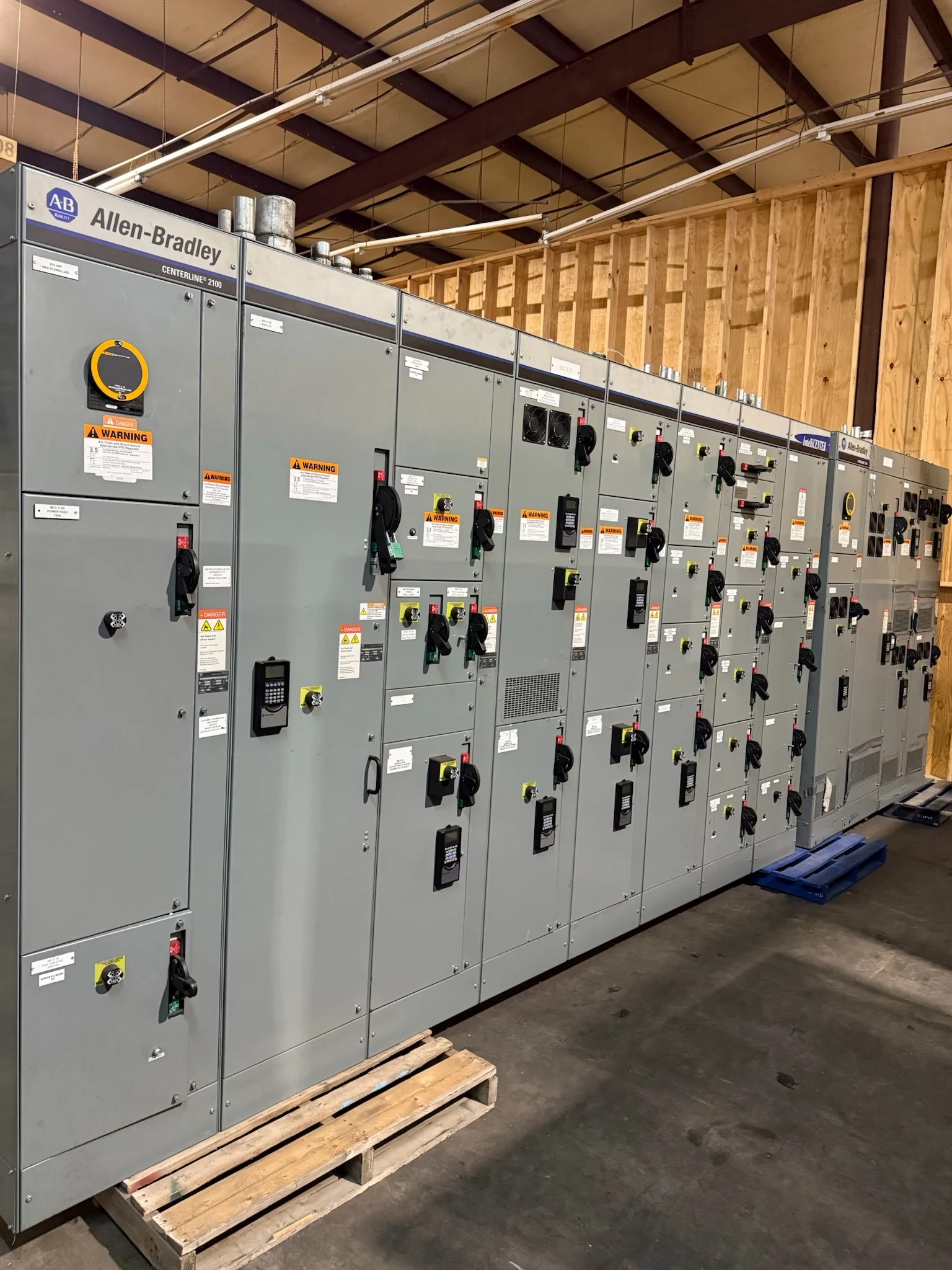
Testing a high-voltage switchgear assembly is a project-specific acceptance exercise, not a single universal checklist.
DIRECT FROM THE MANUFACTURER / NEW EQUIPMENT
THE MANUFACTURER’S PERSPECTIVE — 02
Testing a high-voltage switchgear assembly is a project-specific acceptance exercise, not a single universal checklist. Engineers, owners and contractors need to know what will be demonstrated at the factory, what must wait for site assembly, and which documents support those decisions. Before requesting a new assembly from a direct manufacturer, establish the switching duty and confirm that the proposed equipment and test scope are technically feasible.
Start with the power system and test boundaries
Provide a current one-line diagram, system nominal voltage, grounding arrangement, continuous loads and available fault duty at the connection point. Identify each source, circuit and intended switching function, including any utility interface. The engineer can then define equipment ratings and insulation requirements rather than treating a voltage label as a complete specification.
State the applicable project standards and utility requirements, the intended equipment configuration and environmental conditions. Identify the boundary between manufacturer-supplied equipment, external instrument transformers, cables and protection panels. A test of the assembly alone cannot establish that every external interface or the complete power system is ready for service.
Separate design evidence from routine checks
Ask what design or type-test evidence applies to the proposed construction and which routine production checks will be performed on the actual assembly. The manufacturer and engineer should review whether the evidence covers the selected devices, ratings, arrangement and relevant standard. A report for a different configuration is not automatically proof of equivalence.
An inspection and test plan can identify visual and mechanical checks, wiring verification and dielectric testing where applicable. Specify the test basis, acceptance criteria, instruments or record format and required witness points. For insulation, distinguish factory withstand tests from other measurements; each answers a different question and must follow the approved procedure for that equipment.
Prove the protection and control interfaces
A switching device may be mechanically sound yet fail to respond correctly to the protection scheme. Define which relay inputs, trip and close circuits, auxiliary contacts, interlocks, alarms and control-power supervision will be functionally checked. Agree whether testing uses simulated inputs, test equipment or actual connected devices, and identify who supplies temporary test resources.
Provide instrument transformer ratios and required accuracy or protection characteristics, the intended relay functions and the control-power scheme. The protection engineer should supply or approve settings from the system study; the factory can verify agreed functions without assuming responsibility for that study. Document communications points and local-versus-remote control authority when those interfaces are included.
Define acceptance before the factory test
Turn the purchase specification into a test matrix listing each check, applicable document, acceptance criterion, responsible party and required record. Decide whether the owner or an independent representative will witness selected tests, and whether a hold point requires written release. Clarify how observations, nonconformances, corrective action and retesting will be recorded.
Compare quotes on the same basis: a witnessed functional sequence, detailed relay verification and special documentation may require more time and coordination than a standard inspection. An omitted test is not necessarily a defect, but its absence should be visible. Resolve exceptions and component substitutions before releasing the design for fabrication.
Plan for shipping and site verification
Large assemblies may ship in sections, so identify what can be tested as a complete factory arrangement and what requires field verification after reassembly. The contractor and commissioning provider should receive shipping-split drawings, connection details and the factory records. Site inspections also need to account for transport condition, installation interfaces and the project’s acceptance plan.
Coordinate site test scope with connected cables, surge protection and other equipment so the engineer can evaluate compatibility with the proposed methods. A successful factory test does not replace site commissioning or demonstrate final protective settings across external systems. Qualified personnel perform testing and electrical work under site safety procedures and applicable manufacturer instructions.
Tie records and approvals to the schedule
Request a submittal register covering approved one-lines, elevations, schematics, terminal schedules, device data, test procedures and exceptions. At turnover, seek the agreed test results, corrective-action closure, as-built drawings, manuals and a clear list of outstanding items. Record equipment identification and document revisions so results can be traced to the delivered configuration.
Allow time for engineering review, test-plan approval, component availability, witness scheduling and any retests before arranging delivery or the commissioning window. Identify who owns field testing, utility coordination, settings verification and authorization to energize. Those responsibilities and dependencies make a more reliable procurement comparison than a delivery date considered in isolation.
LET'S BUILD SOMETHING RELIABLE — 03
Ready to talk
switchgear?
Tell us about the new equipment your project needs. Include as much or as little detail as you have today.
(951) 403-5738CALL TO DISCUSS YOUR PROJECT