
BUILT IN THE USA. READY FOR YOUR PROJECT.
Industrial Facilities Switchgear
Industrial facilities need electrical distribution that supports motors, production equipment and critical auxiliaries without treating every load as identical.
DIRECT FROM THE MANUFACTURER / NEW EQUIPMENT
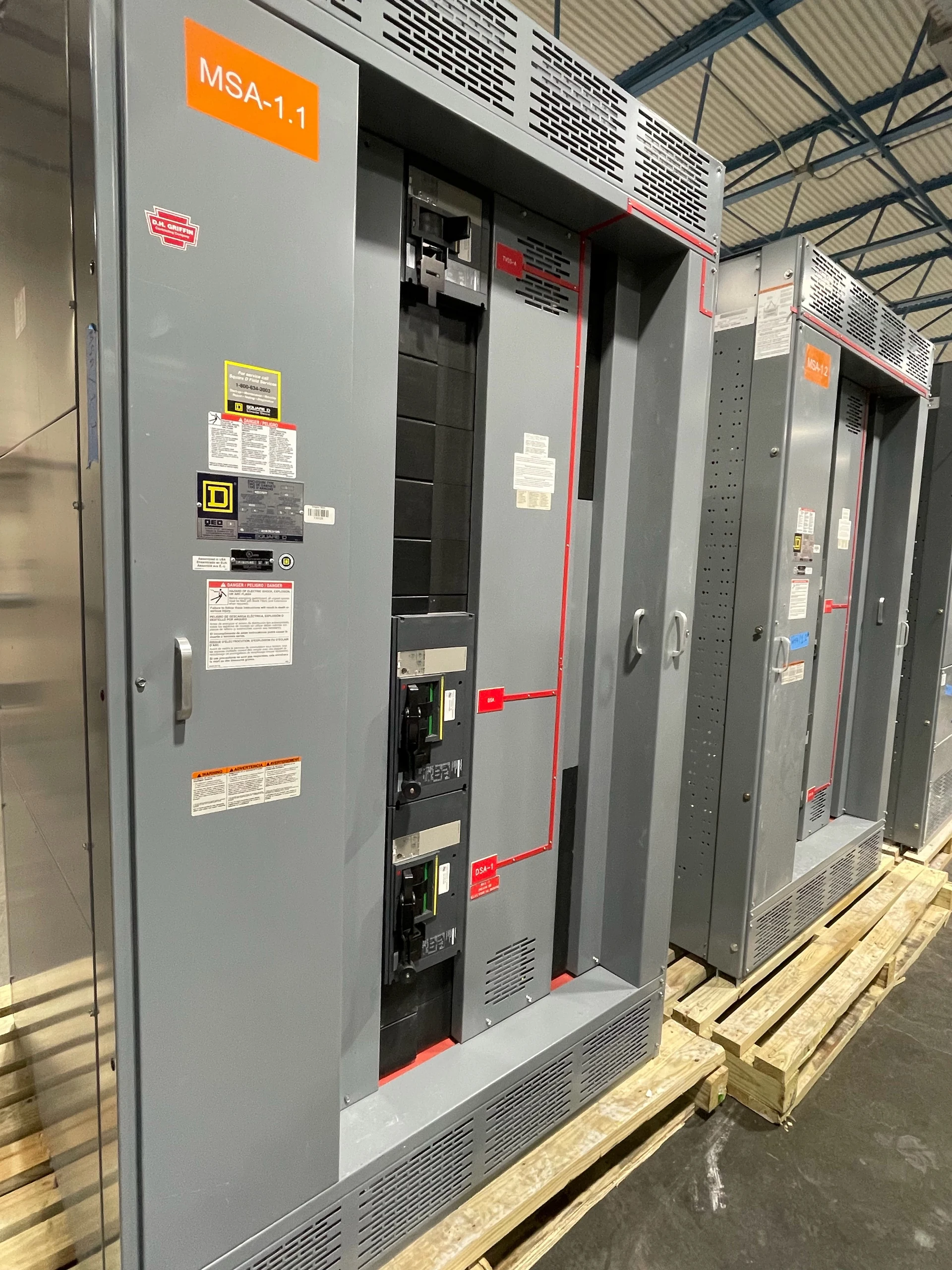
THE MANUFACTURER’S PERSPECTIVE — 02
Industrial facilities need electrical distribution that supports motors, production equipment and critical auxiliaries without treating every load as identical. For owners and engineers in San Antonio, South Texas and nationwide, specifying a new switchgear assembly begins with the plant’s operating requirements and physical constraints. A direct manufacturing purchase should translate those requirements into a defined equipment scope, documented interfaces and an achievable project sequence.
Map the plant before selecting an assembly
Give the manufacturer a current one-line diagram showing incoming sources, transformers, main devices, buses and feeder destinations. Add a load schedule that identifies present demand, anticipated expansions and circuits that must remain independent. An uninterrupted cooling system may deserve a different distribution arrangement from a noncritical workshop feeder, even when their connected loads appear similar.
Switchgear distributes and protects power, while a motor control center groups motor starters and associated controls. A plant may need both, with a switchgear feeder supplying the motor control center. Define that boundary on the one-line, including the conductor or busway connection, feeder protection and responsibility for the downstream assembly.
Account for motor duty and process growth
Motor nameplate information alone does not describe the entire application. Provide motor sizes, starting methods, starting frequency and whether large machines can start together. The engineer can then evaluate starting current, voltage drop and protective-device behavior against the operating sequence, rather than sizing the lineup only from a total connected-load figure.
Variable-frequency drives and nonlinear process loads introduce additional questions about harmonics, heat and grounding interfaces. Share drive documentation and any power-quality study with the design team. For future production lines, distinguish reserved physical space from actual electrical capacity: a spare compartment does not by itself establish available bus capacity or fault-duty suitability.
Coordinate protection with continuity goals
Collect utility and transformer source data, including available fault current and anticipated system configurations. Account for other contributors, such as onsite generation or motors, where the system study requires them. The engineer must compare the resulting duties with both the selected protective devices and the assembly’s verified short-circuit ratings and applicable withstand requirements.
Ask the protection study provider to examine upstream and downstream time-current characteristics over the relevant fault range. Better selectivity can limit the loads affected by a fault, but settings, available devices and arc-flash risk must be evaluated together. The owner should identify who performs the coordination and arc-flash studies, establishes settings and approves revisions.
Define controls and physical interfaces
List each required status, alarm and control signal between the distribution assembly and the plant control system. Specify the communications protocol, network handoff, control power source and responsibilities for point mapping and functional testing. A remote indication is useful for operations, but it does not replace site procedures or establish that a circuit is safe to work on.
Provide room dimensions, cable entry direction, conductor quantities and sizes, delivery access and expected ambient conditions. The design team must coordinate termination space, ventilation, working clearances and equipment access using applicable requirements. Dust, moisture or corrosive exposure may call for different enclosure and cooling choices; those choices also affect heat management and maintenance access.
Plan installation around production
For an operating facility, identify affected loads, permissible outage windows and dependencies such as compressed air, cooling and process controls. The owner and electrical contractor can develop a phased transition and assess temporary power needs with the engineer. Temporary connections, source capacity and protection need their own design review; neither a spare feeder nor a generator connection should be assumed adequate.
Coordinate shipping sections, rigging routes, foundation readiness and field connection work before committing the construction sequence. Allow time for drawing review, component procurement, manufacturing, inspection and site commissioning, with responsibilities assigned for each. Delivery timing depends on approved scope and material availability, so production schedules should include contingency rather than assume a fixed lead time.
Make the quotation and handoff useful
Request an itemized proposal identifying the one-line revision, equipment boundaries, ratings under review, devices, enclosure assumptions and exclusions. Compare bids on equal technical scope, including factory checks, documentation and any witnessed testing. If a specification requires US-made components or a particular listing, identify the requirement early and confirm actual sourcing, availability and the listing applicable to the proposed assembly.
Submittals should address elevations, feeder and terminal schedules, control interfaces, shipping splits and installation constraints. Agree on test records, manuals, final drawings and responsibility for field acceptance before purchasing. Qualified electrical personnel should perform installation, testing and energization under site safety procedures, applicable codes and manufacturer instructions; the owner coordinates access and operating authorization.
LET'S BUILD SOMETHING RELIABLE — 03
Ready to talk
switchgear?
Tell us about the new equipment your project needs. Include as much or as little detail as you have today.
(951) 403-5738CALL TO DISCUSS YOUR PROJECT