
BUILT IN THE USA. READY FOR YOUR PROJECT.
Switchgear and Arc-Flash Studies
An arc-flash study estimates the thermal energy a person could encounter during an electrical arcing fault under defined system conditions.
DIRECT FROM THE MANUFACTURER / NEW EQUIPMENT
THE MANUFACTURER’S PERSPECTIVE — 02
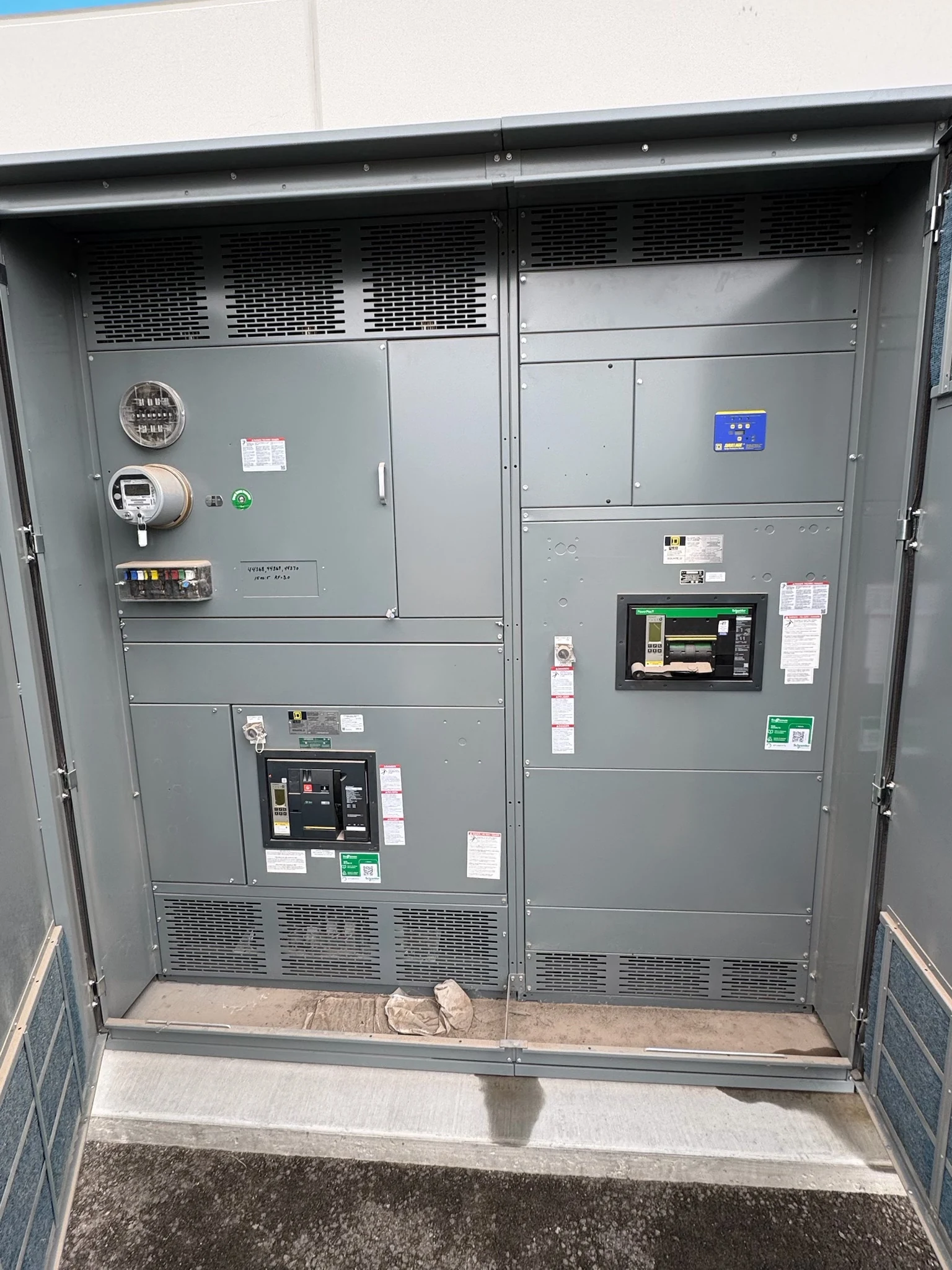
An arc-flash study estimates the thermal energy a person could encounter during an electrical arcing fault under defined system conditions. For a new switchgear purchase, the study is most useful when it informs design before equipment is finalized and is updated to reflect the installation. Its results support an electrical safety program; they do not make energized work automatically safe.
Establish the study boundary
Ask the owner and qualified study provider to define which buses and equipment locations are included, who supplies source information, and which operating configurations will be modeled. A lineup with two utility sources, a tie, or a generator may have materially different fault paths in normal, alternate, and maintenance configurations.
Request available utility fault-current information and the assumptions behind it, including relevant minimum and maximum conditions where obtainable. The provider also needs transformer ratings and impedance, motor contributions when applicable, and conductor sizes and lengths. Mark uncertain values explicitly rather than allowing an unverified assumption to become the basis for a final label.
Give the analyst usable equipment data
A current one-line diagram should identify sources, transformers, protective devices, buses and feeder destinations. For the proposed assembly, provide the equipment arrangement, protective-device types, ratings, trip-unit or relay details, and published time-current characteristics. Include adjustable setting ranges and any settings already specified; a frame size alone does not establish clearing time.
The study provider may also need enclosure dimensions, electrode configuration, conductor gap and working distance, depending on the chosen calculation method and available data. Coordinate these details with the manufacturer during submittal review. The analyst must decide whether the method applies to the actual equipment and document any substitutions or limitations.
Understand clearing time and protection tradeoffs
Incident energy depends on more than available fault current. A protective device may take longer to clear a lower arcing current than a higher fault current, so the provider should evaluate credible source and operating scenarios rather than assume the largest fault produces the greatest exposure. Device characteristics and actual settings matter.
Faster fault clearing can reduce calculated energy, but a proposed setting change may compromise selective coordination, motor starting, or service continuity. A fault on the supply side of a main device may depend on upstream protection, not that main device. The protection engineer should evaluate the complete fault path and document each tradeoff before settings are approved.
Separate the label from the hazard
A study label communicates results for a particular equipment location and the assumptions used. It may show incident energy at a stated working distance and an arc-flash boundary, along with other information selected for the applicable requirements. A label is not a guarantee of safety, a substitute for training, or proof that the current configuration matches the model.
The actual risk depends on the task, equipment condition, exposure and other circumstances, as well as the modeled hazard. Shock and arc-flash hazards both require attention. The employer and qualified workers must apply the site electrical safety program and applicable requirements; exposed live parts should be de-energized before work except where a permitted exception applies.
Define the purchasing and study handoff
When requesting a quote for a new assembly, include the one-line, intended protective devices, known source data and any study-driven features being considered. Clearly identify whether the manufacturer, study provider, contractor or owner supplies calculations, settings, labels and field verification. Do not assume a manufacturing quotation includes a complete facility study.
Ask for the equipment drawings, device identification and characteristic data needed for the analysis, with a schedule for releasing them. If remote operation or a maintenance setting is proposed, define its control interface, operating states and indication requirements. The project engineer must review whether the feature fits the protection scheme and study assumptions.
Close the loop before energization
A useful study deliverable identifies the modeled one-line, source cases, protective settings, calculation method, assumptions and unresolved data. It should present location-specific results and recommended actions, with editable model files if those are included in the agreed scope. The owner should arrange field verification and reconcile changes between the approved drawings and the installed system.
Allow time for study review, approved settings, commissioning verification and label preparation within the project schedule. Qualified personnel implement and verify settings under site procedures and manufacturer instructions. After turnover, assign responsibility for reviewing the study when sources, equipment, settings or operating configurations change, and for keeping labels and safety documentation consistent with the approved revision.
LET'S BUILD SOMETHING RELIABLE — 03
Ready to talk
switchgear?
Tell us about the new equipment your project needs. Include as much or as little detail as you have today.
(951) 403-5738CALL TO DISCUSS YOUR PROJECT