
BUILT IN THE USA. READY FOR YOUR PROJECT.
Cibolo Switchgear Manufacturing
A growing Cibolo facility may need distribution equipment long before every future load is known.
DIRECT FROM THE MANUFACTURER / NEW EQUIPMENT
THE MANUFACTURER’S PERSPECTIVE — 02
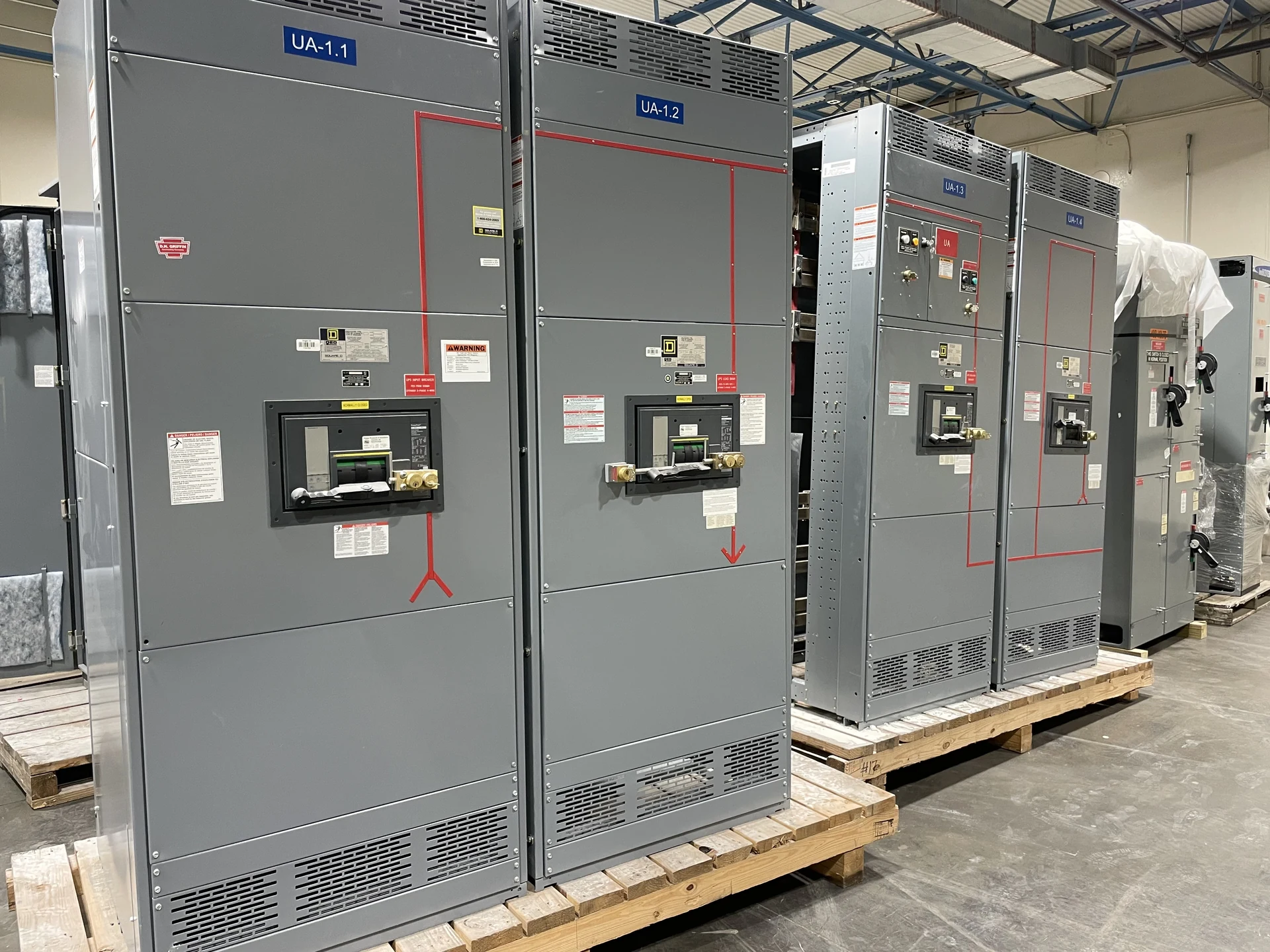
A growing Cibolo facility may need distribution equipment long before every future load is known. Reserving room in a new lineup is useful only if the upstream supply, bus, protection and cable routes can support the intended additions. Owners and contractors can work directly with the manufacturer to define practical expansion allowances without treating an empty compartment as a promise of unlimited capacity.
Turn growth plans into a load scenario
Start with the current one-line diagram and a load schedule showing connected loads, expected demand, operating patterns and any planned additions. Separate committed equipment from tentative growth: a future production line with a defined motor schedule is a different design input from an unassigned area that might be occupied later.
Ask the electrical engineer to evaluate coincident demand rather than simply adding every nameplate value or applying an arbitrary growth percentage. The review should account for starting duty, nonlinear loads and the capacity of the service and transformer. Record assumptions so the owner can revisit them when a new feeder is requested.
Choose what to reserve in the lineup
A spare feeder device provides a defined protection position from the outset, while a prepared space may defer the device purchase until its load is better understood. A space is not necessarily ready for any device: mounting provisions, bus connections, enclosure construction and the approved assembly configuration all matter.
A separate future section can offer more layout flexibility, but requires room, compatible bus extensions and coordination of the end connection. Compare the initial purchase and footprint with later engineering and outage costs. The manufacturer should identify which provisions are included now and what would require a project-specific design review later.
Protect the capacity behind the spare
Spare positions do not increase the current-carrying capability of the main bus or the available supply. Specify the anticipated present and future demand, system configuration and applicable equipment ratings for engineering review. The neutral and grounding arrangements also need to suit both the initial circuits and credible additions.
Provide available fault-current information at the equipment location and identify expected source changes that could affect it. The engineer should coordinate device interrupting duty, assembly short-circuit ratings and protection with the system study. A future feeder must be reviewed against the actual system conditions at the time it is added.
Lay out feeder paths before the room is fixed
Show prospective feeder destinations, estimated cable quantities and sizes, and whether conductors are expected to enter from above or below. These choices affect termination space, bending room, conduit routing and the location of spare positions. If a future cable route crosses another trade’s space, resolve that interface on the coordinated drawings.
Allow the design team to check equipment footprint, working space, access for maintenance and a possible extension path against applicable requirements. Mechanical ventilation, structural supports, door openings and delivery routes can constrain a technically adequate lineup. Space reserved on an elevation is less useful if it cannot be reached or connected later.
Make the purchase scope testable
Request a proposal that identifies the main and feeder devices, spare positions, bus and enclosure provisions, cable-entry assumptions, and any excluded future work. Compare exceptions as carefully as the quoted equipment: two lineups with the same number of spare spaces may differ in electrical capacity, physical preparation and documentation.
Specify required drawings, device schedules, testing records and manuals, plus any component-origin requirements; actual sourcing and availability need confirmation. If a low-voltage switchboard is proposed and UL 891 listing is required, verify the specific assembly and its proposed expansion provisions with the manufacturer and the authority having jurisdiction.
Plan reviews, delivery and the next addition
Build the schedule around the one-line and site information, manufacturer submittals, engineer and owner review, component availability, fabrication, inspection and delivery. Agree who resolves utility interfaces, foundation details and field connections. Changes to feeder count or equipment dimensions after approval may require revised drawings and affect procurement timing.
At turnover, retain the approved drawings, ratings, test records and a register of reserved positions and capacity assumptions. Before an addition, have qualified electrical professionals reassess the load, fault duty, physical provisions and approval requirements; installation, testing and energization belong to qualified personnel following site procedures and applicable codes.
LET'S BUILD SOMETHING RELIABLE — 03
Ready to talk
switchgear?
Tell us about the new equipment your project needs. Include as much or as little detail as you have today.
(951) 403-5738CALL TO DISCUSS YOUR PROJECT