
BUILT IN THE USA. READY FOR YOUR PROJECT.
Service Entrance Switchgear for Commercial Buildings
A commercial building’s service entrance connects the utility supply to the owner’s distribution system, but it also establishes how tenant loads are protected, measured, and expanded.
DIRECT FROM THE MANUFACTURER / NEW EQUIPMENT
THE MANUFACTURER’S PERSPECTIVE — 02
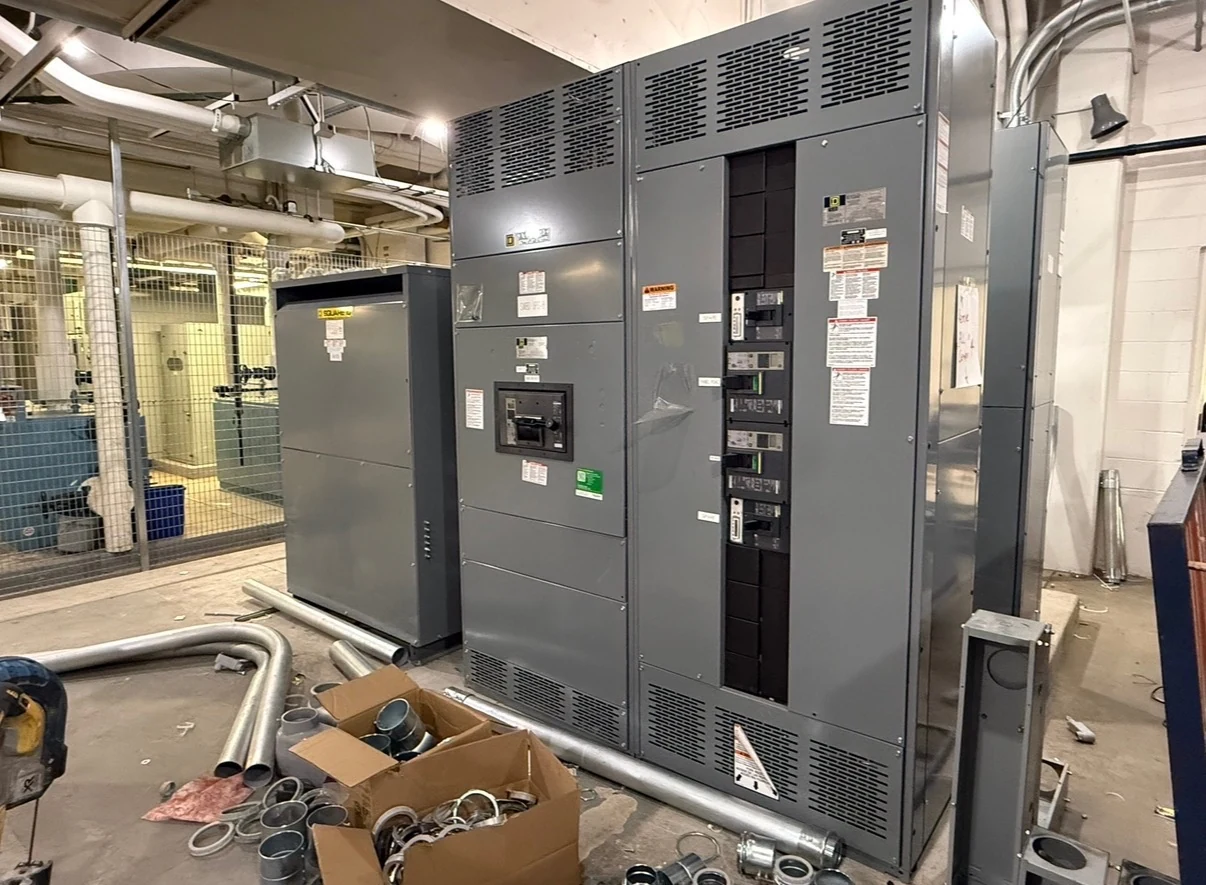
A commercial building’s service entrance connects the utility supply to the owner’s distribution system, but it also establishes how tenant loads are protected, measured, and expanded. Owners and specifying engineers can buy a newly manufactured assembly directly from a manufacturer serving San Antonio, South Texas, and projects nationwide. A useful specification starts with the building’s actual service arrangement, not just a desired lineup size.
Choose an arrangement that fits the building
Start with an up-to-date one-line showing the utility source, service disconnect arrangement, common-area loads, tenant feeders, and any alternate source interfaces. A small office with one tenant has different distribution needs from a mixed-use property with separately leased retail spaces. The design team should identify which equipment is service equipment and where its responsibilities end.
A service-rated switchboard may be appropriate for one project, while another calls for switchgear based on protective devices, operating needs, and the engineering specification. A more elaborate lineup can support different maintenance or coordination objectives but may require more room and a larger budget. Confirm the applicable construction standard, service-equipment marking, and project-specific listing for the actual assembly.
Resolve utility and meter interfaces early
Obtain the serving utility’s current requirements for the proposed service, including point of connection, service voltage and configuration, available fault-current information, metering arrangement, and required approvals. Assign a contact to resolve utility comments. Utility-owned components, customer-owned components, and the physical handoff between them should appear clearly on the drawings.
Revenue meters may require a utility-approved location, instrument transformer provisions, sealing access, or separate compartments; the arrangement depends on utility rules and the project. Tenant submetering for owner billing or energy management is a separate decision. Confirm meter ownership, data access, communication interfaces, and whether the planned layout supports the lease structure.
Plan tenant capacity without guessing
Give the engineer a load schedule that distinguishes common-area equipment from each tenant’s expected loads. Heating and cooling, kitchen equipment, elevators, and future vehicle charging can change feeder capacity and diversity assumptions. The engineer should apply the governing calculation method and document assumptions rather than simply add nameplate values or reserve an arbitrary percentage.
Compare installed spare feeders with prepared spaces or provision for a future section. An installed device costs more initially but can reduce later procurement work; empty space alone does not establish usable bus capacity, fault duty, or approval for future additions. Identify conductor quantities and sizes, neutral needs for nonlinear loads, and the physical route to tenant distribution.
Specify protection and service boundaries
The design team should compare the available fault current at the service with the interrupting capability of protective devices and the applicable assembly short-circuit rating. These are related but different checks. A coordination study can examine whether a tenant feeder device clears a fault before the main device, helping limit disruption, although coordination must be demonstrated across the relevant conditions.
Document the intended service grounding and bonding scheme and identify who provides each field connection. If ground-fault protection, surge protection, or customer monitoring is required, define its sensing and control interfaces and testing responsibilities. The engineer and authority having jurisdiction should review the design against applicable codes and local requirements rather than assume one arrangement fits every service.
Fit the lineup into an occupied property
Room drawings should show the equipment footprint, required working clearances, door swing, cable entry, ventilation, and routes for bringing shipping sections into the building. Coordinate floor loading and anchorage with the structural team. A compact layout is not a saving if conductors cannot be routed or maintenance access is compromised.
For an occupied building, map affected tenants and building services before setting a construction sequence. The owner, utility, contractor, and facility manager should agree on outage windows, access restrictions, notification, inspections, and any engineered temporary power. Qualified electrical personnel plan and perform field work under applicable safety procedures; the equipment purchase itself does not authorize energization.
Make the quote and approval schedule useful
Send the manufacturer the one-line, load and feeder schedules, utility criteria, available fault data, room dimensions, enclosure environment, and target milestones. Request a quotation that distinguishes the included assembly, metering provisions, shipping sections, testing, and documentation from field wiring, civil work, settings, and commissioning. Clearly listed exceptions make competing proposals easier to compare.
Ask for drawings showing elevations, device schedules, terminal interfaces, ratings, and meter compartments before releasing the final configuration. For an applicable switchboard, verify any required UL 891 listing for that specific assembly; it is not a blanket standard for every form of switchgear. Allow time for utility and owner review, component availability, fabrication, inspections, delivery, and qualified commissioning without treating any date as guaranteed.
LET'S BUILD SOMETHING RELIABLE — 03
Ready to talk
switchgear?
Tell us about the new equipment your project needs. Include as much or as little detail as you have today.
(951) 403-5738CALL TO DISCUSS YOUR PROJECT