
BUILT IN THE USA. READY FOR YOUR PROJECT.
Medium-Voltage Switchgear for Hospitals
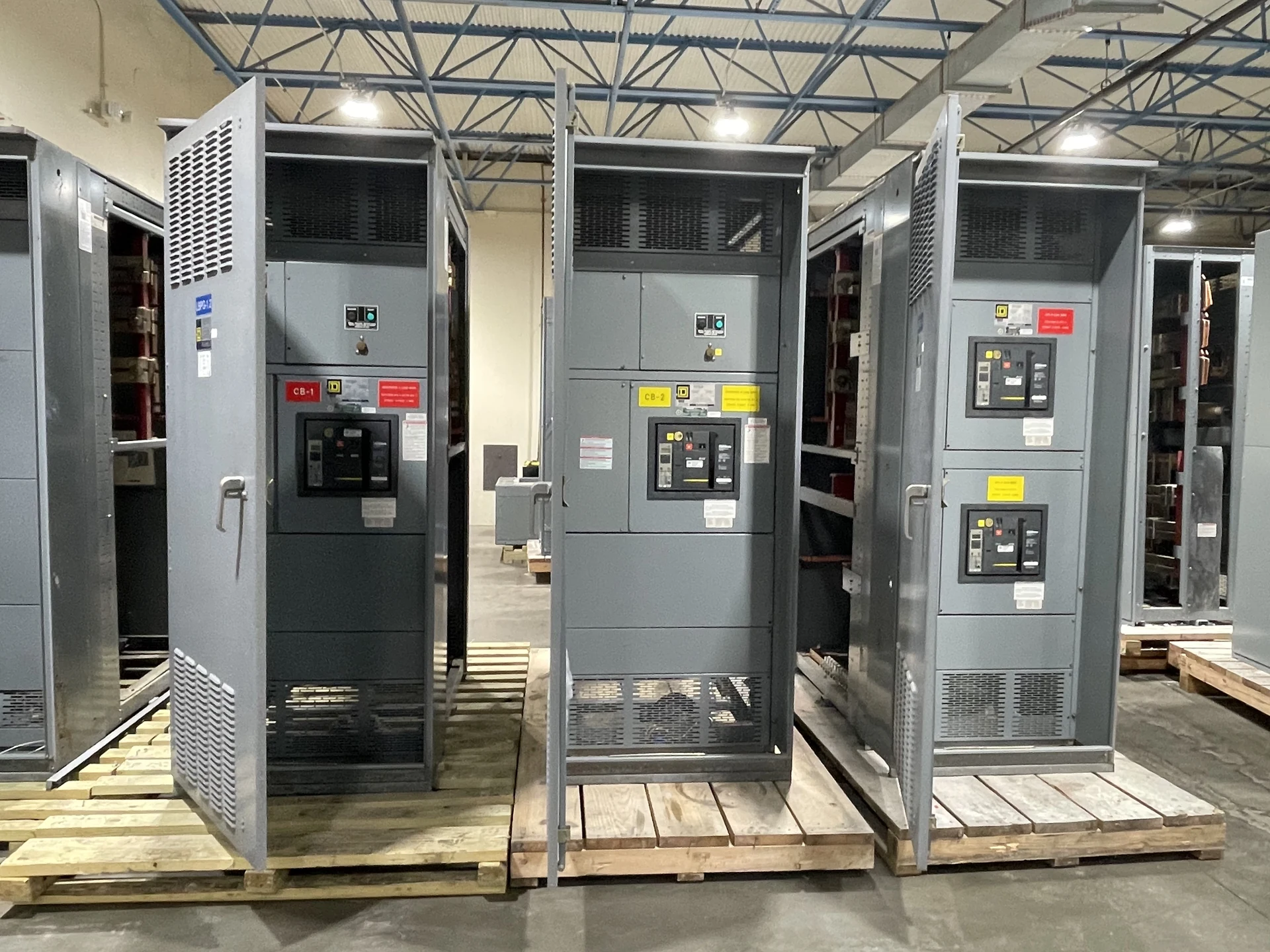
A hospital’s medium-voltage switchgear connects its incoming power sources to transformers and feeders that ultimately support patient care.
DIRECT FROM THE MANUFACTURER / NEW EQUIPMENT
THE MANUFACTURER’S PERSPECTIVE — 02
A hospital’s medium-voltage switchgear connects its incoming power sources to transformers and feeders that ultimately support patient care. The right lineup is not simply the largest available assembly: it must fit the facility’s source arrangement, protection strategy, and planned maintenance. Owners and engineers should define how a disturbance or planned outage affects essential electrical loads before purchasing new equipment.
Map the hospital’s electrical dependencies
Begin with an up-to-date one-line showing utility sources, medium-voltage feeders, transformers, downstream distribution, generators, and transfer equipment. Identify which paths serve clinical areas, life-safety functions, and other essential loads. The hospital’s essential electrical system is more than the incoming lineup; downstream separation and transfer arrangements determine whether a particular load has an alternate supply.
Ask the design team for present demand, planned additions, feeder destinations, transformer information, operating voltage, available fault current, and grounding details. A proposed expansion can change both normal loading and fault duty. Specify spare feeder positions or future space only after confirming the bus, enclosure, and protection provisions can support the intended growth.
Balance fault protection with continuity
A fault on one transformer feeder should not unnecessarily interrupt other patient-care services. The engineer should evaluate protective devices and time-current characteristics across the medium-voltage and downstream systems, including selective coordination where required. This review needs actual source fault contributions, transformer characteristics, device curves, and operating scenarios; adjacent devices do not coordinate automatically.
Circuit breakers with protective relays and fused switching arrangements offer different choices for protection, monitoring, maintenance, and initial scope. Compare the proposed devices against interrupting and assembly withstand duties as well as normal current. Document current-transformer requirements, relay functions, trip power, settings ownership, and the impact of losing control power before approving a design.
Define the alternate-source interface
Do not assume standby generation supplies the entire medium-voltage lineup. A hospital may transfer essential loads downstream, or the design may include alternate-source connections at a different point. The one-line and sequence of operations should identify exactly what each source can supply, where transfer occurs, and which equipment controls or monitors that transfer.
Coordinate generator starting signals, source-available indications, interlocks, communications, and alarm ownership with the transfer and generator suppliers. The design engineer should review source capacity, grounding, neutral treatment, and protection in every intended operating state. Resolve whether sources may ever operate in parallel and specify the necessary controls and approvals rather than leaving that decision to field commissioning.
Choose construction around access and space
Metal-clad and other metal-enclosed arrangements can differ in compartmentation, device access, footprint, and maintenance provisions. A drawout arrangement may improve access to certain devices but can require additional clearance and a higher initial investment. Confirm the construction and device features for the proposed assembly rather than assuming every enclosure offers the same isolation.
Provide room dimensions, cable entry direction, termination quantities, door paths, delivery constraints, ambient conditions, and required working clearances. Coordinate transformer connections, grounding conductors, equipment anchorage, and ventilation with the responsible trades. Separate or redundant paths may reduce the effect of some maintenance events, but their value depends on the full system configuration and approved operating plan.
Plan shutdowns with clinical stakeholders
For a new lineup at an occupied hospital, the owner’s project team should map affected departments and equipment before selecting installation phases. Facilities staff, clinical leadership, the utility, the electrical contractor, and the engineer can evaluate outage windows, patient-care contingencies, temporary power needs, and the consequences of an unsuccessful cutover.
A written plan should assign approvals, communications, testing milestones, restoration criteria, and a practical rollback path. Temporary connections also need engineering review for capacity, protection, and transfer compatibility. Switching, isolation, verification, and commissioning belong to qualified personnel following site safety procedures, applicable requirements, and equipment instructions; a procurement drawing is not an operating procedure.
Buy against a defined submittal and test scope
For a useful manufacturer quotation, provide the one-line, equipment specification, fault study inputs, site constraints, required construction standard, and desired delivery sequence. Ask for a clear boundary between the new assembly and field-supplied cables, foundations, settings, startup, and temporary power. Confirm proposed ratings, component availability, and any project-specific listing or certification before approval.
Request drawings showing elevations, connections, protection and control schematics, a device schedule, and identified exceptions. Agree on factory inspection and functional-test scope, witness requirements, records, and the party responsible for field acceptance testing. Allow time for submittal review, procurement, manufacturing, testing, and outage coordination; specify any US-made component requirements and verify actual sourcing and availability.
LET'S BUILD SOMETHING RELIABLE — 03
Ready to talk
switchgear?
Tell us about the new equipment your project needs. Include as much or as little detail as you have today.
(951) 403-5738CALL TO DISCUSS YOUR PROJECT