
BUILT IN THE USA. READY FOR YOUR PROJECT.
Load Growth and Switchgear Capacity
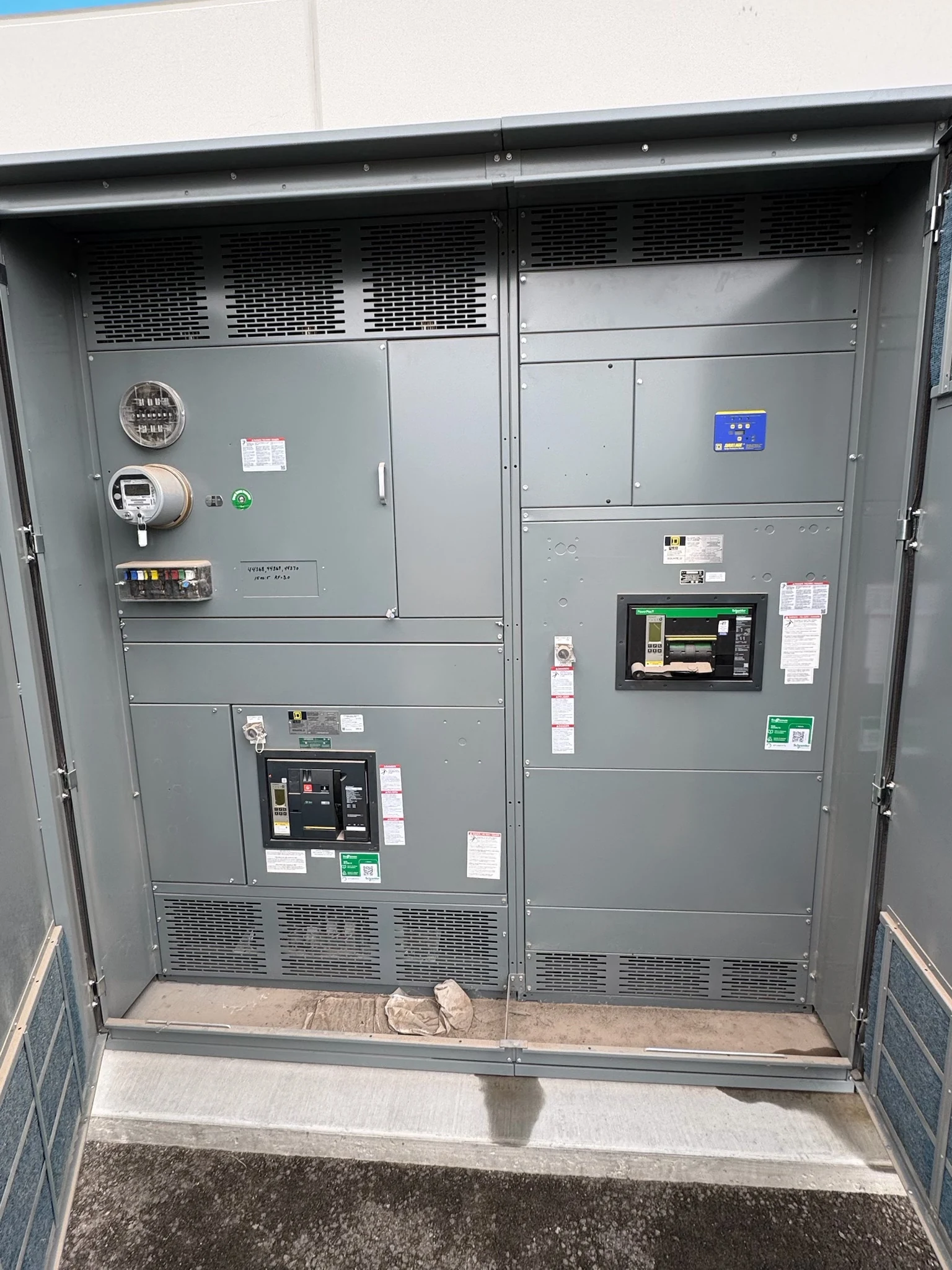
A switchgear lineup should support the facility that will actually be built, not a guessed percentage of the loads on a drawing.
DIRECT FROM THE MANUFACTURER / NEW EQUIPMENT
THE MANUFACTURER’S PERSPECTIVE — 02
A switchgear lineup should support the facility that will actually be built, not a guessed percentage of the loads on a drawing. For specifying engineers, contractors and owners, capacity planning connects present demand with credible expansion scenarios, protective devices and available physical space. A disciplined forecast can avoid an immediate bottleneck without committing the project to unnecessary capacity that may never be used.
Establish a trustworthy demand baseline
Collect utility interval data and facility meter records covering representative operating periods, including seasonal peaks where available. Record the measurement interval, operating hours and unusual shutdowns. A service-level peak can conceal heavily loaded individual feeders, while energy consumption over a month does not by itself reveal the highest simultaneous demand.
Have a qualified electrical professional evaluate phase currents, neutral loading and power quality where relevant, using appropriate site safety procedures. Compare recorded demand with the load schedule and equipment nameplates; installed nameplate totals are not necessarily simultaneous demand. For a new facility, document the operating assumptions behind calculated loads instead of presenting estimates as measurements.
Turn expansion plans into load scenarios
Create a schedule of proposed loads with expected dates, voltage, phase, operating current or power, duty cycle and intended feeder. Identify large motors, variable-speed drives, heating equipment and other loads with distinctive starting or harmonic characteristics. Ask process and facilities teams which additions can run together, rather than assuming that every future load peaks at once.
Consider a base case, a committed expansion and a plausible later phase. For example, a plant might first add a packaging line and later electrify process heating; each scenario should identify its own coincident peak and assumptions. Show uncertain projects separately so the owner can decide whether to build capacity now or reserve a practical expansion route.
Translate demand into an engineered rating
The engineer of record evaluates the calculated load against the applicable code, equipment ratings and operating conditions. Continuous loads, motor behavior, phase imbalance, nonlinear loads and ambient temperature can change the result. Demand in kilowatts alone is insufficient: voltage, power factor and current by phase matter when assessing conductors, protective devices and bus capacity.
Do not treat a larger main bus as proof that the whole distribution path is ready for expansion. The source, transformer, service conductors, main device, feeder devices and neutral must each be reviewed for their particular duties. Available fault current and equipment short-circuit ratings also require separate evaluation; spare load capacity does not establish fault-duty adequacy.
Distinguish spare space from usable capacity
A reserved feeder space, an installed spare breaker and a future section are different purchasing choices. An installed breaker can simplify a planned connection but fixes its characteristics earlier and may consume space and budget. A prepared space defers device selection, provided the assembly design and available components permit the intended future addition.
Ask the manufacturer to identify the capacity, compatible devices and physical provisions included in the proposal, along with any limitations on later modifications. A spare position is not a promise that the bus, upstream protection or source can supply the eventual load. Review future cable routes, termination room and maintenance access with the contractor before freezing the layout.
Coordinate the upstream and site interfaces
Share the growth scenarios with the serving utility or source owner early. Service capacity, metering arrangements and interconnection requirements may influence whether expansion can occur in one stage or needs a later service upgrade. Coordinate transformer and generator capabilities where applicable, especially when loads must operate during an alternate-source condition.
On the site, compare the proposed lineup and any reserved section with room dimensions, equipment access, cable entry, ventilation and the applicable working-space requirements. A capacity increase can have structural and delivery consequences as well as electrical ones. Design professionals should review these interfaces and verify project-specific equipment ratings and any required listing.
Buy against a documented capacity plan
Provide the direct manufacturer with a current one-line diagram, load and growth schedules, source and fault information, intended feeder list, enclosure conditions and dimensional constraints. Request a proposal that separates present equipment from optional expansion provisions and identifies assumptions, exclusions, drawings, testing and field interfaces. Compare alternatives on the same stated operating scenarios, not bus amperage alone.
Build time into the schedule for utility input, engineering review, submittal approval, component availability and factory testing; changes to future-load assumptions can affect each step. At turnover, retain the approved drawings, ratings, test records and documented spare provisions. Installation, protection settings and energization belong to qualified personnel under the project’s approved procedures.
LET'S BUILD SOMETHING RELIABLE — 03
Ready to talk
switchgear?
Tell us about the new equipment your project needs. Include as much or as little detail as you have today.
(951) 403-5738CALL TO DISCUSS YOUR PROJECT