
BUILT IN THE USA. READY FOR YOUR PROJECT.
Switchgear vs. Switchboard
Switchgear and switchboards both distribute power and contain protective devices, but the names do not describe interchangeable assemblies.
DIRECT FROM THE MANUFACTURER / NEW EQUIPMENT
THE MANUFACTURER’S PERSPECTIVE — 02
Switchgear and switchboards both distribute power and contain protective devices, but the names do not describe interchangeable assemblies. For engineers, contractors and facility owners, the choice depends on fault duty, continuity expectations, maintenance access and the applicable equipment standard. Compare actual construction and documented ratings before deciding which new assembly belongs on the one-line diagram.
Device architecture shapes the lineup
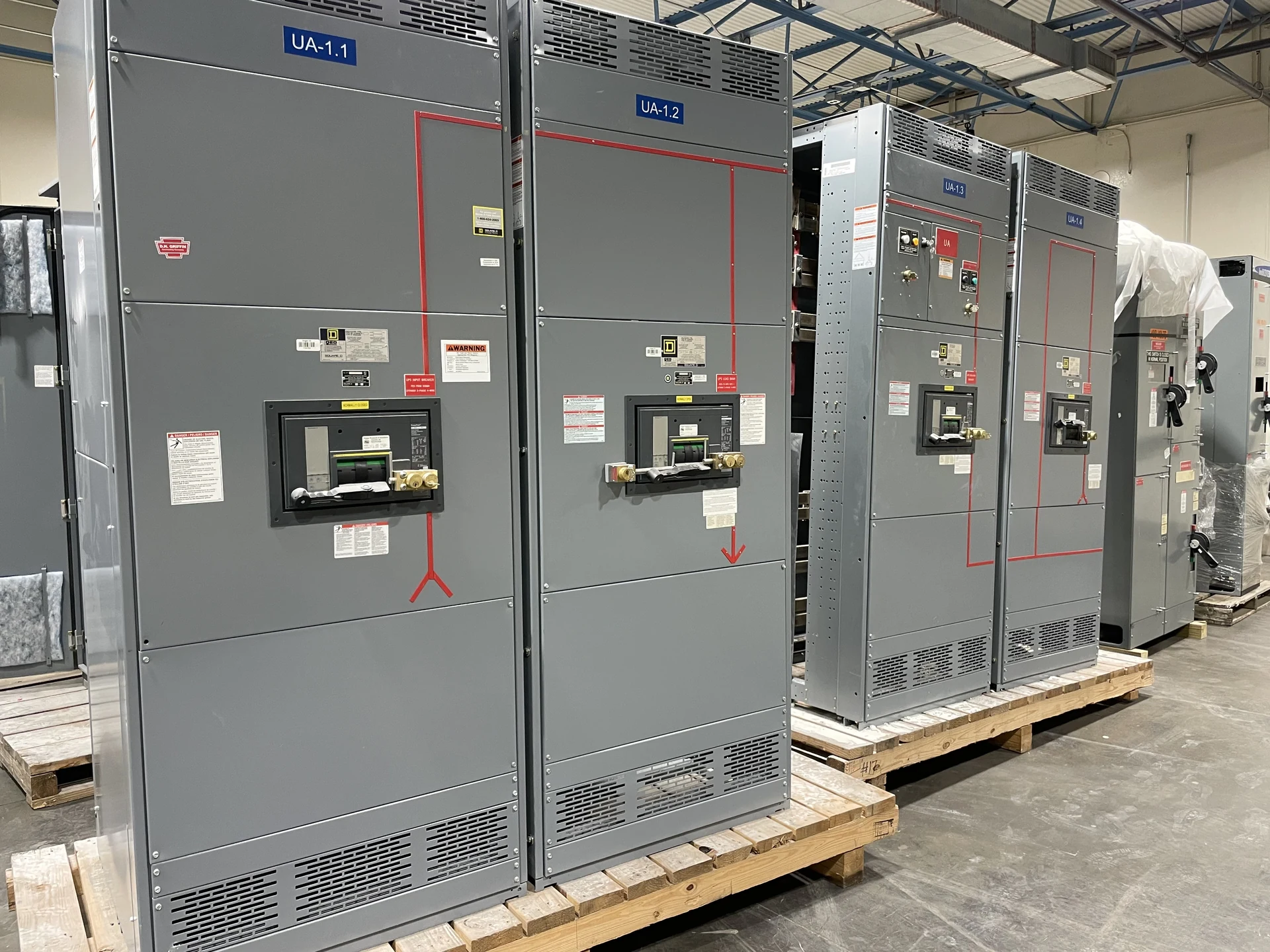
This comparison centers on low-voltage distribution. Low-voltage power circuit breaker switchgear generally uses individually mounted power breakers with barriers between major portions of the assembly. A switchboard often groups molded-case breakers or uses insulated-case breakers, and may also incorporate fusible switches. The actual design and device options depend on the specified assembly.
A switchboard can put many feeders in a relatively compact lineup, which may suit a crowded electrical room. Switchgear construction often requires more space for compartmentation and breaker access. Neither name alone confirms how devices mount, which metering is included or whether a particular feeder can be added later; ask for an equipment elevation and device schedule.
Maintenance access is a design decision
Some switchgear uses drawout breakers, allowing a breaker to be moved to defined positions for maintenance or testing without disconnecting its load cables. Some switchboards offer drawout devices too, while others use fixed mounting. Compare the actual device arrangement, lifting provisions, barriers and access to terminations rather than treating drawout construction as automatic.
Owners should explain which loads can tolerate an outage and how maintenance will be organized. Compartmentation does not make live work inherently safe or guarantee that the rest of a lineup can remain energized. Qualified personnel must assess each task, establish safe work conditions and follow site procedures and manufacturer instructions.
Fault duty and coordination must match
Give the engineer the available fault current at the proposed installation and the source information behind it. Breaker interrupting ratings and assembly short-circuit ratings address different parts of the design; both need review. Where a specified device has a short-time withstand rating, its current and duration must be compatible with the protection scheme.
Selective coordination aims to let the protective device closest to a fault clear it without unnecessarily opening an upstream device. Power breakers in switchgear can offer useful short-time characteristics, but coordination is not automatic. The engineer must examine device curves, settings and the relevant fault-current range; delayed clearing can also affect arc-flash exposure.
Specify the standard, not just the label
UL 891 addresses applicable low-voltage switchboard assemblies. UL 1558 covers metal-enclosed low-voltage power circuit breaker switchgear; IEEE C37.20.1 is another standard relevant to that equipment category. Medium-voltage switchgear has a different standards framework. The specifying engineer should identify the applicable codes and standards for the actual equipment and installation.
A statement that a component is listed does not establish the listing of the complete assembly. Request the proposed assembly designation, applicable evaluation or listing documentation, and any exceptions to the specification. Verify the scope with the manufacturer and the authority having jurisdiction rather than assuming that the word switchgear means UL 891 applies.
Match the choice to operating priorities
For a commercial building with conventional feeder distribution and limited room, a switchboard may meet the protection and access requirements with a smaller footprint. A process facility with demanding coordination and maintenance objectives may justify power circuit breaker switchgear. Both decisions require review of the actual system, not an assumption based on building type.
Multiple sources, such as a utility and generator, add interface questions for either assembly. Identify transfer equipment, control signals, interlocks, grounding arrangements and fault contribution in each operating state. Ask the electrical designer to assess these conditions alongside the utility requirements and the owner’s desired sequence of operation before equipment is ordered.
Make competing quotations comparable
For a direct manufacturer quote, provide the one-line diagram, system voltage, phase and wire configuration, load and feeder schedules, available fault data and desired protective functions. Include service-metering requirements, cable entry, conductor quantities, room dimensions, environmental conditions and future capacity. Identify unresolved utility information so assumptions are visible rather than buried in the price.
Request drawings, device schedules, ratings, listing evidence where required, test records, manuals and a clear list of exceptions. Compare who supplies field connections, protection settings and commissioning. Allow time for engineering review, approval, component procurement, fabrication and inspection; the installer and qualified electrical team must coordinate delivery, clearances, outages and energization authorization.
LET'S BUILD SOMETHING RELIABLE — 03
Ready to talk
switchgear?
Tell us about the new equipment your project needs. Include as much or as little detail as you have today.
(951) 403-5738CALL TO DISCUSS YOUR PROJECT